
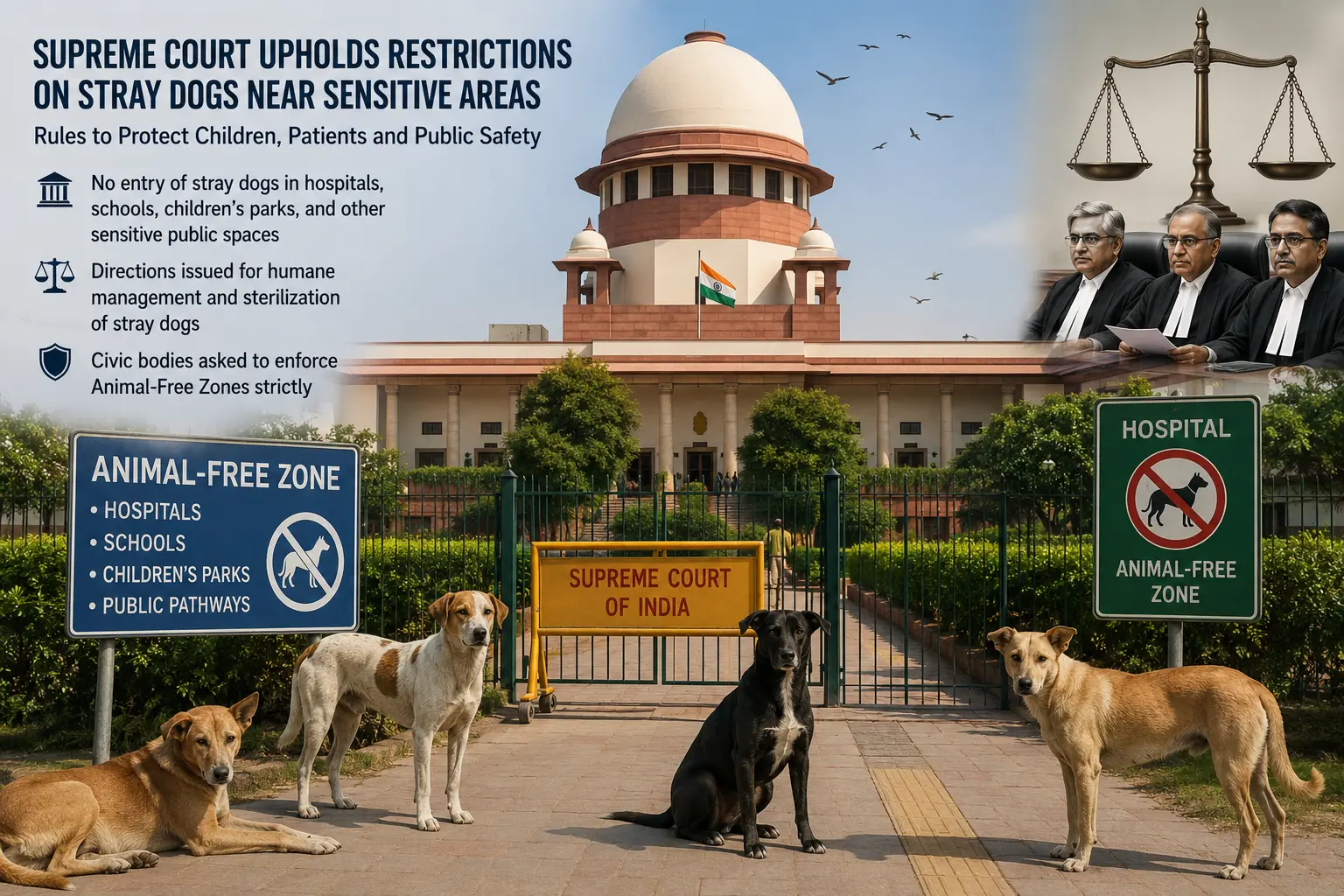
The debate over India’s stray dog crisis has intensified once again after the Supreme Court declined to soften its earlier directives on the issue. In a significant move, the apex court reaffirmed its position that sensitive public areas—including hospitals, schools, and railway stations—must remain free from stray dogs.
The latest decision comes at a time when concerns over dog bite incidents and public safety are growing across the country, putting local authorities under increasing pressure to find effective solutions.
Supreme Court Stands Firm on Earlier Order
The Supreme Court refused to alter its November 2025 directive related to stray dog presence in public spaces considered highly sensitive and crowded.
During the proceedings, the bench made it clear that public safety cannot be compromised and observed that authorities have struggled to properly enforce existing regulations designed to control stray animal populations.
The court indicated that despite established frameworks and rules, implementation on the ground has remained weak.
As complaints and reports of dog-related incidents continue surfacing nationwide, the judges emphasized that immediate and practical action from authorities is essential.
Rising Dog Bite Cases Raise Serious Concerns
The court took note of increasing reports of dog attacks and injuries affecting citizens in various parts of the country.
Particular concern was expressed for vulnerable groups who may face greater risks in such situations.
These include:
- Young children
- Senior citizens
- Foreign tourists
- Individuals in crowded public spaces
The bench suggested that these groups often face heightened safety concerns when stray animals occupy busy or sensitive areas.
Court Makes Strong ‘Survival of the Fittest’ Remark
During the hearing, the Supreme Court delivered a pointed observation that quickly drew attention.
The bench remarked that the “Darwinian principle of survival of the fittest seems to be working.”
The statement reflected the court’s concern that citizens should not be left in situations where they are expected to navigate safety risks without meaningful support or intervention.
Judges stressed that governments and civic bodies hold a constitutional duty to provide secure public environments.
According to the court, ensuring safe access to schools, hospitals, and transport facilities falls under that broader responsibility.
Public Safety vs Animal Welfare Debate Reignites
The decision has once again triggered a larger national conversation around how India should manage stray dog populations.
Supporters of stricter controls argue that the growing number of bite incidents demands urgent and realistic solutions.
Many believe spaces such as:
- Schools
- Hospitals
- Railway stations
- Transport hubs
should be treated as high-priority zones where human safety must come first.
According to advocates of tighter regulations, these heavily used public areas require stronger preventive measures.
Animal Rights Activists Voice Concerns
While some welcomed the court’s focus on public safety, animal welfare groups raised concerns about how the order may eventually be implemented.
Animal rights activist Kamna Pandey supported the court’s continued emphasis on the Animal Birth Control (ABC) program, which promotes sterilization and vaccination as humane population-control methods.
However, she also expressed caution regarding how the language of the order might ultimately be interpreted.
Pandey indicated that activists intend to closely review the detailed directives before forming final conclusions.
Activists Warn Against Cruel Removal Measures
According to Pandey, concerns remain over whether future actions could potentially lead to broad removal drives without sufficient protections against cruelty.
She stated that if authorities interpret the ruling as permission for unrestricted removal of stray dogs, activists may challenge the decision and seek further review.
Animal welfare advocates continue to argue that any lasting strategy should strike a balance between two critical priorities:
- Public safety
- Humane treatment of animals
For many activists, both concerns can coexist through structured implementation of sterilization and vaccination programs.
What Happens Next?
The Supreme Court’s latest position once again highlights a challenge that India has wrestled with for years: managing stray dog populations while respecting animal welfare laws.
As debate continues, local administrations may face increasing pressure to strengthen:
- Sterilization initiatives
- Vaccination campaigns
- Population management systems
- Public safety measures
The discussion is far from over.
For now, however, the court has made one message clear: authorities must ensure that essential public spaces remain safe, while finding long-term solutions that do not ignore animal welfare concerns.

