
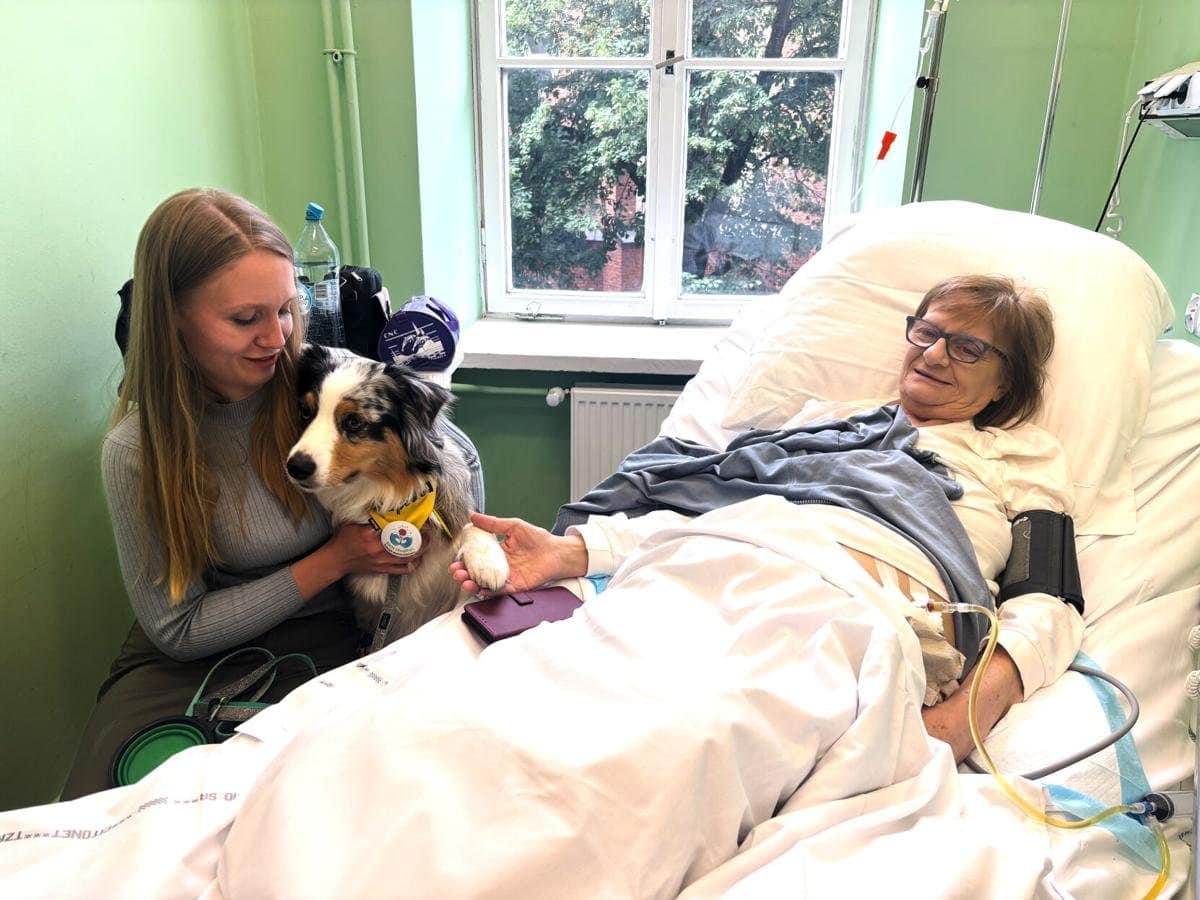

For many people facing a life-limiting illness, comfort comes from family, friends, and compassionate medical care. But for some, one of the most meaningful sources of support has four legs, a wagging tail, and unconditional love.
That reality is now driving a growing movement in Poland, where lawmakers are considering new legislation that would officially allow pets to visit patients in hospices and palliative care wards.
The proposal has gained attention after stories from terminally ill patients highlighted the profound emotional connection between people and their animals during some of life’s most difficult moments.
One such story belongs to 70-year-old Ewa Lutka-Krawczyk, who was diagnosed with gallbladder cancer. While many people might focus first on their own health after receiving such news, Lutka-Krawczyk’s immediate concern was for Gaja, the rescue dog she welcomed into her life three years ago.
She recalled asking her doctor for reassurance that she would have a few more years to live, not for herself, but so Gaja would not be left alone without her.
Unfortunately, her condition worsened, and she was recently admitted to a palliative care ward in Warsaw. Back at home, Gaja remained with Lutka-Krawczyk’s husband but reportedly struggled with her owner’s absence.
According to Lutka-Krawczyk, the dog has barely been eating and appears to be waiting for her return.
“She is waiting for me,” she said from her hospital bed, where she continues to receive treatment.
A Push for Change in End-of-Life Care
Although some medical facilities in Poland already permit pet visits on a case-by-case basis, there is currently no nationwide law guaranteeing that right for patients in hospices or palliative care units.
That could soon change.
The proposed legislation would formally allow terminally ill patients to receive visits from their pets, recognizing the emotional and psychological benefits that animal companionship can provide.
Leading the effort is Dr. Tomasz Dzierżanowski, director of the Palliative Medicine Clinic at the Medical University of Warsaw. The proposal has been introduced in parliament through a lawmaker from Prime Minister Donald Tusk’s centrist political party.
Dzierżanowski believes that pets can play a vital role in easing suffering, especially at a time when loneliness has become increasingly widespread.
He describes modern society as facing what he calls an “epidemic of loneliness,” particularly among vulnerable and seriously ill individuals.
The Comfort Only a Pet Can Give
In palliative care settings, emotional wellbeing is often just as important as physical treatment. Dzierżanowski says medical teams work hard to ensure that patients do not face their final days in isolation.
“When someone is suffering, it is important that somebody is there for them,” he explained.
While human companionship remains invaluable, he noted that not everyone has family members or close friends available to provide that support.
Many elderly patients have outlived loved ones and social circles. Younger patients can also experience isolation despite being digitally connected, as online relationships do not always translate into deep personal support during times of crisis.
For these individuals, pets often become trusted companions whose presence provides comfort, familiarity, and emotional security.
The Story That Started It All
Dzierżanowski says his campaign was inspired by a patient named Waldemar, who was battling advanced cancer.
According to the doctor, Waldemar was less concerned about his own condition than he was about the future of his two beloved cats.
Recognizing the importance of that bond, Dzierżanowski arranged for the cats to visit him in the hospital ward.
The reunion left a lasting impression.
The patient was overwhelmed with emotion, and the cats appeared to react strongly upon seeing their owner again. The touching encounter also affected hospital staff and other patients who witnessed the moment.
For Dzierżanowski, it became a turning point.
Seeing the emotional impact of that reunion convinced him that the issue deserved broader attention and legal recognition.
Hope for Patients and Their Pets
At Dzierżanowski’s clinic, pet visits are already permitted whenever practical and safe conditions can be maintained. That means Lutka-Krawczyk may soon be reunited with Gaja despite her hospitalization.
The possibility of seeing her dog again has brought her comfort during an incredibly challenging period.
Supporters of the legislation argue that the practice is already happening in many healthcare settings and should be formally regulated rather than left to individual decisions.
Katarzyna Piekarska, the lawmaker who introduced the proposal, believes the law would provide clarity and consistency across the healthcare system.
She pointed out that animals are already entering hospitals in many situations and said it makes sense to establish clear rules governing such visits.
A Growing Recognition of the Human-Animal Bond
As the proposal moves through Poland’s parliamentary health committee, advocates hope it will help reshape how end-of-life care is viewed.
Beyond medicine and treatment plans, the discussion highlights the powerful emotional role pets play in people’s lives.
For patients facing serious illness, a visit from a beloved dog or cat may not change a diagnosis. But it can offer comfort, reduce feelings of loneliness, and provide a precious reminder of home, love, and connection.
And for people like Ewa Lutka-Krawczyk, that connection means everything—because somewhere at home, a loyal dog named Gaja is still waiting.