
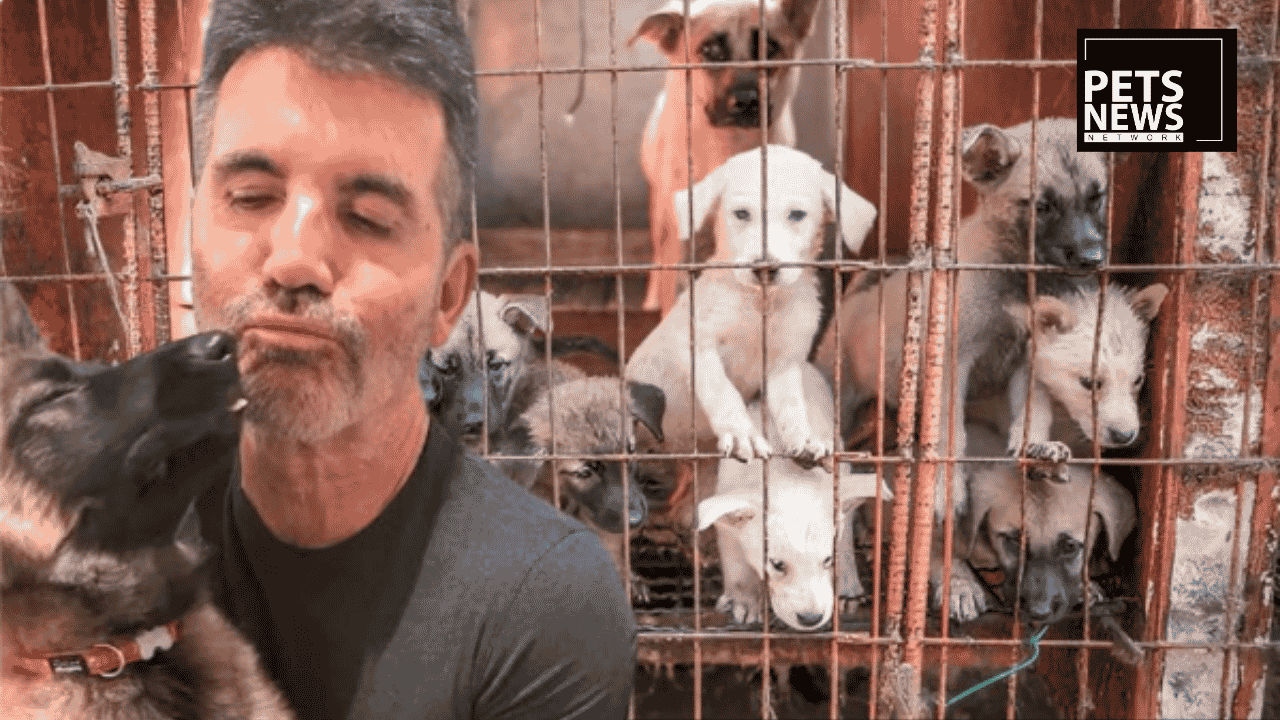

In 2018, it took a celebrity donation to shut down a single dog meat farm in South Korea. It was the thirteenth farm the charity had closed in several years of work. Today there are still more than a thousand farms operating — and a legal deadline arriving in 2027 that will close every one of them at once. The law is settled. The question nobody has answered is what happens to the animals inside.
How it used to be done
In September 2018, Simon Cowell donated £25,000 — roughly $32,575 at the time — to Humane Society International to help close a dog meat farm in Namyangju, South Korea. He also pledged to match public donations up to the same amount.
The money funded the rescue of more than 200 dogs and puppies. According to HSI, around 90 of them were puppies born in the weeks before the rescue. The animals had spent their lives in small metal cages with minimal human contact; some had untreated injuries and skin conditions. They were eventually flown to shelters in the United States, the United Kingdom, Canada and the Netherlands.
It was HSI’s thirteenth farm closure in South Korea. By that point the organisation had permanently shut twelve farms and rescued close to 1,400 dogs. HSI’s UK executive director, Claire Bass, described the donation at the time as a significant boost to the appeal.
Thirteen farms. Several years. One high-profile donation at a time.
That was the model: identify a farm, raise the money, negotiate with the farmer, help him switch to another livelihood — mushrooms, chillies, parsley — and fly the dogs abroad because there were nowhere near enough homes for them in Korea.
It worked. It was also never going to scale.

What changed in January 2024
On 9 January 2024, South Korea’s National Assembly voted 208 to 0, with two abstentions, to pass a special act ending the breeding, slaughter, distribution and sale of dogs for meat.
In a legislature known for being bitterly divided, not one member voted against it.
The law does not criminalise eating dog meat. It dismantles the industry that supplies it:
| Offence | Maximum penalty |
|---|---|
| Slaughtering dogs for meat | 3 years’ imprisonment or a fine of around 30 million won |
| Breeding or distributing dogs for meat | 2 years’ imprisonment or a fine of around 20 million won |
Farmers and restaurant owners were given a three-year grace period to wind down, submit closure plans and claim state support for switching trades.
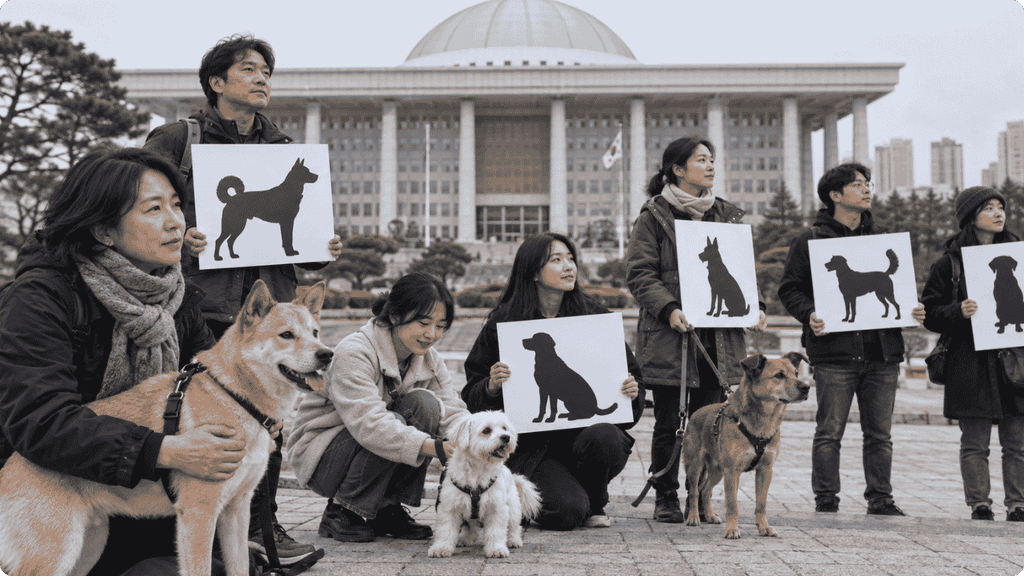
That grace period expires in February 2027.
The scale of what is still operating
South Korean government data from 2023 recorded roughly 1,100 to 1,150 dog farms and about 1,600 restaurants serving dog meat. Every one of those businesses was required to file a phase-out plan with local authorities.
The number of dogs inside that system is harder to pin down, and the gap between estimates is itself part of the problem. A 2022 government study counted more than half a million dogs being raised for meat. Animal welfare organisations have long put the figure closer to one million a year.
Either way, the arithmetic is uncomfortable. HSI’s Models for Change programme — the one Cowell’s donation fed into — has rescued more than 2,700 dogs across its entire run, placing them in the US, Canada, the UK, the Netherlands and a small number of homes in South Korea.
More than 2,700 dogs, over many years, at considerable cost. Against a population measured in hundreds of thousands.
The part of the story nobody wants to say out loud
The ban is a genuine landmark. It is also the first time in modern animal welfare that an entire livestock sector has been abolished with a hard deadline — and the legislation is far clearer about closing businesses than about rehoming animals.
Three pressures are converging on February 2027.
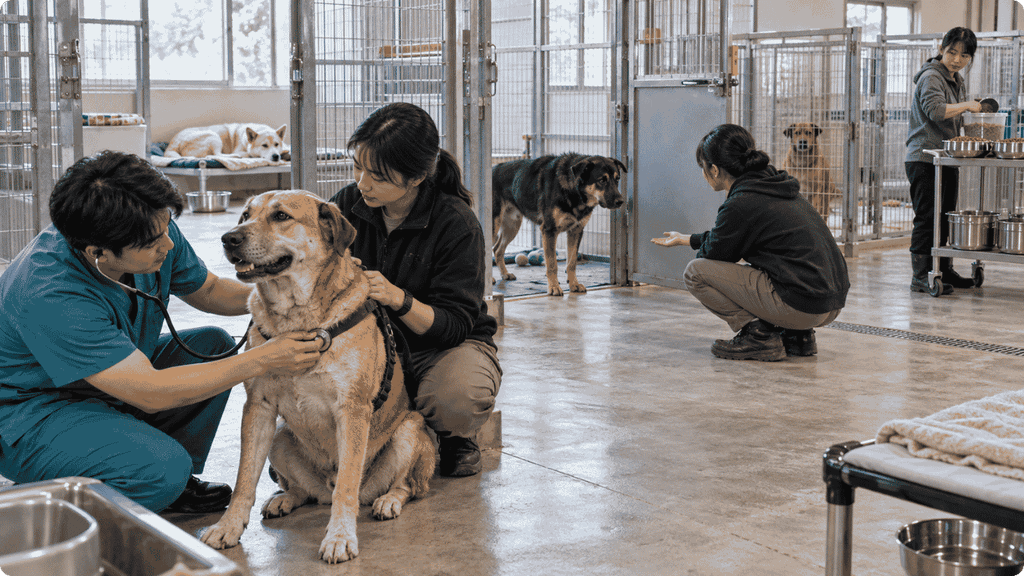
There is no adoption market of that size. South Korea’s domestic pet-adoption capacity cannot absorb hundreds of thousands of animals. The dogs most commonly farmed are large, often Tosa-type or mixed breeds, raised with minimal socialisation — among the hardest animals to place anywhere in the world. Overseas placement, the route used for Cowell’s 200, is slow, expensive and limited by receiving countries’ own shelter capacity.
Farmers have made their position clear. During protests against the bill, the Korea Dog Meat Farmers’ Association stated it was prepared to release its dogs in Seoul — the association claimed around two million animals, a figure far above government estimates and best read as a negotiating threat rather than a count. At one demonstration, protesters brought roughly 100 dogs into the city centre before police intervened.
And the numbers have already started moving. As the sector shrinks ahead of the deadline, welfare groups have raised questions about a decline in recorded dog numbers that nobody has fully accounted for. Rescue organisations have been asking for proper tracking and reporting throughout the phase-out — precisely so that “the industry got smaller” can be distinguished from “the animals were disposed of quietly.”
That is the question sitting underneath the celebration. A farm that closes is a success. A farm that empties is not necessarily the same thing.
Why the public turned first, and the law followed
The ban did not arrive against public opinion. It arrived well behind it.
A 2023 Gallup survey found that only 8% of South Koreans had eaten dog meat in the previous twelve months, and 93% said they had no intention of eating it in future. Polling commissioned by HSI Korea found 57% actively supporting a ban.
Dog meat consumption in South Korea had been dying on its own, carried mainly by older consumers and the summer tradition of bosintang, a soup regarded as restorative. Younger South Koreans overwhelmingly keep dogs as pets.
The ban closed a gap that had already opened. Animal rights groups had been pushing for it since the 1980s; earlier attempts failed against organised resistance from farmers. What finally carried it was a population that had stopped buying the product.
Why this matters well beyond Korea
For readers in India, the relevance is not the dog meat trade. It is the mechanism.
South Korea has demonstrated something that advocates in many countries argue about endlessly: that a long-entrenched animal use industry can be legislated out of existence, unanimously, once public opinion shifts far enough ahead of the law. Not through boycotts, not through gradual attrition, and not — ultimately — through charitable buyouts.
But it is also demonstrating the limit of that approach. Passing the law was the easy part. Closing a farm takes a signature. Rehoming the animals inside takes shelters, veterinarians, transport, funding and years — and none of that was legislated with the same precision as the penalties.
Dog meat has already been outlawed in Hong Kong, Taiwan, the Philippines and parts of China and Indonesia. Each of those jurisdictions faced a version of the same problem, at smaller scale.
South Korea is about to face it at the largest scale yet attempted.
What to watch
February 2027. The date enforcement begins. Watch whether it holds, or whether an extension is granted under farmer pressure.
The dog census. Whether the government publishes a verifiable count of animals removed from the system, and where they went.
International placement capacity. Whether receiving countries expand intake, or whether the pipeline that moved Cowell’s 200 dogs proves too narrow for what is coming.
Eight years ago, saving 200 dogs required a celebrity, a charity and an international appeal. The law has now made that model obsolete. What it has not yet made is a plan for the animals the model existed to save.
Pets News Network is India’s first dedicated media platform for the pet and animal industry. For breaking global pet news, brand coverage, and advertising enquiries, contact: info@petsnewsnetwork.com