
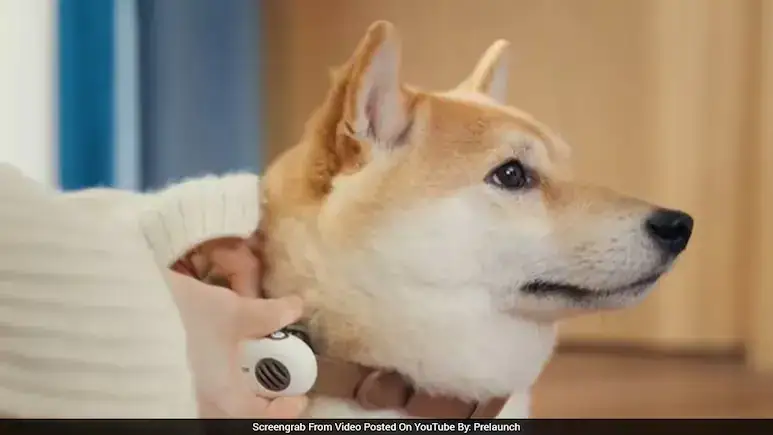

Imagine hearing your dog say, “Let’s play!” or your cat expressing, “Leave me alone.” It sounds like something straight out of a futuristic movie—but a new AI-powered gadget is now claiming to make those conversations possible.
A Chinese startup has sparked curiosity and debate after unveiling a wearable device designed to translate pet sounds and behavior into human-like speech. The product, called PettiChat, is being promoted as an artificial intelligence tool that can interpret what pets may be feeling and convert those signals into understandable phrases.
And naturally, the internet has a lot to say about it.
Meet PettiChat: The AI Device Trying to Decode Pets
Chinese startup PettiChat claims its wearable translator uses artificial intelligence to analyze pet vocalizations, emotional signals, and behavioral patterns.
According to the company, the technology runs on Qwen, developed by Alibaba Cloud, and aims to convert sounds and movements into human-style responses in real time.
The startup, based in Hangzhou and led by Meng Xiaoyi, says the system can understand what pets are trying to communicate through barks, meows, and body language.
Its reported accuracy claim has also turned heads: 94.6%.
That figure alone has fueled both excitement and skepticism.
How the Pet Translator Supposedly Works
According to the company, PettiChat is a lightweight wearable that attaches directly to a pet’s collar.
Some reported features include:
- Weight of approximately 27.2 grams
- Smartphone app connectivity
- Built-in microphones
- Motion sensors
- AI-driven behavior analysis
- Real-time translation capability
The company says the technology has been trained using millions of pet sound samples, allowing it to recognize emotional patterns and behavioral cues.
PettiChat claims it can process information and deliver responses in as little as 1.2 seconds.
Its promotional materials suggest pets might generate phrases such as:
- “Play”
- “Come on”
- “Leave me alone”
- “I don’t like you”
The company also says the system is backed by over 1 million pet data points combined with research-based learning models.
Promotional Videos Trigger Internet Skepticism
While the concept has fascinated pet lovers, not everyone is convinced.
Soon after demo videos began circulating online, skepticism followed.
Several viewers questioned whether the examples shown in promotional clips accurately represented real-world performance.
Critics pointed out that some videos appeared heavily staged, while others suspected that AI-generated voices may have been added during editing rather than created instantly by the device itself.
For many viewers, the translations simply seemed too human.
Some online reactions suggested that the demonstrations felt closer to science fiction than practical pet technology.
Experts Urge Caution Around “Mind Reading” Claims
The idea of understanding animals through technology is not entirely new.
Researchers have spent years studying animal communication patterns, vocal behaviors, and emotional signals. Artificial intelligence has increasingly entered that space as companies explore whether machine learning can identify patterns humans miss.
However, experts frequently caution that interpreting emotions and translating them into exact human sentences are very different things.
Pets communicate in complex ways through body posture, sound variation, context, and learned behavior—not direct language systems comparable to human conversation.
That distinction is why some observers remain cautious about bold translation claims.
PettiChat Opens Pre-Orders as Global Interest Grows
Despite the online debate, interest appears strong.
The company says pre-orders opened on May 1 ahead of the official launch and claims around 10,000 reservations have already been placed worldwide.
Customers can currently choose from:
- Brown
- Pink
- Silver
The device is being marketed for both cats and dogs.
The listed price currently sits at $149.99 during a promotional sale, down from the reported limited-edition price of $189.99.
So… Can AI Truly Understand Pets?
That remains the question driving curiosity around PettiChat.
For now, the idea of translating a bark into “I missed you” or a meow into “Feed me now” continues capturing attention online.
Whether PettiChat becomes a breakthrough in pet communication—or simply another viral gadget riding the AI wave—one thing is already clear:
Pet owners everywhere would love to know what their furry companions are really thinking.