
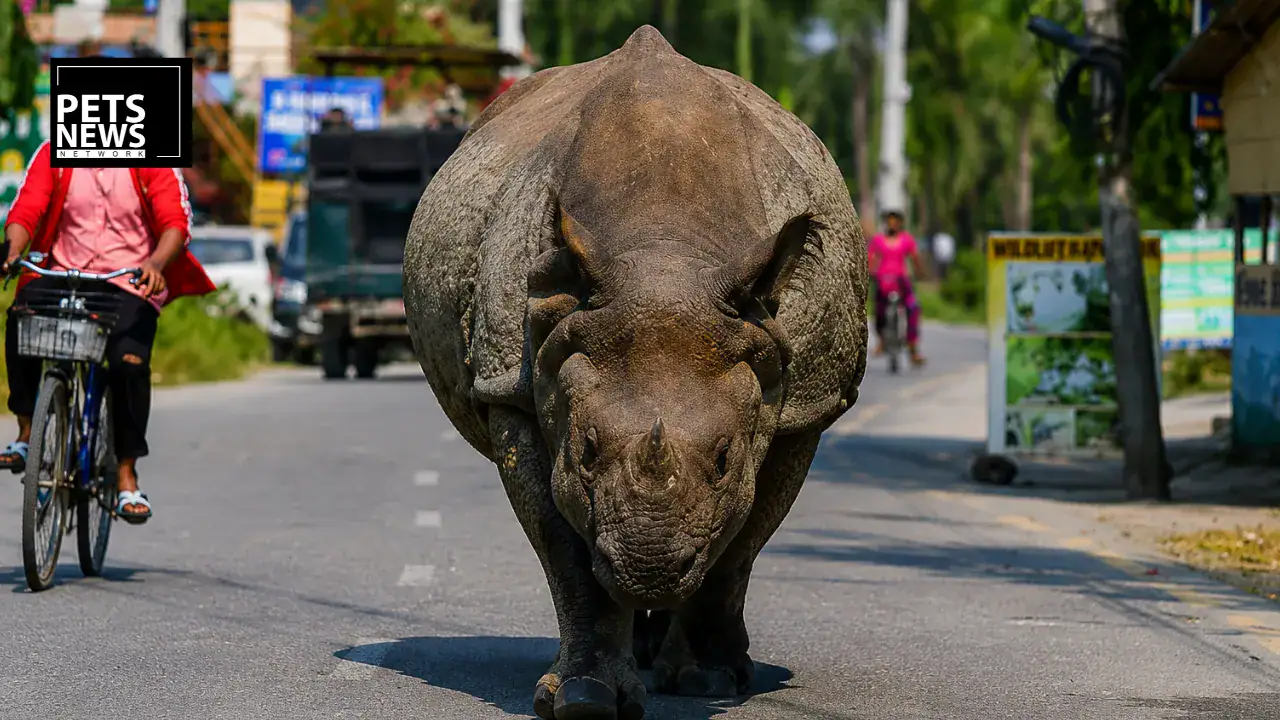

In most parts of the world, spotting a rhinoceros means heading deep into a national park with a guide, a jeep, and a healthy dose of patience. In Sauraha, Nepal, you might just see one wandering down the main road past a row of shops, or napping quietly on a hotel lawn while scooters buzz by.
Sauraha sits right on the border of Chitwan National Park, a UNESCO World Heritage Site and one of Nepal’s most important wildlife sanctuaries. As a tourist gateway town built almost entirely around access to the park, Sauraha has developed an unusually blurred boundary between human settlement and wild animal habitat, one that has produced a genuinely rare phenomenon: greater one-horned rhinos that behave, for all practical purposes, like part-time townsfolk.
Rhinos in the Restaurant District
The scenes that play out in Sauraha are the kind that would seem almost surreal anywhere else. Greater one-horned rhinos, animals that can weigh close to two tons, casually make their way down paved roads, ambling past local shops, restaurants, and hotel parking lots as though it were the most ordinary thing in the world.
Some of these rhinos have been documented snoozing on hotel lawns, grazing quietly in backyards, and generally coexisting alongside the everyday rhythm of scooters, bicycles, and pedestrians moving through town. It’s a scene wildlife researchers and travel writers alike have described as almost nothing like typical urban wildlife encounters seen elsewhere, where the occasional fox, raccoon, or bold deer might wander into view. In Sauraha, the scale is simply different: coexistence here involves genuine giants.
From Near-Extinction to a Genuine Conservation Success
The presence of rhinos in and around Sauraha at all is, in many ways, a story of conservation success rather than failure. Nepal’s rhino population once faced a genuine crisis. Back in the 1970s, decades of poaching and habitat loss had driven the country’s rhino numbers down to a critical low of roughly 100 animals, a population size that put the species at real risk of local extinction within Nepal.
What followed was a sustained, multi-decade conservation effort built around strict anti-poaching patrols, active community involvement, and the formal protected status granted to Chitwan National Park. That combined effort has paid off dramatically. According to a recent census, Chitwan National Park alone is now home to roughly 694 greater one-horned rhinos, part of a broader national population recovery that stands as one of South Asia’s genuine conservation success stories.
Why Some Rhinos Prefer Town to the Jungle
Not every rhino wandering Sauraha’s streets got there by simple chance. A number of the most well-known “town rhinos” are, in fact, rescue animals, orphaned or injured calves that were separated from their mothers within the park and subsequently hand-reared by conservation agencies, including Nepal’s National Trust for Nature Conservation (NTNC), which operates directly out of Sauraha.
The challenge with this kind of rescue and rehabilitation work is what happens after these calves grow up. Having spent their formative months or years in close daily contact with human caretakers, many of these rhinos become genuinely habituated to people, comfortable around human activity in a way wild-raised rhinos simply aren’t. Even after being released back toward the wild near Sauraha, several of these rescued animals have continued gravitating back toward town, preferring the familiar presence of people over life deep in the surrounding jungle.
Wildlife experts and park officials describe this as a genuinely difficult ongoing dilemma. Fully rewilding a habituated rhino isn’t always straightforward, and some conservationists have argued that certain individual rhinos may never be able to return to a fully wild existence, raising complicated long-term questions about how to manage animals caught between two worlds.
Living With Giants: Respect, Familiarity, and Real Risk
Despite the inherent danger involved, the relationship between Sauraha’s residents and its town rhinos has, by most accounts, settled into something resembling careful, mutual respect. Local residents often recognise individual, well-known rhinos by name and generally understand how to maintain a safe distance during encounters, knowledge built up over years of living alongside these animals as an everyday reality rather than a rare event.
That familiarity, however, doesn’t erase the genuine danger these animals pose. Despite their often calm, unbothered demeanor, rhinos remain wild animals, capable of moving with surprising speed and equipped with sharp incisors and immense physical power. Close encounters, particularly involving tourists unfamiliar with rhino behaviour, require real caution. Non-lethal deterrents such as flashlights, along with clear community guidelines on maintaining distance and avoiding provocation, play an important role in keeping both people and rhinos safe during these routine, if extraordinary, encounters.
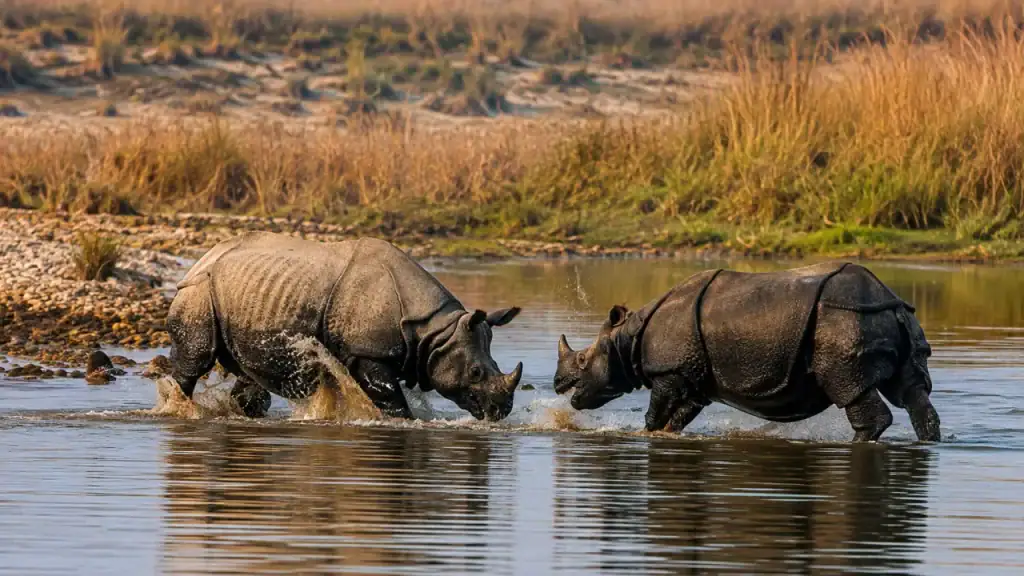
Local wildlife officials have also pointed to a more structural explanation for why rhinos increasingly appear near settlements: competition among male rhinos within the park itself. When dominant males assert territorial control, weaker individuals are sometimes pushed toward the park’s edges and beyond, into the very roads and neighbourhoods that make up Sauraha.
A Rare Model of Coexistence, With Real Trade-offs
Sauraha’s story offers a genuinely unusual window into what large-scale wildlife coexistence can look like when a conservation success story collides with rapid tourism growth and settlement expansion around a protected area. It’s not a simple, uncomplicated success, park officials, conservationists, and residents continue to debate the best long-term approach for habituated rhinos, and the risk of dangerous encounters remains real and ongoing.
But as a snapshot of what’s possible when decades of dedicated anti-poaching work and community-based conservation actually succeed, Sauraha’s wandering rhinos offer something rare: a living, walking reminder that conservation victories don’t always stay neatly contained within a park’s boundaries, sometimes, they simply move into town.
Pets News Network is India’s first dedicated media platform for the pet and animal industry. For breaking global pet news, brand coverage, and advertising enquiries, contact: ankur@petsnewsnetwork.com