
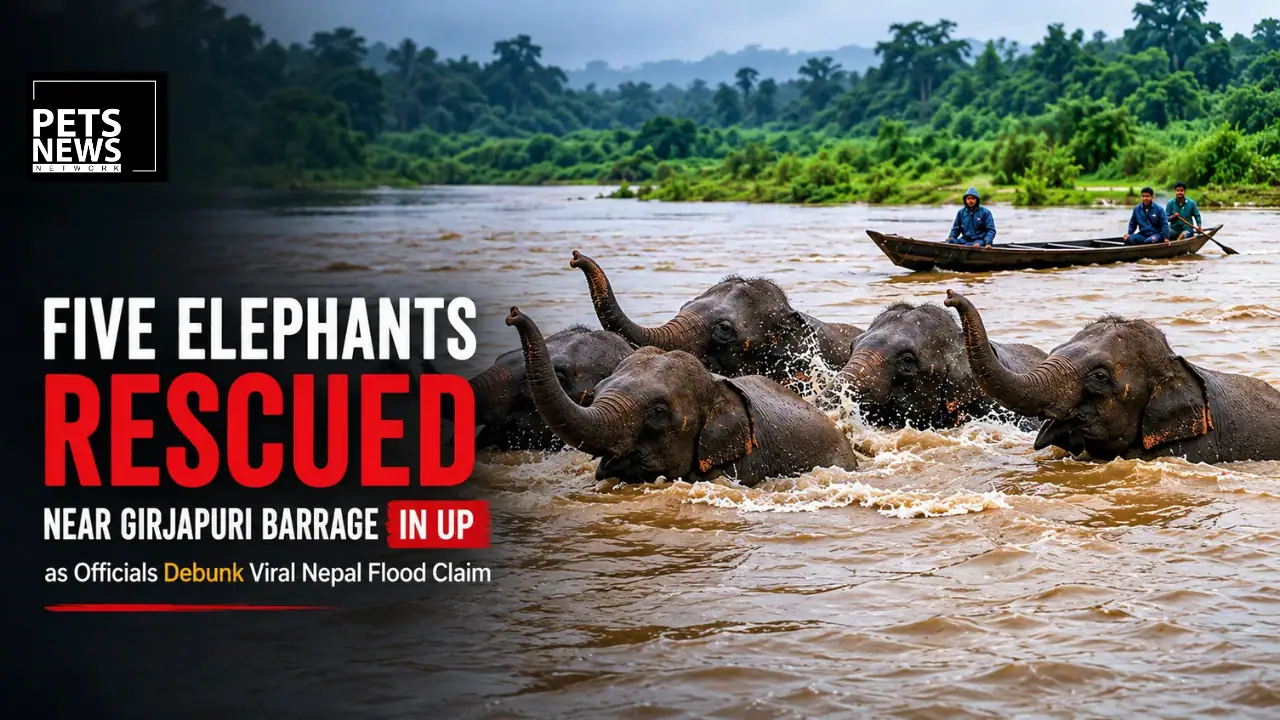

A five-member wild elephant herd, including three adults and two calves, was safely rescued after being swept by a powerful river current towards the Girjapuri Barrage in Uttar Pradesh’s Bahraich district.
The incident took place on the morning of August 25, 2026, inside the Katarniaghat Wildlife Division, where forest officials received an emergency message that the elephants were struggling in the fast-flowing Kaudiyala River.
The two calves were in the greatest danger.
According to forest officials, the current was strong enough to pull the young elephants downstream while the adults stayed close and followed them, apparently trying to prevent the calves from being separated from the group.
The entire herd was moving towards the barrage gates, where strong currents and hydraulic structures could have turned the incident into a serious wildlife tragedy.
A rapid joint operation involving the Uttar Pradesh Forest Department and Irrigation Department eventually reduced the force of the water and allowed all five elephants to reach safety.
The rescue began with an alert at around 10:20 am
Katarniaghat Range headquarters received a wireless message through the Kailashpuri Barrier at approximately 10:20 am.
The message warned that the herd was being carried towards the Girjapuri Barrage by the strong current of the Kaudiyala River, also known locally as the Gerua.
Forest teams immediately moved towards the barrage area.
Indian Forest Service officer Ramesh Pandey later said the current was particularly difficult for the calves, which were being carried along by the water.
Even the adult elephants were struggling to maintain control.
Adults stayed with the calves through the strongest current
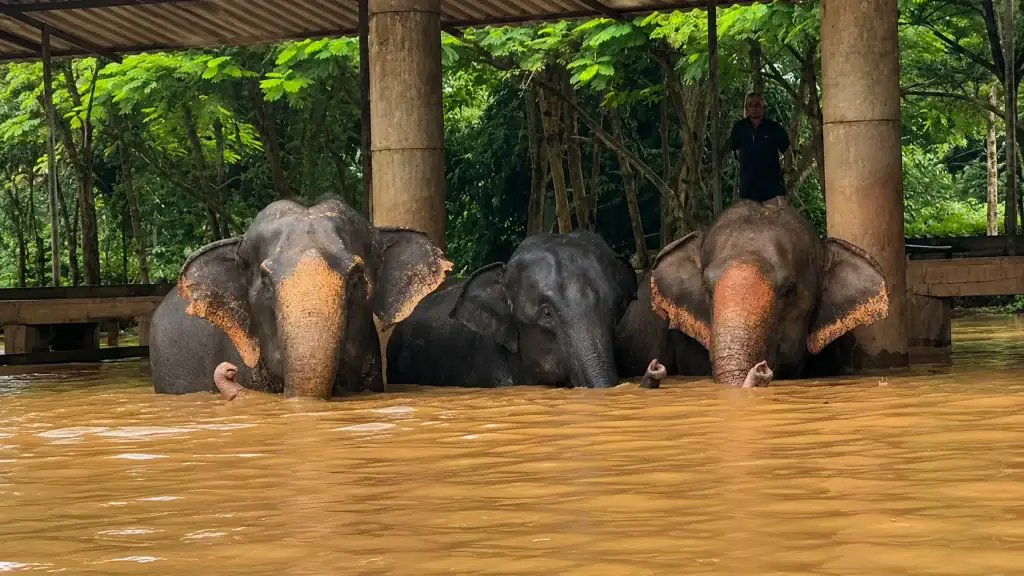
Videos from the scene showed the elephants remaining close together as they struggled against the water.
Forest officials said the adult elephants stayed near the calves rather than moving independently towards safer ground.
Once the water eventually slowed, the adults were able to regain control and guide the younger elephants away from the most dangerous section.
Some viral descriptions claimed the adults formed a precise protective circle around the calves. The verified accounts support that they stayed close and helped protect and guide the young animals, but do not establish that exact formation.
Barrage gates were closed to reduce the current
The most critical human intervention came from the Irrigation Department.
Once forest teams reached the area, officials contacted irrigation authorities and requested immediate assistance in controlling the water flow.
The department closed the relevant barrage gates, reducing the velocity of the river.
That change gave the elephants the opportunity they needed.
As the current weakened, the adult elephants regained their footing and began guiding the calves towards safer water.
Forest personnel used ‘hanka’ to move the herd back
Slowing the water was only the first stage.
The elephants had already reached the vicinity of the barrage gates, and forest teams still needed to direct them away from the structure.
Personnel used a controlled “hanka” technique, creating coordinated noise and movement to encourage the elephants to move towards the forest.
Once the animals were clear of the danger zone, the herd moved back into the Katarniaghat forest.
Officials later confirmed that all five elephants reached a safe area and were being monitored.
No serious injuries to the elephants were reported.
Forest teams also used drones to locate the larger herd from which the five elephants were believed to have separated, raising the possibility that they could naturally reunite.
Officials debunk the viral Nepal flood story
After videos of the rescue spread widely online, a dramatic claim began circulating with them.
Posts said the elephants had been swept out of Nepal by devastating floodwaters and had crossed into Uttar Pradesh before being rescued near Girjapuri Barrage.
That story has now been officially rejected by the Katarniaghat Wildlife Division.
Divisional Forest Officer Apoorv Dixit clarified on August 28 that the rescue occurred on August 25.
The major flash floods in Nepal began one day later, on August 26.
Officials said there had been no direct impact from the Nepal flash floods on Katarniaghat at the time of the elephant incident.
The five elephants were also not identified as a herd carried across the international border.
Instead, the Forest Department said they were a breakaway group from a larger herd already present in the Katarniaghat landscape.
Why the Nepal claim seemed believable
The incorrect claim spread partly because Katarniaghat sits within a broader transboundary wildlife landscape.
The Kaudiyala river system is connected to waterways originating in Nepal, and the Terai region supports wildlife movement across India and Nepal.
Elephants can move across large landscapes that do not conform to political borders.
For news organisations and wildlife platforms, the episode is a reminder that authentic video can still be accompanied by inaccurate captions.
Strong river flows continue to affect Katarniaghat wildlife
Although the five elephants were not victims of the Nepal flash floods, Katarniaghat has continued to experience strong river currents.
On August 28, officials reported separate wildlife rescues involving a gharial and a smooth-coated otter near the Girjapuri Barrage.
The gharial had been carried out of the river into a crowded irrigation campus area and was guided back towards the water using non-invasive methods.
In another operation, a smooth-coated otter became stranded near the barrage after being swept downstream by the fast current. Forest personnel rescued the animal and released it into suitable natural habitat.
A successful rescue built on fast coordination
The five-elephant rescue could easily have ended differently.
The calves were being pushed downstream, the adults were struggling to remain with them, and the herd was approaching a large barrage structure.
Instead, a wireless alert reached forest staff quickly, teams reached the site, irrigation officials changed the flow conditions, and forest personnel guided the elephants back towards the sanctuary.
The result was a rare positive ending to a high-risk wildlife emergency.
The verified story is compelling enough on its own.
Three adult elephants stayed with two vulnerable calves through a dangerous river current. Government teams changed the flow of water to give them a chance. Forest personnel then guided the family away from the barrage and back into one of Uttar Pradesh’s most important wildlife landscapes.
And after dramatic footage triggered a wave of misinformation, officials provided an equally important final step: establishing what actually happened.
Pets News Network is India’s first dedicated media platform for the pet and animal industry. For breaking global pet news, brand coverage, and advertising enquiries, contact: info@petsnewsnetwork.com