

A new Scientific Reports study combines computer vision with cardiac data to flag missed alerts before a dog ever meets the target odour. Here is what it found, and what it has not yet proven.
A detection dog on a working search is doing several demanding things at once. It is moving continuously, often for long stretches. It is managing its own body heat, which for a panting, sniffing animal is a real physiological trade-off, because the same airway used to cool down is the one used to sample odour. And it is holding focused attention on a task that asks it to pick out a faint chemical signature against a crowded background of other smells.
Most of the time, well-trained dogs manage all of this remarkably well. But performance is not a fixed quantity. It drifts with fatigue, heat, arousal and attention, and sometimes a dog walks past a target it would have caught an hour earlier.
That is the missed alert, and in explosives screening, hazardous substance detection or search and rescue, it is usually the more dangerous of the two errors a dog can make. A false alert wastes time and erodes confidence. A missed alert leaves the threat in place, or the person unfound.
A study published in Scientific Reports on 15 September 2026 set out to answer a question handlers have always had to answer by instinct: can you tell, before it happens, that a dog is heading into a miss?
The Handler as the Only Early-Warning System
Until now, the safeguard against declining reliability has been the handler. Experienced handlers read posture, gait, search intensity and general engagement, then combine what they see with their knowledge of the individual animal to decide when to pause, rotate or rest it.
This system works, and it will keep working. Its weakness is that it relies on subtle cues being visible to a person whose attention is already split between navigation, personal safety, communication with a team and the dog itself. In a busy terminal or an unstable structure, the early signs of a dog “going off” are easy to miss, not because the handler lacks skill, but because the cues are small and the environment is loud.
The research team, led by corresponding author Jörg Schultz of Tier Wohl Team GbR in Germany, with Liza Rothkoff, Edgar O. Aviles-Rosa and Nathaniel J. Hall of Texas Tech University and Michele N. Maughan of Precise Systems Inc., asked a more basic question. Does the dog’s body already carry measurable signs of an upcoming miss? And if it does, can a machine learning model pick them up earlier or more consistently than a human observer?
Building an Experiment Around Exact Timing
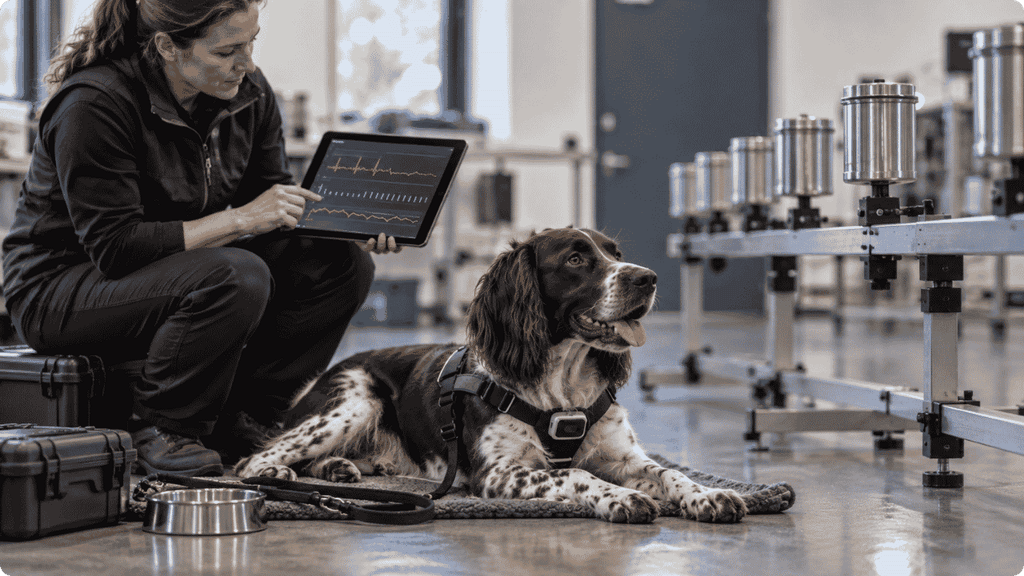
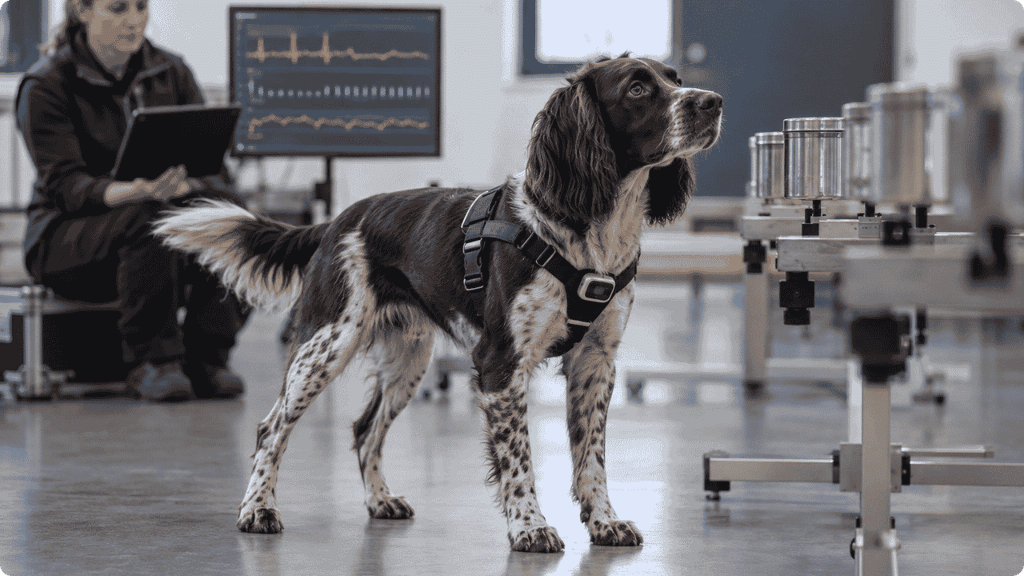
To study the moments before a miss, you need to know exactly when the dog could first have smelled the target. In a free search that is almost impossible to pin down. The team solved this with an “olfacto-treadmill”, a treadmill combined with a computer-controlled olfactometer that releases odour at precisely known moments while the dog keeps a steady pace.
The dogs. Four dogs aged between two and four years, all healthy and actively trained in detection. Three of them, Adele, Boomer and Iitooma, came from a working-dog supplier in Texas and were housed at Texas Tech’s Canine Olfaction Research and Education (CORE) Lab. The fourth, Charles, was a staff member’s pet who came in daily and had taken part in earlier work by some of the same researchers.
The task. Each dog indicated by nose-poking: pushing its muzzle into an odour port and breaking an infrared beam for a minimum time. That threshold was 0.4 seconds for two dogs and 0.8 seconds for the other two, adjusted for muzzle shape rather than ability. The target odour was 1-bromooctane diluted in food-grade mineral oil, at a concentration calibrated to each dog through earlier threshold testing.
The sessions. A trial was triggered every 20 seconds, with target odour present on a randomised half of them. Dogs completed fixed-pace sessions of 100 trials at a constant walk or trot, and pace-transition sessions of 140 trials with a speed change partway through. Every dog ran multiple sessions of each type on separate days.
The analysis window. Performance fell off more clearly at the faster pace, so the core analysis focused on target-present trials while dogs trotted at 8 km/h. For each one, the team extracted exactly 4.5 seconds of data immediately before the odour was released.
That design choice is what gives the study its weight. During those 4.5 seconds the target was not yet present. Whatever the model found had to be coming from the dog’s state, not from any reaction to the scent.
Reading the Outside: 29 Points, 30 Times a Second
Movement was captured using markerless pose estimation, built on the open-source tool DeepLabCut. Instead of fixing reflective markers to the dog, the software learns to locate anatomical landmarks directly from video.
The team tracked 29 landmarks across the whole body: the head and neck, the length of the spine, the tail, and both fore and hind limbs. At 30 frames per second, this produced a continuously updating skeletal map of the dog through the pre-odour window.
Raw coordinates are misleading on their own. A dog that drifts forward on the belt, or a larger dog next to a smaller one, will produce different numbers without any real change in posture. To remove that noise, every point was expressed relative to the withers, the ridge between the shoulder blades. What remained reflected changes in posture and coordination, not position on the treadmill.
The model itself was a spatiotemporal graph neural network. The “graph” part treats the body as it actually is: a set of connected joints, where the neck relates to the shoulder and the spine relates to the tail. The model first learned how connected joints moved together within a single frame, then tracked how that coordinated pattern changed over the 4.5 seconds. That allowed it to register both brief micro-adjustments and slower postural drift, the sort of change a handler might feel rather than consciously see.
Reading the Inside: Heart and Core Temperature
Posture is the visible half. Three physiological streams were recorded over the same window:
- Heart rate, via a Polar H10 chest strap, a commercially available monitor.
- Inter-beat interval (IBI) statistics, the fine timing between individual heartbeats, summarised into seven measures of short-term heart rate variability.
- Core body temperature, from an ingestible AniPill capsule made by BodyCap, transmitting once per minute.
These signals went through a separate branch of the model and were then fused with the movement representation before the final prediction, so the model could weigh external body language and internal state together.
What the Model Found
Movement alone was a strong predictor
On a held-out set of 216 trials it had never seen during training, the movement-only model separated upcoming misses from successful indications with an AUC of 0.81 and overall accuracy of 73.6%. (AUC measures how well a model discriminates between two outcomes: 0.5 is a coin toss, 1.0 is perfect.)
The detail matters. The model caught 77% of the trials that turned out to be misses, and when it predicted a miss, it was right 82% of the time. It was weaker at recognising successful indications, correctly identifying 67% of them.
For an operational tool, that imbalance is arguably the right one. A monitoring system that occasionally flags a dog who was actually fine costs a short rest. One that stays quiet before a real miss costs much more.
The signal lived on the body’s central axis
To understand what the model was responding to, the researchers ran a saliency analysis, nudging each landmark slightly and measuring how much the prediction changed.
The influential points were not spread across the body. They clustered along the axial line: the top of the head, a vertebra near the base of the skull, the withers and the tip of the tail. Most leg joints and points along the mid-back mattered far less.
This fits what is already known about canine behaviour. Small shifts in head position plausibly reflect how the dog is oriented toward the odour source, an early sign of waning engagement before it becomes obvious. Tail carriage and movement have been linked in other research to changes in arousal and emotional state.
The practical reading is useful for handlers: before a miss, the dog did not become visibly sloppy or uncoordinated. The warning signs were local and subtle, concentrated in the parts of the body tied to attention and arousal.
Physiology improved the model where it counts
Adding heart rate, IBI statistics and core temperature left overall discrimination essentially unchanged, at an AUC of 0.80 against 0.81 for movement alone. But the combined model’s ability to catch actual misses rose from 77% to 85%.
This is worth stating precisely, because it is the figure most likely to be misreported. The 85% is recall for missed alerts, the share of real misses the model flagged in advance. It is not an overall accuracy score. For the job this tool would eventually do, recall on misses is the more important number.
Beat-to-beat timing mattered more than heart rate
The researchers removed each physiological input in turn to see how much performance suffered without it.
Short-term IBI statistics were the most important single input; removing them produced the largest drop in predictive performance. Core temperature contributed a moderate amount. Plain heart rate barely registered once the other two were included.
That separates this finding from a simple exertion story. If misses were just a function of a dog working harder, raw heart rate would have carried the signal. Instead, it was the variation in timing between individual beats, a marker associated with autonomic nervous system regulation, that did the work. The dog’s internal balance between arousal and recovery appears to shift before its performance does.
From Single Predictions to a Running Risk Score
A trial-by-trial prediction is scientifically interesting but not how a handler would use the information. In the field, the useful question is not “will this next sniff fail?” but “is this dog, right now, drifting into a state where misses are becoming more likely?”
To move in that direction, the team built a Bayesian aggregation method that combines a stream of individual predictions into a continuously updated estimate of miss risk across a session. As a demonstration, they applied it to one full session from one dog, 50 target-present trials. As the dog’s observed miss rate rose through the session, the aggregated risk estimate rose with it, even though the model never saw the actual outcomes as it went.
The authors present this as an illustration, not a validated tool. But it shows what a practical version could look like: a single readout that trends upward as reliability declines, giving the handler a clear reason to rotate the dog.
What This Means for Operations and Welfare
For detection reliability. If the approach can be validated in realistic conditions, it gives handlers something they have not had before: an objective early warning that a dog’s reliability is slipping, ahead of an operational failure. In airport security, explosive sweeps and search and rescue, that lead time has direct value.
For working dog welfare. The same signal that protects the mission protects the animal. A system that flags early fatigue or fading focus gives handlers a data-backed reason to rest a dog before it is pushed into genuine physical or attentional strain. Workload decisions that are currently subjective, and sometimes under pressure to keep going, could be anchored to measurable biology.
For how performance is understood. The deeper contribution is conceptual. A missed alert, on this evidence, is not a random one-off. It is preceded by a coordinated shift in posture and autonomic state that is detectable before the dog meets the odour. Detection performance looks less like a string of independent passes and fails and more like a continuously fluctuating biological state that can, in principle, be monitored.
Limitations and Field Reality
The authors are explicit about the boundaries of what they have shown, and those boundaries are significant.
The environment was controlled by design. Odour came from a fixed, known port. Real searches require the dog to locate an unknown source across varied terrain, in changing airflow, with far more distraction.
The indication differs from operational practice. A timed nose-poke is not the sustained sit, stand or stare many working dogs are trained to give. Whether the same pre-miss signals appear with those responses is an open question.
The sensors are research tools. An ingestible temperature capsule and a chest-strap monitor were described by the researchers as experimental equipment rather than field-ready kit. Continuous, unobstructed side-on video, which pose tracking depends on, is rarely available during a real search.
The sample was small. Four dogs, one lab, and a risk-score demonstration drawn from a single session of a single dog. Individual variation between dogs is large, and the findings need testing across many more animals, breeds and working roles.
Field-ready alternatives are untested. The authors suggest wearable accelerometers, already used in other canine behaviour research, might capture comparable movement signals without video. That is a reasonable direction, not a demonstrated one.
The underlying science is peer-reviewed and carefully designed. A deployable monitoring product based on it does not exist yet, and the researchers do not claim otherwise.
The Bottom Line
This study puts measurement behind something good handlers have long sensed: a dog’s coming failure to alert is not sudden or random. Its roots are visible in head and tail carriage and in the timing of the heartbeat, seconds before the dog ever encounters the target.
Using only data from before odour release, the researchers’ model caught most upcoming misses, and caught more of them once cardiac timing and core temperature were added. The route from treadmill to field is still long, and it runs through more dogs, realistic search conditions and sensors a working dog can actually wear. But the starting point is solid, and it serves two goals at once: fewer missed targets, and better protection for the dogs doing the work.
Editor’s Take
Pets News Network covers research like this because the pet and working animal industry in India is moving quickly toward technology-assisted care, and working dogs deserve the same evidence-based attention as the handlers beside them. Predictive monitoring that reads a dog’s state before performance drops could reshape how workloads are managed, shifting rest and rotation from judgement under pressure to decisions grounded in the animal’s own biology. We will keep tracking this work as it moves from the lab toward the field.
Study Details Schultz, J., Rothkoff, L., Aviles-Rosa, E. O., Hall, N. J., & Maughan, M. N. (2026). Scientific Reports, 16, Article 28712. Published 15 September 2026. DOI: 10.1038/s41598-026-71367-8 Funding: U.S. Army, via the Chemical Biological Advanced Materials and Manufacturing Science (CBAMMS) Program at DEVCOM Chemical Biological Center.
Pets News Network is India’s first dedicated media platform for the pet and animal industry. For breaking global pet news, brand coverage and advertising enquiries, contact: info@petsnewsnetwork.com