
While other Indian cities threaten fines and build shelters, Lucknow has quietly spent seven years doing the unglamorous work. Its latest move is a set of billboards and a phone number — aimed at the hardest dogs to reach.
What has been announced
Humane World for Animals India, formerly Humane Society International/India, has installed billboards at key locations across Lucknow urging residents to bring unsterilised community dogs from their neighbourhoods to the city’s Animal Birth Control (ABC) Centre at Jarhara, Indiranagar.
The services are free: sterilisation and anti-rabies vaccination.
Residents who notice an unsterilised community dog in their area can call 9336312853 to book an appointment, or bring the dog directly to the centre between 8am and 12pm, Monday to Friday.
Dr Ratnesh Rao, senior manager of the companion animal and engagement team at Humane World for Animals India, explained the thinking:
“With these billboards we want to encourage more people to bring in unsterilized dogs to ABC. This will allow residents to see our work first-hand and get their questions answered. A simple phone call can help prevent an increase in street dog populations and ensure that a dog and the community are protected against rabies.”
And the target:
“Our goal is to make Lucknow one of the first few cities in India to achieve sterilization and vaccination coverage as high as 90%, while creating safer, kinder communities for both people and animals.”
That 90% figure is the whole story.
Why 90% matters, and why 84% isn’t enough
Sterilisation programmes do not work in proportion to effort. They work by crossing a threshold.
Below a certain coverage level, the uncaught portion of the population simply breeds the numbers back. Above it, births fall below replacement and the population begins to decline. For rabies control, high vaccination coverage is what breaks transmission across a dog population rather than merely protecting individual animals.
Reporting on the Lucknow programme has put coverage at over 84% of the city’s street dogs sterilised and vaccinated. That is far ahead of most Indian cities. It is also not yet where the programme wants to be.
The remaining stretch is the hardest part of any ABC programme, and this is the part rarely explained in coverage. The first 80% of dogs are reached through systematic street-by-street catching in areas with active volunteers and cooperative residents. What remains afterwards is scattered — dogs in neighbourhoods with no volunteer network, animals that evade catching teams, newly arrived dogs, and litters born in pockets that catching rounds have already covered and moved past.
You cannot solve that with more vehicles. You solve it by getting residents themselves to identify specific unsterilised dogs and bring them in. Which is exactly what a billboard and a phone number are for.
The programme behind the campaign
The ABC programme in Lucknow began in 2019, run by Humane World for Animals India in collaboration with the Lucknow Nagar Nigam.
According to the organisation, the programme now involves:
- More than 100,000 dogs sterilised to date
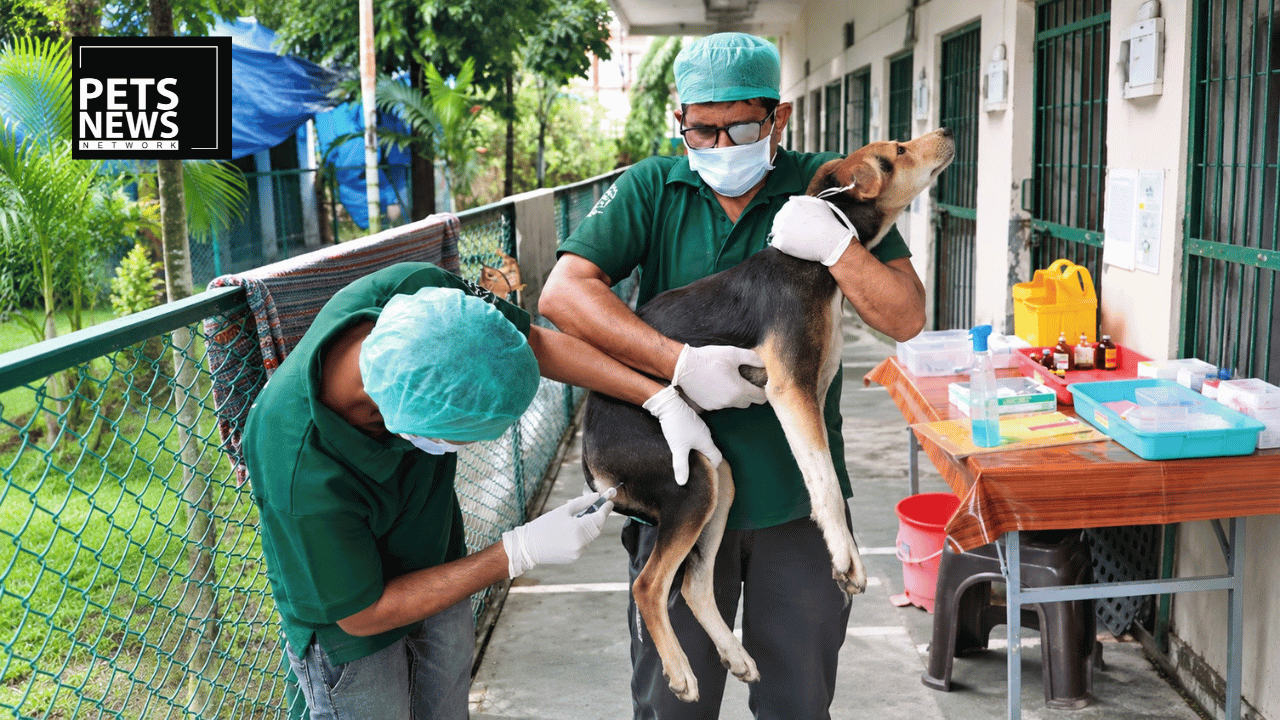
- 250 to 300 dogs sterilised, vaccinated and released back to their original locations every week
- More than 30 trained staff members and six vehicles
- A network of community volunteers
- More than 32,000 public concerns about street dogs addressed through sterilisation, vaccination and community awareness
The 100,000th dog, a community dog named Chitti, was found injured on the street by a resident volunteer and brought to the facility. The milestone was marked in February 2026 by painting educational murals across the ABC centre — a deliberate choice to make the facility something residents would approach rather than avoid.
Dogs that have been through the programme carry a V-shaped ear notch, a visible mark that the animal has been sterilised and vaccinated. For residents, that notch is a quick way to tell which dogs still need to be brought in.
The Supreme Court has already noticed
This is not simply an NGO promoting its own work. Lucknow’s programme has been recognised by the Supreme Court as a national benchmark for humane and effective stray dog management.
That recognition came during the Court’s proceedings on stray dogs, where animal welfare advocates pointed to Lucknow and Dehradun as evidence that the sterilise-vaccinate-return approach produces results when it is actually funded and run consistently.
The Animal Birth Control Rules, 2023, notified under the Prevention of Cruelty to Animals Act, make sterilisation and anti-rabies vaccination the legal cornerstone of community dog population management in India. Lucknow is, in effect, the demonstration that the rules work when implemented properly.
The programme is supported by the Mars Impact Fund, which is also backing India’s first National ABC Training Centre in Lucknow — a facility intended to train animal welfare professionals from across the country.
Across all its Indian programmes, Humane World for Animals says more than 400,000 street dogs have been sterilised and vaccinated since 2013.
The contrast with everywhere else
Place this alongside what other Indian cities are doing right now, and the comparison becomes uncomfortable.
Shimla has warned of heavy fines for feeding community dogs outside designated zones, encouraged residents to photograph and report offenders, and is seeking High Court permission to permanently house aggressive dogs — while its own feeding zones remain largely unbuilt.
Delhi was ordered to create designated feeding points in every ward. A ground inspection found only 14 of 292 were functional.
Pimpri-Chinchwad moved to set up shelters after a serious attack on a child, with the civic body directed to investigate whether its own lapses contributed.
Each of those is a reaction to a crisis. Each centres on removal, restriction or enforcement.
Lucknow’s approach is slower, less dramatic, and involves no announcements about penalties. It is seven years of catching dogs, operating on them, vaccinating them, notching their ears and putting them back where they came from — 250 to 300 a week, every week.
The results are measurable. The approach is legal. And the Supreme Court has pointed to it.
What this means elsewhere in India
Three things are worth taking from Lucknow’s experience.
Consistency beats intensity. No single year of Lucknow’s programme is remarkable. Seven consecutive years is. ABC programmes fail in Indian cities not because the method is wrong but because they are funded in bursts, suspended, restarted and never sustained long enough to cross the threshold where the numbers turn.
Community participation is the bottleneck, not capacity. Lucknow has the staff, vehicles and surgical capacity. What it needs now is residents picking up the phone about the specific unsterilised dog on their street. That is why the billboards exist, and it is the stage every city eventually reaches.
Visibility builds trust. The murals, the open centre, the public phone number and Dr Rao’s point about residents seeing the work first-hand all address the same problem: ABC programmes are widely distrusted because nobody sees what happens inside them. Residents who suspect dogs are being harmed or dumped elsewhere do not cooperate. Residents who have visited the facility do.
For readers in Lucknow
If you know of an unsterilised community dog in your neighbourhood:
- Check the ears first. A V-shaped notch means the dog has already been sterilised and vaccinated.
- Call 9336312853 to book an appointment, or bring the dog to the ABC Centre at Jarhara, Indiranagar, between 8am and 12pm, Monday to Friday.
- Both services are free — sterilisation and anti-rabies vaccination.
- Dogs are returned to the same location after recovery, as required under the ABC Rules, 2023.
The unglamorous version works
There is no dramatic announcement here. No fines, no enforcement drive, no shelter construction, no court petition. Just billboards asking people to make a phone call.
But a city that has sterilised a hundred thousand dogs and reached 84% coverage, with the Supreme Court citing it as the national benchmark, has earned the right to be boring about it.
The question for the rest of India is not whether this approach works. Lucknow has answered that. The question is whether other municipalities are willing to do the same thing for seven unglamorous years before expecting results.
A note on sourcing: Programme figures in this article — including sterilisation totals, weekly throughput, staffing and public concerns addressed — are as stated by Humane World for Animals India. Coverage percentages and the Supreme Court’s recognition of the Lucknow model are drawn from independent reporting.
Pets News Network is India’s first dedicated media platform for the pet and animal industry. For breaking global pet news, brand coverage, and advertising enquiries, contact: info@petsnewsnetwork.com