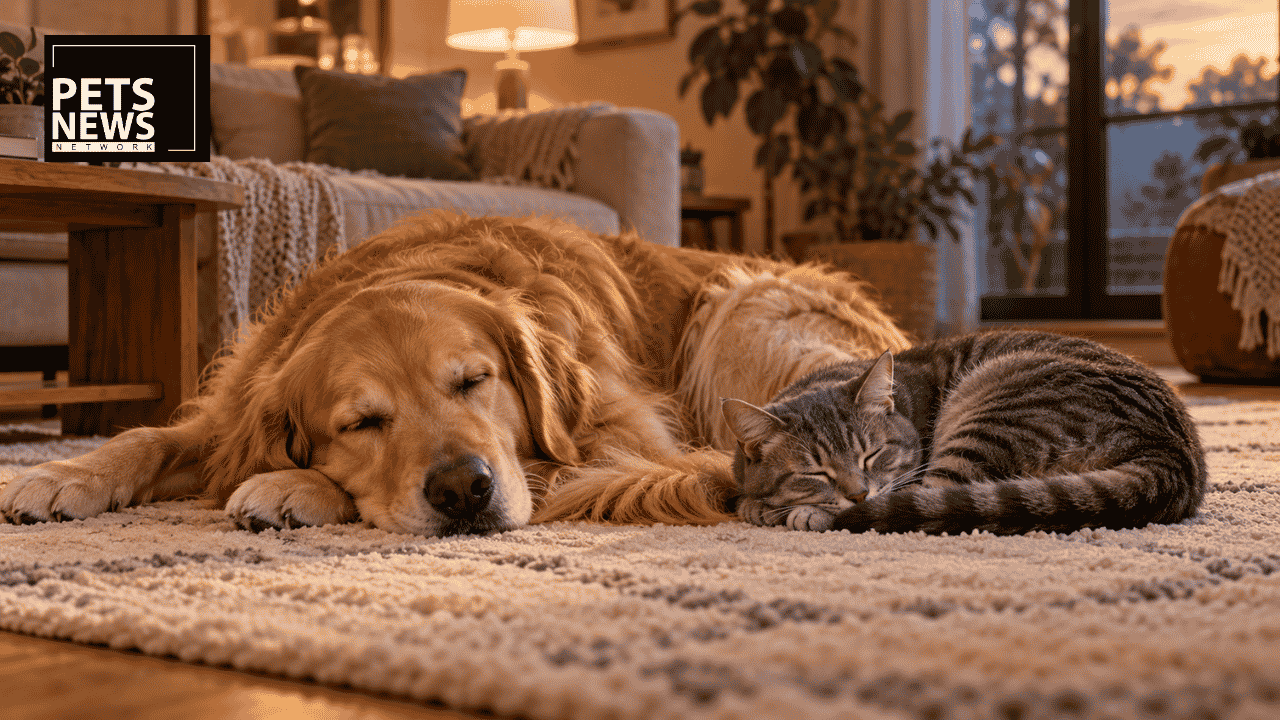

Your dog’s paws paddle. Her whiskers quiver. A muffled woof escapes. Six decades of neuroscience now tell us a surprising amount about what is actually happening — and rather less than most articles claim.
The question every pet owner asks
It is close to midnight and your dog is asleep on the floor. Her paws begin to move as though she is running. Her eyes dart beneath closed lids. On the sofa, your cat’s tail flicks three times and his claws flex against the cushion.
Every owner has watched this and wondered what is going on inside that sleeping head.
The honest scientific answer sits between two extremes. Pets are not blank during sleep, and the evidence that they experience something during REM is strong. But as Harvard dream researcher Dr Deirdre Barrett has put it plainly: “Anything about what animals dream, or even if they dream, is speculative.”
That caveat comes from one of the field’s most-quoted authorities, and it is worth holding onto while reading everything that follows. What researchers have established with confidence is the machinery. What they infer about the content is reasoning, not recording.
How a pet’s brain builds the night
Dreaming is tied to a specific, measurable brain state. To understand pet dreams you first have to understand how their sleep is structured.
Slow-wave sleep: the repair stage
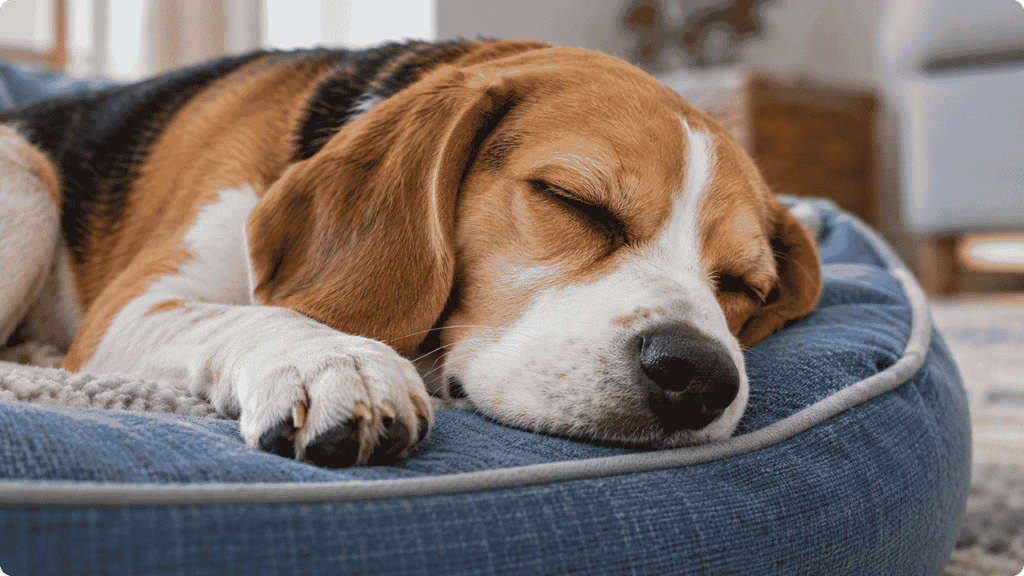
The first phase is slow-wave sleep, also called non-REM or deep sleep. On an electroencephalogram (EEG) it produces large, slow, rolling brain waves. Heart rate and breathing slow, muscles relax, and the body attends to physical maintenance and the consolidation of simpler memories. A pet in this stage lies still and breathes deeply, with little twitching.
REM sleep: where dreaming happens
The second phase is rapid eye movement sleep. The brain becomes highly active, firing in fast, low-amplitude patterns. The eyes flick beneath the lids, breathing becomes rapid, shallow and irregular, and in dogs heart rate typically drops below 60 beats per minute.
Crucially, muscle tone collapses into a state of near-total paralysis called atonia — a safety brake that stops the sleeper acting out whatever the brain is generating. The twitches and paddling you see are small signals leaking past that brake.
Why pets cycle faster than we do
Humans sleep in one long consolidated block and move through roughly 90-minute cycles. Dogs and cats are polyphasic sleepers: they sleep in many shorter bouts spread across the full 24 hours.
Research on dogs describes a mean sleep cycle duration of around 20 minutes, with drowsiness and NREM occupying roughly two-thirds of it and REM the remaining third. One review estimates dogs accumulate around 2.9 hours of REM sleep per day — more than humans, estimated at 1.9 hours, and more than rats at 2.4.
In cats, average daily sleep is often cited at around 16 hours, though with considerable variation between studies, and an average sleep cycle of roughly 26 minutes. A 2024 study using non-invasive EEG on family cats found that while the EEG signatures and temporal organisation of sleep states are very similar in cats and dogs, the duration and pattern of their polycyclic sleep–wake cycles differ.
| Humans | Dogs | Cats | |
|---|---|---|---|
| Sleep pattern | Monophasic | Polyphasic | Polyphasic |
| Typical sleep cycle | ~90 min | ~20 min | ~26 min |
| Estimated daily REM | ~1.9 hours | ~2.9 hours | Varies by study |
A note on figures: pet sleep statistics circulate widely online with more precision than the research supports. Totals vary substantially depending on whether the animal is recorded at home or in a laboratory, the time of day, and the individual animal. Treat any single number as an approximation.
Because their cycles are compressed, pets enter REM many times a day. That is why you catch your dog twitching during an afternoon nap rather than only at 3 a.m.
The evidence: four pillars
1. Michel Jouvet, University of Lyon (1959–1965): cats that acted out their dreams
The foundational work came from French neuroscientist Michel Jouvet, who coined the term paradoxical sleep to describe REM — the brain looking awake while the body lay limp.
Jouvet was studying the pons, the brainstem structure responsible for atonia. To find out what the paralysis was concealing, he surgically disabled the region of the pons producing it in cats.
The result was extraordinary. On entering REM, the cats remained physiologically asleep, yet stood up and performed. They stalked, arched their backs, pounced, hissed and swatted at nothing. They were enacting organised, instinct-driven behaviour — not random movement.
Barrett summarised it this way:
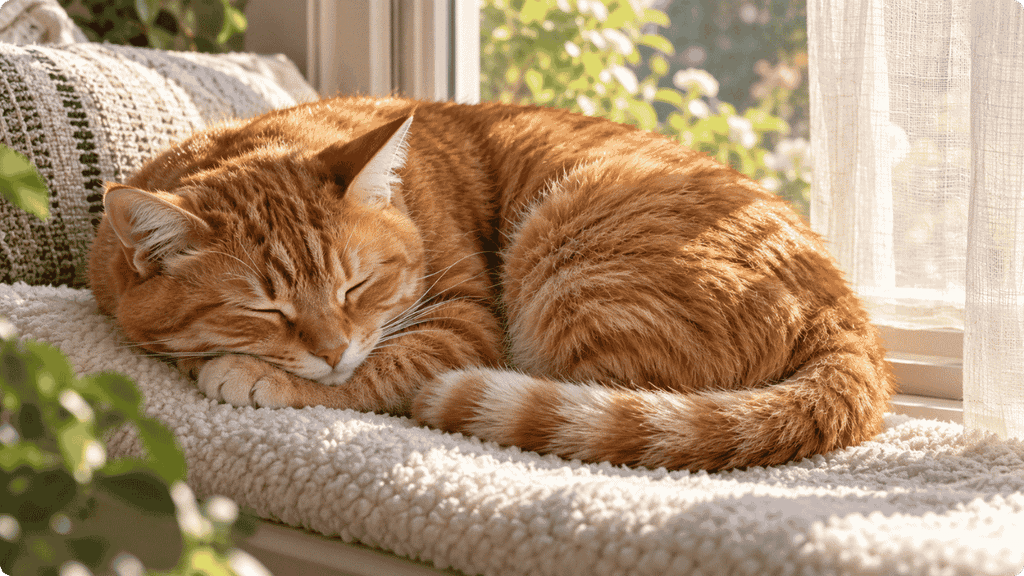
“Cats lay quietly through the other stages of sleep, and when REM began, they leaped up, stalked, pounced, arched their backs and hissed. They looked like they were hunting mice in their dreams.”
This remains the single most vivid demonstration of structured mental content during animal REM sleep. It is also worth noting what it was: invasive brain-lesion surgery on cats, conducted in an era with different ethical frameworks. The knowledge is real; so is its cost.
2. Louie and Wilson, MIT (2001): replaying the maze
If Jouvet showed that animals experience something, this study showed how specific it can be.
Kenway Louie and Matthew Wilson, working at MIT, published “Temporally Structured Replay of Awake Hippocampal Ensemble Activity during Rapid Eye Movement Sleep” in Neuron (Vol. 29, Issue 1, pp. 145–156).
Their method was elegant. While rats ran a maze, the researchers recorded the firing signatures of individual neurons in the hippocampus, the brain’s memory and navigation centre. Each location produced a distinctive pattern. They then recorded the same neurons while the rats slept.
During REM, the rats’ brains replayed those firing sequences in the correct order and at close to real-time speed. The correspondence was precise enough that researchers could identify where in the maze the sleeping rat’s brain “was,” and whether it was running or still.
This is direct evidence that a sleeping mammalian brain re-experiences specific sequential memories.
3. Stanley Coren: why size changes the pattern
Dr Stanley Coren, Professor Emeritus of Psychology at the University of British Columbia, brought the question into the living room. Because canine brains resemble human brains structurally and produce the same sleep-stage waveforms, he has argued there is little reason to assume dogs do not dream.
His best-known observation links body size to dream pattern: small dogs dream more frequently but briefly, large dogs less frequently but for longer. In his original framing, a small dog such as a toy poodle might dream roughly every 10 minutes, while a very large dog such as a mastiff or Irish wolfhound might go an hour and a half between dreams.
Secondary coverage has since substituted various breeds — Chihuahua, Labrador, Golden Retriever, Great Dane — so the specific breed names vary by source. The pattern is what matters.
Coren also reports that dogs typically enter REM around 20 minutes into a nap and remain there for roughly two to three minutes, timings any attentive owner can watch for.
One further observation of his explains something many owners notice: the pons is underdeveloped in puppies and less efficient in elderly dogs, which is why both twitch considerably more in their sleep than healthy adults.
| Small breeds | Large breeds | |
|---|---|---|
| Dream frequency | Roughly every 10–15 minutes | Roughly every 60–90 minutes |
| Dream duration | About a minute | Several minutes |
| What you see | Frequent small twitches, soft yips | Fewer but more pronounced paddling |
4. Deirdre Barrett, Harvard Medical School (2016): the dog’s-eye view
The most widely shared contribution is also the most speculative, and Barrett says so herself.
A clinical and evolutionary psychologist at Harvard Medical School, Barrett reasons from human dream research:
“Humans dream about the same things they’re interested in by day, though more visually and less logically. There’s no reason to think animals are any different.”
From that, she concludes:
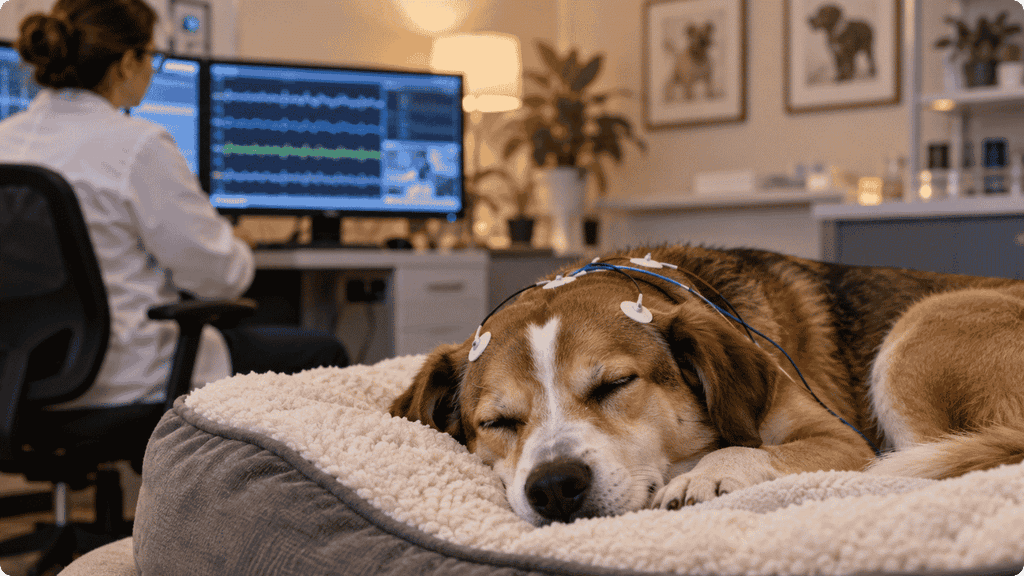
“Since dogs are generally extremely attached to their human owners, it’s likely your dog is dreaming of your face, your smell and of pleasing or annoying you.”
On cats she is on firmer ground, because she is citing Jouvet’s observations rather than inferring. Cats, she notes, do not appear to dream about their owners nearly as often — their REM behaviour points to hunting.
Her practical advice is the most actionable thing she offers: the best way to encourage good dreams is positive waking experiences and a comfortable, safe place to sleep.
What newer research adds
The classic studies are the ones everyone cites. More recent work using non-invasive polysomnography — EEG recording on awake, unrestrained family pets — has begun answering questions the older literature could not.
Sleep and emotion are linked in both directions. One study found that in dogs, a negative emotional experience before sleep was associated with increased REM duration and shortened sleep latency. A separate experiment that selectively disrupted REM versus non-REM sleep found measurable effects on how dogs subsequently processed human emotional expressions. Your dog’s day shapes its night, and its night shapes the next day.
Sleep changes with cognitive decline. A polysomnographic study of senior dogs found that higher scores on a canine dementia rating scale correlated with less time spent in REM sleep. This matters clinically: changes in an older dog’s sleep may be an early signal of canine cognitive dysfunction syndrome, a condition with similarities to Alzheimer’s disease.
Owners are not always reliable reporters. In one validation study, owners’ assessments of how often their dog appeared to dream showed no correlation with the dog’s actual measured REM time or REM latency. Twitching is not a reliable proxy for dreaming.
So what do pets dream about?
Combining the evidence, two threads appear to run through pet dreams: hard-wired species behaviour, and lived experience.
The species script. Jouvet’s cats did not move randomly; they hunted. Much of what an animal appears to generate during REM reflects behaviours its species evolved to perform. For cats, that is the solitary predatory sequence — the flexing claws and twitching tail you observe are consistent with a stalk-and-pounce routine. For dogs, Coren has suggested breed-typical patterns: pointers pointing at dream birds, and so on.
Lived experience. The MIT replay data shows that specific daily events are reactivated during sleep. Whatever a dog did today — the walk, the game, the arrival home — is the kind of frequently repeated, emotionally weighted material most likely to be replayed.
Where those two threads meet is Barrett’s inference about owners. It is reasonable. It is not proven. Treat it as the best available guess rather than a finding.
Nightmares, sleep disorders and the one safety rule
Telling a good dream from a bad one
Most pet dreams are unremarkable: soft paw paddling, a gently wagging tail, muffled woofs, relaxed facial muscles.
Distress looks different — whimpering or whining, growling, rigid or clenched muscles, agitated thrashing rather than gentle twitching, sometimes a yelp. An occasional bad dream is normal. Frequent, intense night-time distress is worth raising with your vet, as it can relate to anxiety, pain or past trauma.
Recognised sleep disorders
- Sleep apnea — breathing repeatedly stops and restarts. Most common in overweight pets and flat-faced (brachycephalic) breeds such as Pugs, Bulldogs and Persian cats. Loud chronic snoring, gasping and choking sounds are warning signs.
- Narcolepsy — sudden collapse into sleep, often triggered by excitement such as food or play. Documented in certain breeds including Dobermans and Labradors, and the subject of a long-running research colony at Stanford.
- REM sleep behaviour disorder — the naturally occurring version of Jouvet’s experiment. When atonia fails, the animal physically acts out its dreams, running, biting or crashing into furniture while asleep. Unlike ordinary twitching, this involves whole-body forceful movement and warrants veterinary assessment.
Never wake a dreaming pet abruptly
This is the most important practical point in this article.
During REM your pet’s brain is inside a vivid, often instinct-driven scene. A sudden touch pulls the animal out of it with no chance to orient. For a crucial fraction of a second, the still-dreaming brain cannot distinguish your hand from something inside the dream. The result can be a reflexive defensive snap that has nothing to do with the animal’s temperament.
Even the gentlest dog can bite a beloved owner under these conditions. The risk is highest with children, who tend to be closest to a pet’s face and least able to read warning signs.
If you need to wake a dreaming pet:
- Use your voice first. Say its name softly from a slight distance.
- Keep your hands back until the animal has clearly woken, lifted its head and recognised you.
- Make gentle ambient noise — a soft clap, a footstep, the rustle of a treat bag.
- Allow a few seconds of disorientation before touching.
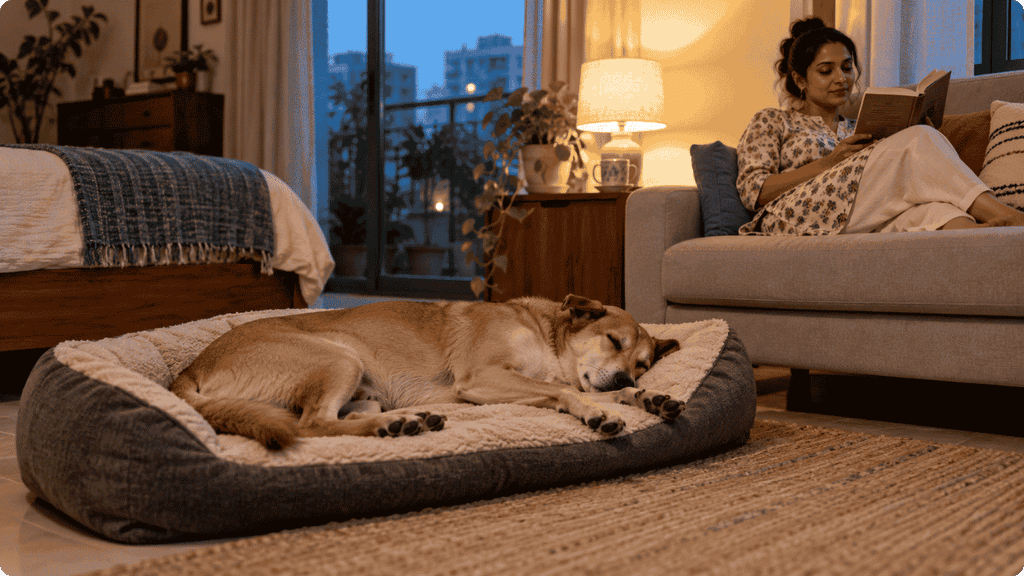
- Otherwise, leave it alone. “Let sleeping dogs lie” turns out to be sound neuroscience.
The honest conclusion
Dogs and cats have the brain architecture for dreaming, enter the state in which dreaming occurs many times a day, and — when the brake on their muscles is removed, surgically or by disease — act out organised, species-typical behaviour. Rat studies show sleeping mammalian brains replaying specific waking experiences in sequence.
That is a substantial body of evidence, and it justifies saying pets almost certainly experience something during REM sleep.
What nobody has done is record the content of a dog’s dream. When you read that science has “confirmed” your dog dreams about you, what has actually happened is that a respected researcher has reasoned from human dream patterns to a plausible conclusion — and openly described that reasoning as speculative.
It may well be true. The next time your dog’s tail wags gently in her sleep, there is a real chance something good is happening in there.
References
- Jouvet, M. (1959–1965). Research on paradoxical (REM) sleep and the role of the pons in muscle atonia, University of Lyon.
- Louie, K., & Wilson, M. A. (2001). “Temporally Structured Replay of Awake Hippocampal Ensemble Activity during Rapid Eye Movement Sleep.” Neuron, 29(1), 145–156.
- Coren, S. Observations on canine dreaming, including the relationship between breed size and dream frequency and duration, Psychology Today and Do Dogs Dream? Nearly Everything Your Dog Wants You to Know.
- Barrett, D. (2016). Comments to People magazine on animal dreaming.
- Bunford, N. et al. “Sleep in the dog: comparative, behavioral and translational relevance.” Current Opinion in Behavioral Sciences.
- “Noninvasive EEG measurement of sleep in the family cat and comparison with the dog.” Journal of Mammalogy (2024), 105(2), 300.
- “Sleep and cognition in aging dogs. A polysomnographic study.” Frontiers in Veterinary Science.
- “Development and validation of a sleep questionnaire, SNoRE 3.0, to evaluate sleep in companion dogs.” Scientific Reports (2023).
- “REM versus Non-REM sleep disturbance specifically affects inter-specific emotion processing in family dogs.” Scientific Reports.
Editorial note: This article is for general educational purposes. If your pet shows signs of a sleep disorder, persistent night-time distress, or a significant change in sleep behaviour, consult a qualified veterinarian.
Pets News Network is India’s first dedicated media platform for the pet and animal industry. For breaking global pet news, brand coverage, and advertising enquiries, contact: info@petsnewsnetwork.com