
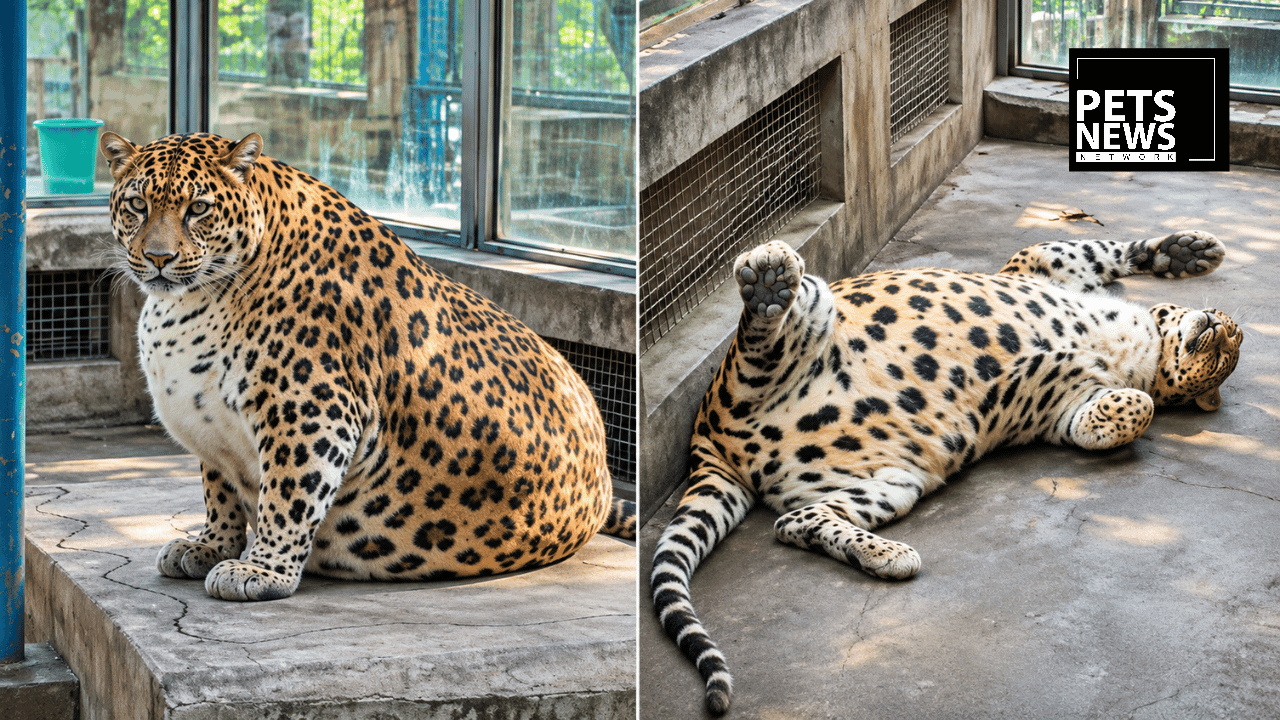

Pan Baobao, the leopard whose round outline made him famous across China in 2024, is no longer on a diet. The zoo in Panzhihua, in Sichuan province, has said it will stop trying to make him thinner. He is about 19, which is very old for a leopard, and the zoo now says that a steady weight and good spirits are the right aim for him. It sounds like a joke about quitting. However, it is closer to the opposite, and it reflects something every owner of an elderly pet eventually has to weigh up.
What the zoo has decided
| Detail | What is reported |
|---|---|
| The animal | Pan Baobao, a male leopard |
| Where | The zoo at Panzhihua, Sichuan province, south-western China |
| Age | About 19 |
| The decision | Weight loss is no longer the goal; keeping his weight stable and his health good is |
| What he eats | More than 500 grams of beef a day, with chicken added for balance |
| Exercise | Keepers have given him a large ball |
| Health | A recent veterinary check and blood tests were reported as good |
No figure for his weight has been published.
Zhang Songwen, of the zoo, explained the thinking:
“It’s not that we’re not controlling its diet, but it’s getting old and shouldn’t be losing weight.”
He added: “As long as its weight remains stable and it’s in good spirits, that’s the best condition for it.”

How he became famous
| When | What happened |
|---|---|
| March 2024 | Videos of the leopard spread online. Viewers compared him to Officer Clawhauser, the plump, cheerful character in the animated film Zootopia |
| Spring 2024 | The zoo put him on a diet, changed how he was fed, and roughly doubled his living space |
| June 2024 | After about two months the zoo reported that his weight had not changed, and that he was considered too old for the changes to work |
| November 2026 | The zoo says he should no longer be losing weight at all |
Accounts of the period in between differ: one says he looked slimmer by early 2025 before regaining the weight. His age was also reported as 16 in 2024, which does not quite add up to 19 now; “about 19” is the safest way to put it.
Not all of it is fat
One detail from Zhang deserves more attention than it has had. “Animals are actually like people,” he said. “As they get older, their skin becomes loose.”
That matters for how Pan Baobao looks. An old cat of any size tends to lose muscle along the spine and hindquarters while the skin of the belly slackens and hangs. From the front, sitting upright, that can produce the pear shape that made him famous. Some of what the internet read as obesity may simply be age.

Why an old animal should not be slimmed
For a young, overweight animal, losing weight is plainly good. For a very old one, the calculation changes, and for reasons that apply to pets as much as to leopards.
Old animals lose muscle, not only fat. Cut the food of an elderly animal and a good part of what comes off can be muscle it cannot easily rebuild. Less muscle means weaker legs, more falls and a faster decline.
Cats handle rapid weight loss badly. In domestic cats, a sudden drop in food intake can trigger a serious liver condition. Big cats are different animals, but the caution that vets apply to cats in general is a reasonable one.
Reserves matter in old age. An elderly animal that falls ill often stops eating. One with something in reserve may cope better than one already lean.
Stress has a cost. Hunger, a changed routine and a rearranged enclosure are all harder on an old animal than a young one.
Time is short. A leopard in the wild rarely lives much past its early teens. In captivity, the late teens and around twenty is a long life. The benefits of weight loss, such as less strain on joints over years to come, are benefits he may not live to collect, while the risks arrive immediately.
Put together, the zoo’s position is a sound one: hold the weight steady, keep him moving, watch his blood tests, and leave him in peace.
How zoo animals put on weight
Pan Baobao’s case is unusual in how visible it became, not in how it happened.
- Food arrives without effort. A wild leopard may go days between kills and spend a great deal of energy on each one. A zoo leopard is fed on schedule.
- Space is limited. Even a generous enclosure is a tiny fraction of a wild territory.
- There is little reason to move. No prey to stalk, no rivals to avoid, no ground to patrol.
- Enrichment costs staff time and money. Hidden food, varied feeding times, climbing structures and objects to wrestle with are harder for smaller zoos to provide.
The zoo’s earlier response, doubling his space and changing how he was fed, was a standard approach. So is the ball. Whether he uses it has not been confirmed.

What this means for an old dog or cat
Owners of elderly pets face a small version of the same decision. A few principles carry across.
Start with the vet, not the scales. A weight problem in an old animal should prompt a check-up first. Pain, thyroid disease, heart disease and arthritis all change weight and activity. What old age looks like in a dog is covered in our report on senior dogs.
Ask about muscle as well as fat. Vets score both. An old pet can be overweight and under-muscled at once, and the plan for that animal is different from the plan for a plump four-year-old.
If weight loss is advised, go slowly. A gentle, steady reduction under veterinary guidance is the rule. Fast is not better.
Never crash-diet a cat. A cat that stops eating, or is cut back sharply, can become seriously ill within days. Any cat that refuses food for more than a day or so should see a vet.
Keep the protein up. Old animals generally need good-quality protein to hold on to muscle. Simply feeding less of the same food cuts protein along with calories, a point explored in our guide to why feeding less is not always the answer.
Favour movement that is kind to joints. Short, frequent walks, swimming for dogs that enjoy it, and play that does not involve jumping.
Accept “stable” as a good result. For a very old pet that is eating, moving and content, holding steady may be exactly the right target.
Do not use any of this as a reason to ignore obesity in a young animal. Extra weight in early and middle life can shorten lives and cause years of joint pain. The time to act is long before nineteen.
Where this stands
- Pan Baobao is about 19 and is no longer on a weight-loss plan.
- The zoo’s aim is stable weight and good health, with daily beef and chicken and a ball for exercise.
- A recent health check was reported as good.
- No weight figure has been made public.
He became famous for his shape. The zoo has decided, with reason, that at his age the shape is not the thing to fix.
Pets News Network is India’s first dedicated media platform for the pet and animal industry. For breaking global pet news, brand coverage, and advertising enquiries, contact: info@petsnewsnetwork.com