


The Shimla Municipal Corporation has warned of strict action and heavy fines against anyone feeding community dogs outside designated zones. It has also asked residents to photograph offenders. The question nobody has answered is how many of those zones actually exist.
What the Mayor announced
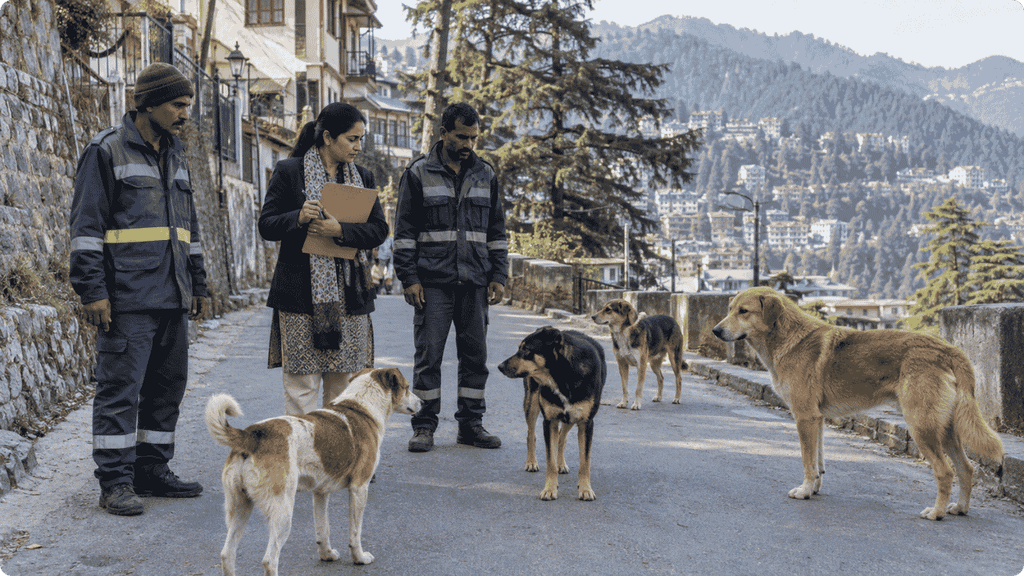
Shimla Mayor Surender Chauhan has said that feeding community dogs anywhere other than the feeding zones established by the corporation will be dealt with strictly, and that hefty fines will be imposed on those who do it.
He went further, encouraging residents to immediately share videos and photographs of anyone found feeding dogs in public places.
The warning came alongside a wider set of measures. The Mayor directed Municipal Commissioner Sachin Kanwal and Additional Commissioner Bhuwan Sharma to identify land within a week for a dedicated dog shelter, preferably at Tutikandi or Bharyal, to house aggressive and ferocious dogs. The corporation also announced a citywide mass sterilisation and vaccination drive beginning 3 October.
Separately, the SMC has decided to approach the Himachal Pradesh High Court for permission to permanently house ferocious dogs in designated dog huts, rather than releasing them back where they were caught.
“We understand the sentiments of dog lovers who feed stray dogs, but they should also understand that human life is important,” the Mayor said.
What triggered it
The immediate context is an attack on a 20-month-old girl in the Shankli area of the city.
The Shimla Nagrik Sabha, a citizens’ forum, protested in the aftermath, demanding the corporation bear the child’s full medical expenses along with ₹2 lakh in compensation to the family. It also asked the MC to constitute a joint high-level committee with the Forest Department, the Animal Husbandry Department and the district administration, and to hold special ABC and rabies vaccination camps.
Notably, the residents’ own list of demands included setting up designated feeding points for dogs. The citizens’ forum and the corporation agree on that much.
Earlier figures give a sense of the scale. Shimla has an estimated 4,500 street dogs across its 34 wards, of which around 2,000 had been vaccinated as of the previous count. Deen Dayal Upadhyay Zonal Hospital recorded 817 dog bite cases in a single six-month period. Residents report packs at The Mall, The Ridge and Sanjauli, areas heavy with both locals and tourists.
These are real problems, and the pressure on the corporation to act is genuine.

The part that doesn’t add up
Here is the difficulty with reporting this as news.
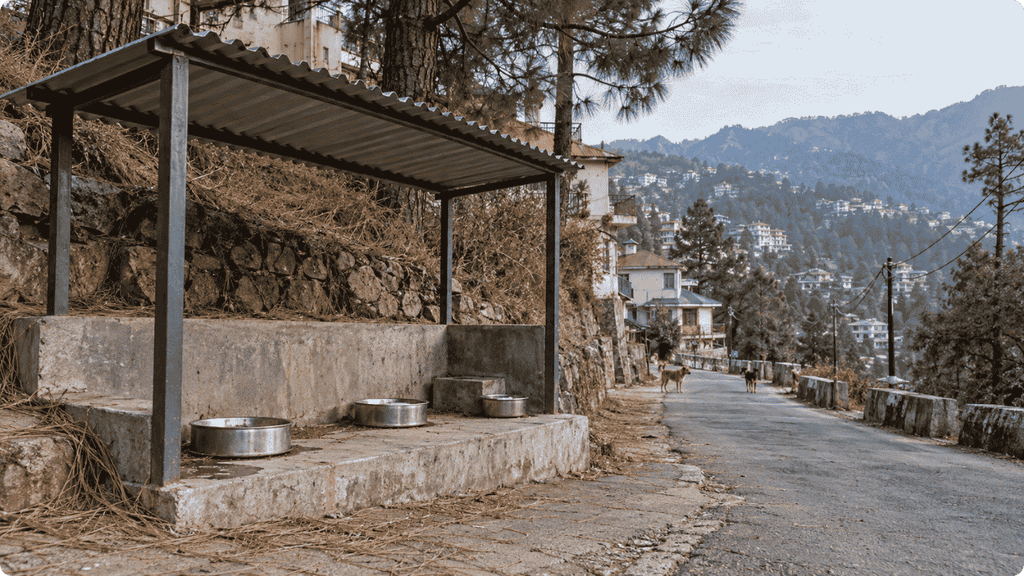
Shimla announced designated feeding zones more than a year ago.
In a statement carried by The Tribune in 2025, the same Mayor said: “Designated feeding areas are being marked across Shimla, and residents will be allowed to feed stray dogs only at these spots. Stringent action will be taken against violators.”
That was the announcement then. The announcement now is substantially the same: feed only at designated zones, or face action.
Which raises a question that no coverage has answered. How many feeding zones have actually been notified across Shimla’s 34 wards, and how many are functional and usable?
This is not a pedantic point. A feeding restriction only works if the alternative exists. If a resident in a ward with no notified feeding point is told she may no longer feed the dogs she has fed for years, the instruction is not a relocation of feeding. It is a prohibition on it.
India has seen exactly this before
The pattern is familiar from the capital.
Following the Supreme Court’s directions of 22 August 2025, which prohibited feeding stray dogs in streets and public places while requiring municipal authorities to create dedicated feeding spaces in every ward, Delhi’s civic body identified 292 feeding spots.
A ground inspection found only 14 of those 292 were functional. Some placements drew criticism — one near a metro station described by locals as a messy corner strewn with garbage and stones, another positioned at the centre of a roundabout. The distribution was lopsided, with one zone holding 60 points and another just four.
The lesson is not that feeding zones are a bad idea. They are the humane and workable answer, and they are what the Supreme Court actually ordered. The lesson is that announcing them is the easy part.
The legal tangle over aggressive dogs
The second element of Shimla’s plan raises a separate issue.
The corporation wants High Court permission to permanently house aggressive dogs in dog huts. As The Tribune noted in its reporting, under the Animal Birth Control (ABC) Rules, stray dogs cannot ordinarily be permanently relocated.
That is precisely why permission is being sought. But it also means Shimla is asking a High Court to allow something the national framework restricts.
The Supreme Court’s August 2025 order is relevant here. A three-judge bench stayed an earlier direction that would have required stray dogs to be removed to shelters permanently, holding it too harsh and inconsistent with the ABC Rules. It directed instead that dogs be sterilised, dewormed and vaccinated, then released back into the same locality — with an exception for dogs infected with rabies, suspected of infection, or displaying aggressive behaviour, which may be kept separately.
So there is a lawful route for genuinely aggressive dogs. The question is how “aggressive” gets defined and who assesses it, because that determination decides whether an animal returns to its street or spends the rest of its life in a municipal shelter.
Shimla has floated a colour-coded collar system to address this — red collars marking dogs with a history of aggression or biting, green or blue for non-aggressive animals. If applied with proper assessment and record-keeping, that is a sensible idea. If applied loosely, it becomes a label that is difficult for any dog to shed.
The surveillance element
One detail in the Mayor’s statement deserves attention on its own: the appeal for citizens to photograph and report anyone feeding dogs in public.
Feeding community dogs is not illegal in India. What the Supreme Court restricted is where it may be done. Asking residents to document and report neighbours engaged in an activity that is lawful in the right location, in a city where the right locations may not yet exist in every ward, is likely to produce friction between neighbours rather than better outcomes for dogs or people.
Feeders and welfare organisations are likely to have a strong view on this, and the corporation would be on firmer ground making its case alongside a published, ward-wise list of where feeding is permitted.
What would actually settle this
Three questions, each answerable with a single response from the Shimla Municipal Corporation:
- How many feeding zones are notified, ward by ward, across all 34 wards?
- How many are currently functional — marked, accessible, and in use?
- What is the fine amount, and under what provision is it being levied?
Until those are on the record, the enforcement warning is the only concrete part of the policy, and the humane alternative remains an announcement.
Shimla’s underlying problem is real. Eight hundred and seventeen bite cases in six months is not a statistic anyone can wave away, and a 20-month-old child was hurt. But the sequence matters. Build the feeding zones, publish where they are, then enforce.
Doing it the other way round does not reduce conflict between people and dogs. It simply moves the conflict between people.
Sources: Statements by Shimla Mayor Surender Chauhan and Shimla Municipal Corporation plans as reported by The Tribune and Hindustan Times, September–October 2026. Supreme Court directions of 22 August 2025 in In Re: ‘City Hounded By Strays, Kids Pay Price’. Delhi feeding point data from The Tribune.
Pets News Network is India’s first dedicated media platform for the pet and animal industry. For breaking global pet news, brand coverage, and advertising enquiries, contact: info@petsnewsnetwork.com