

A New Round-the-Clock Lifeline for Goa’s Injured Wildlife
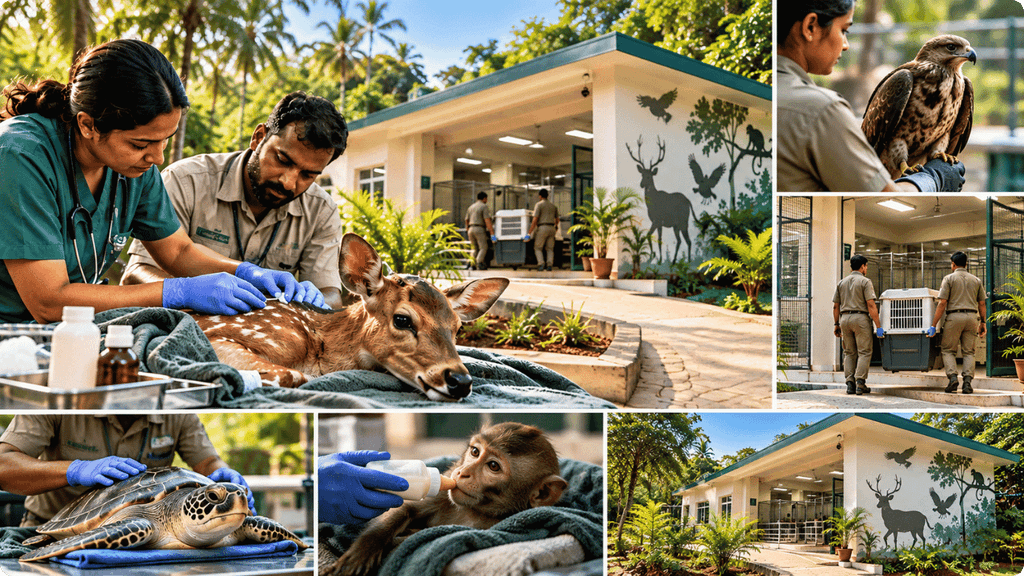
Goa has launched its first round-the-clock, 24×7 temporary transit treatment facility dedicated to injured wild animals, located in Ponda. The facility is staffed full-time by a dedicated team comprising forest personnel, veterinarians, and wildlife rescuers, who are stationed to handle incoming emergency cases as they arrive, at any hour of the day or night.
The facility’s primary role is to provide immediate medical stabilization, on-site treatment, and health clearances for rescued wild animals before they are either released back into the wild or, if their condition warrants further care, moved on to more specialised treatment.
The Problem This Facility Is Meant to Fix
Until now, Goa’s system for handling injured wildlife carried a significant structural limitation: rescued wild animals, regardless of how severe or minor their injuries were, had to be transported directly to the Bondla Wildlife Sanctuary for any veterinary attention. For an animal with a serious injury rescued far from Bondla, that meant enduring a potentially long transport time before receiving even initial medical care, precious time during which a treatable injury could worsen, or a stabilising intervention that should have happened immediately was instead delayed by the logistics of distance.
The new Ponda facility is designed specifically to close that gap. By providing a treatment point that doesn’t require animals to first reach Bondla, the facility eliminates the long transport times that previously stood between an injured animal and its first medical attention in many cases. It also allows for immediate triage, with health parameters checked on-site so that forest and veterinary staff can quickly decide whether an animal can be safely released after treatment or needs to be admitted for more extended care.
For animals in genuine medical distress, that shift from “transport first, treat later” to “treat immediately, then decide” is not a minor procedural change. It represents a fundamentally different, and considerably more animal-welfare-conscious, approach to how the state handles wildlife emergencies.
An Interim Step Toward a Permanent Wildlife Hospital
Importantly, the Ponda facility is not intended to be Goa’s final answer to this infrastructure gap. It is explicitly positioned as an interim unit, while the state forest department works toward establishing a permanent, full-fledged wildlife hospital complex at Bethora.
The planned Bethora facility, as outlined by the forest department, is intended to be considerably more comprehensive than the current transit unit in Ponda. Its planned features include:
- An advanced veterinary hospital with full surgical capabilities, including a dedicated Operation Theatre (OT)
- Diagnostic laboratories capable of testing for both viral and bacterial infections, enabling far more precise treatment decisions than field-level assessment alone can offer
- Animal observation and quarantine cages, essential for managing infectious disease risk among rescued wildlife and preventing cross-contamination between species
- Dedicated emergency stabilisation units, extending the kind of immediate-response care the Ponda facility currently offers, but within a permanent, better-equipped setting
Taken together, this points to a phased infrastructure strategy: Ponda addresses the most urgent gap, the total absence of any treatment option outside Bondla, immediately and at relatively low cost, while Bethora is being built out as the long-term, comprehensive solution.
Bringing Emergency Care to the Animal, Not Just the Animal to Care
Alongside the new transit facility, Goa’s forest department is also rolling out an advanced wildlife rescue ambulance, developed in collaboration with RESQ Charitable Trust, a Maharashtra-based NGO that already operates corporate-funded veterinary hospitals in Pune and Nashik. RESQ’s involvement brings established operational experience in wildlife emergency response to Goa’s evolving system, rather than requiring the state to build this specific expertise from scratch.
The ambulance is designed to function as a genuine mobile intensive care unit, equipped with specialised paramedics and veterinary gear capable of treating animals, including large-bodied wildlife that are particularly difficult and risky to transport, directly at the rescue site.
This detail matters more than it might initially seem. For a large or severely injured wild animal, the process of capture and transport is itself a source of significant physical stress and trauma, sometimes worsening the animal’s condition before it ever reaches a treatment facility. By enabling paramedics to begin treatment at the rescue location itself, rather than defaulting to immediate transport, the mobile unit is intended to reduce that additional trauma, stabilising animals in place before deciding whether, and how, they need to be moved further.
Why This Combination of Fixed and Mobile Care Matters
What makes Goa’s evolving wildlife emergency response system notable is the way these two pieces, the Ponda transit facility and the RESQ-developed mobile ambulance, are designed to work together rather than in isolation. A fixed facility alone still requires animals to be brought to it, and a mobile unit alone lacks the infrastructure for more involved treatment or extended observation.
Together, they form a more complete emergency response chain: the mobile ambulance can reach and stabilise animals, particularly large or severely injured ones, at the point of rescue, while the Ponda facility, and eventually the more comprehensive Bethora hospital, provides the fixed infrastructure needed for sustained treatment, diagnostics, and recovery monitoring.
What This Means for Goa’s Wildlife
Goa’s forests, coastal areas, and protected sanctuaries are home to a wide range of wildlife, and incidents involving injured animals, whether from vehicle strikes, human-wildlife conflict, natural predation encounters, or illness, are a routine part of the state’s conservation and forest management work. A system that previously funnelled every case, regardless of severity, through a single facility at Bondla was always going to strain under that volume, particularly for animals located far from the sanctuary.
The introduction of a dedicated, round-the-clock transit facility, backed by a mobile emergency response unit, represents a meaningful upgrade to that system’s capacity and responsiveness. For wildlife rescuers and forest personnel on the ground, it also means a genuine reduction in the operational pressure of racing against time and distance for every single case that comes in, a pressure that, in wildlife rescue work, often translates directly into whether an animal survives or doesn’t.
What to Watch Next
As the Ponda facility becomes fully operational and the Bethora hospital complex moves through its planning and construction phases, several questions will likely shape how effective this new system proves to be in practice: how quickly Bethora’s more advanced facilities, including its surgical and diagnostic capabilities, actually come online; how the RESQ-developed ambulance service scales to cover Goa’s geography, particularly more remote forest areas; and whether this model, combining an interim transit facility with a mobile rescue unit ahead of a permanent hospital, becomes a template other states with similar wildlife rescue infrastructure gaps choose to follow.
For now, Goa’s wildlife has, for the first time, a dedicated point of round-the-clock emergency medical care that doesn’t depend on how far an injured animal is from Bondla, a change that forest officials and wildlife rescuers alike are likely to regard as long overdue.
Pets News Network is India’s first dedicated media platform for the pet and animal industry. For breaking global pet news, brand coverage, and advertising enquiries, contact: info@petsnewsnetwork.com