
A dog rescued from the streets as a puppy has become the face of a nation’s earthquake response. Behind the statue is a question worth asking in India too: how many dogs are actually trained to do this work?
The unveiling
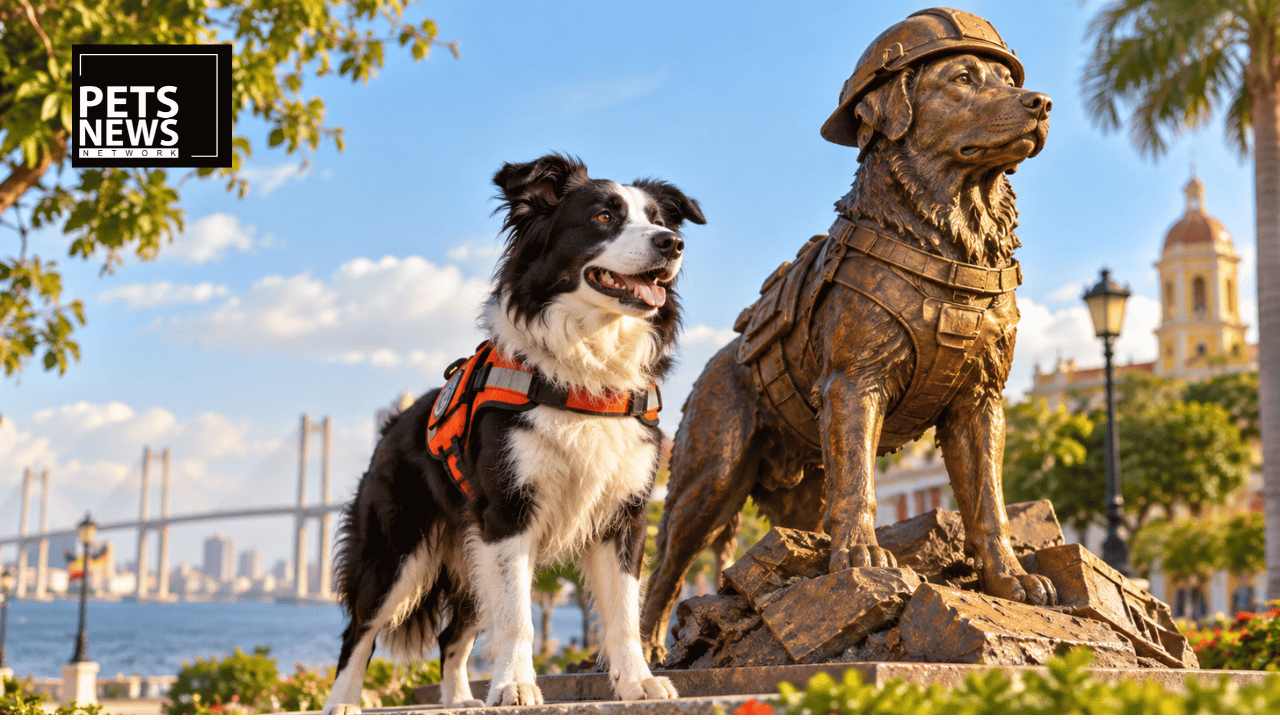
On a September morning in the lakefront Vereda del Lago park in Maracaibo, Venezuela, a crowd gathered around a bronze statue of a dog. Standing beside it, apparently unbothered by the fuss, was the dog himself.
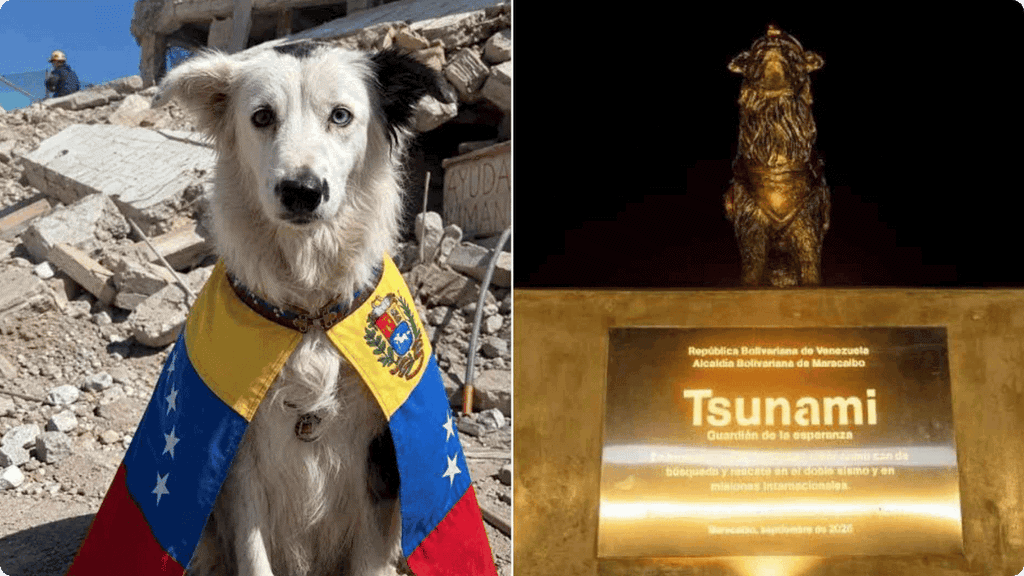
Tsunami, a border collie with one blue eye and one brown, had arrived with his handler, Jorge Beens, for the unveiling of a monument in his honour. The sculpture, created by Venezuelan artist Benjamín Figueroa, carries a plaque naming him Guardián de la esperanza — Guardian of Hope.
Maracaibo’s mayor, Giancarlo Di Martino, presented Tsunami with the city’s Honor of Merit award. The city’s fire department added its own Medal of Valor. Reports from the ceremony note that the tribute also marks the end of Tsunami’s working career; his unit has confirmed his retirement.
It is an unusual honour for a dog. It is a considerably more unusual honour for a dog who began life as a stray.
What Tsunami did
On 24 June 2026, two powerful earthquakes struck northern Venezuela, 39 seconds apart. The United States Geological Survey measured them at magnitude 7.2 and 7.5. The second was the strongest earthquake to hit the country in more than a century.
The scale of the disaster was enormous. Official and humanitarian figures have varied widely as the recovery progressed, but aid organisations and international tallies have placed the death toll above 6,500, with tens of thousands injured and well over a million people needing humanitarian assistance. Buildings across Yaracuy, Carabobo, Aragua, Miranda, La Guaira and Caracas collapsed, and more than a thousand aftershocks followed in the fortnight that followed.
Into that rubble went Tsunami and Jorge Beens, who founded a canine disaster-response training organisation in Venezuela. Reports credit Tsunami with helping locate at least 26 survivors buried beneath collapsed buildings. Footage of him picking his way across broken concrete slabs circulated widely during the response, and he became something close to a national symbol of hope in a country going through one of the worst weeks in its modern history.
It was not his first disaster. His service record reportedly stretches back years, including the Las Tejerías and El Castaño mudslides in Venezuela in 2022, and the catastrophic earthquakes in Turkey and Syria in 2023.
“His service saved lives during the darkest times, both in Venezuela and on international missions in Turkey and Syria,” Mayor Di Martino said at the ceremony.
Before he rescued anyone, someone rescued him
The detail that has resonated most widely is how Tsunami’s life began.
He was not bred for the work. As a puppy, he was himself a rescue, taken in after being found in poor conditions. He eventually came to Beens, who recognised his drive and began training him for urban search and rescue.
That trajectory, from discarded street puppy to decorated working dog, is the part of this story that travels furthest. It is also the part most likely to be misread. Tsunami is not proof that any stray can become a rescue dog. He is proof that the raw ability is not confined to purpose-bred animals, and that what turns ability into capability is years of structured training, a skilled handler and an organisation willing to fund it.
What a search-and-rescue dog actually does
The popular image of a rescue dog is a dog digging. The reality is closer to a dog reading the air.
Live-find search dogs are trained to detect human scent escaping through gaps in collapsed concrete, then to signal the location to handlers, usually by barking and holding position. They work off-lead across unstable surfaces, in noise, dust and heat, often with aftershocks continuing around them. A single dog can cover ground in minutes that a human team would need hours to search, and in the early hours after a collapse, when the chance of finding survivors is highest, that speed decides outcomes.
The cost is real. Working dogs in disaster zones suffer cut and burned paw pads, exhaustion, dehydration and respiratory strain from dust. Handlers build in rest cycles and veterinary checks, and the working life of a search dog is finite, which is why retirement announcements like Tsunami’s usually follow a few years of high-intensity deployment.
A second category of dog, trained to locate human remains rather than survivors, works alongside them. That is grim but necessary work, allowing families to recover their dead.
The question this raises for India
It is easy to read a story like this as a feel-good item from far away. It is more useful to ask what the equivalent capacity looks like here.
India sits across seismically active zones, with much of the Himalayan belt and the northeast in the highest-risk categories, and its cities carry the same dense, rapidly built concrete stock that turns an earthquake into a rubble event. The country does have a trained canine capability. The National Disaster Response Force began raising a dedicated urban search and rescue dog squad about a decade ago, training a batch of 162 dogs specifically for finding life under debris, which it described at the time as the first indigenous programme of that scale in India.
That capability has been used abroad as well as at home. When earthquakes devastated Turkey in February 2023, India sent NDRF teams with specially trained dogs, among them Labradors named Julie, Romio, Honey and Rambo. NDRF dogs have also been deployed for flood and landslide operations across Indian states, and were sent to Sri Lanka with rescue teams after Cyclone Ditwah. The force has more recently begun training its first cadaver dogs, largely Belgian Malinois and Labradors, at its bases in Arakkonam and Ghaziabad.
What India has far less of is capacity outside the central force. Most state disaster response units and municipal fire services operate without trained search dogs of their own, and privately trained civilian K9 teams of the sort Jorge Beens runs in Venezuela are rare here. In a large-scale urban collapse, the dogs would have to come from elsewhere, and travel time is exactly what a live-find dog does not have.
The other gap is what happens after. A working dog’s retirement, veterinary care and rehoming is a serious commitment, and it is not consistently provided for across Indian services.
Why a statue matters
Cynics will say a bronze dog changes nothing about Venezuela’s earthquake recovery, and they are right. Maracaibo’s statue will not rebuild a home or return anyone to their family.
What it does is make something visible. Working dogs occupy an odd position in disaster response: indispensable during the operation, invisible in the accounting afterwards. Naming one, recording what he did, and putting him in a public park is a way of insisting that the contribution was real and that the animal doing it was not equipment.
There is a precedent for this. Japan has Hachikō. Britain has the Dickin Medal, awarded to animals for conspicuous gallantry. Across Latin America, monuments to rescue dogs have become symbols of civic solidarity after disasters.
Tsunami now joins them, which is a reasonable outcome for a puppy nobody wanted.
Sources
- Al Jazeera, “Venezuela quakes rescue dog ‘Tsunami’ honoured with statue,” 20 September 2026.
- CBS Newspath / Storyful, coverage of the Maracaibo unveiling ceremony, September 2026.
- My Modern Met, “Tsunami the Heroic Dog Is Honored With a Statue,” September 2026.
- United States Geological Survey, 24 June 2026 Venezuela earthquake data.
- UN News and humanitarian agency reporting on the 2026 Venezuela earthquakes.
- PTI reporting on the National Disaster Response Force urban search and rescue dog programme.
- PTI, “NDRF to commission cadaver dogs to assist in disaster operations.”
Pets News Network is India’s first dedicated media platform for the pet and animal industry. For breaking global pet news, brand coverage, and advertising enquiries, contact: info@petsnewsnetwork.com