


More than four decades after it was first described, veterinary medicine still cannot say what causes feline dysautonomia, still has no cure, and still cannot confirm it with a single test in a living cat. Here is what cat owners should know about the symptom pattern that matters most.
A disease that arrived suddenly and has never been fully explained
In 1982, veterinarians Key and Gaskell described a strange new illness in cats in the United Kingdom. The affected animals were losing control of functions that should be entirely automatic: digestion, tear production, bladder emptying, the constriction of the pupil in bright light. The condition was named feline dysautonomia, and it has been known ever since as Key-Gaskell syndrome.
What followed was, in veterinary terms, close to an epidemic. Cases spread widely across the UK through the 1980s. Then the numbers fell away almost as mysteriously as they had risen. Today, according to the MSD Veterinary Manual, the incidence has declined considerably, though cases continue to be reported in Europe, New Zealand, the United Arab Emirates and the United States.
More than forty years on, three things remain true. Nobody knows what causes it. There is no cure. And there is no single blood test that confirms it in a living cat.
That combination — genuine rarity, no known cause, and a set of early symptoms that can each look like something minor — is what makes this condition worth recognising, even for owners who will almost certainly never encounter it.
What the autonomic nervous system actually does
To understand why this disease is so serious, it helps to know what it attacks.
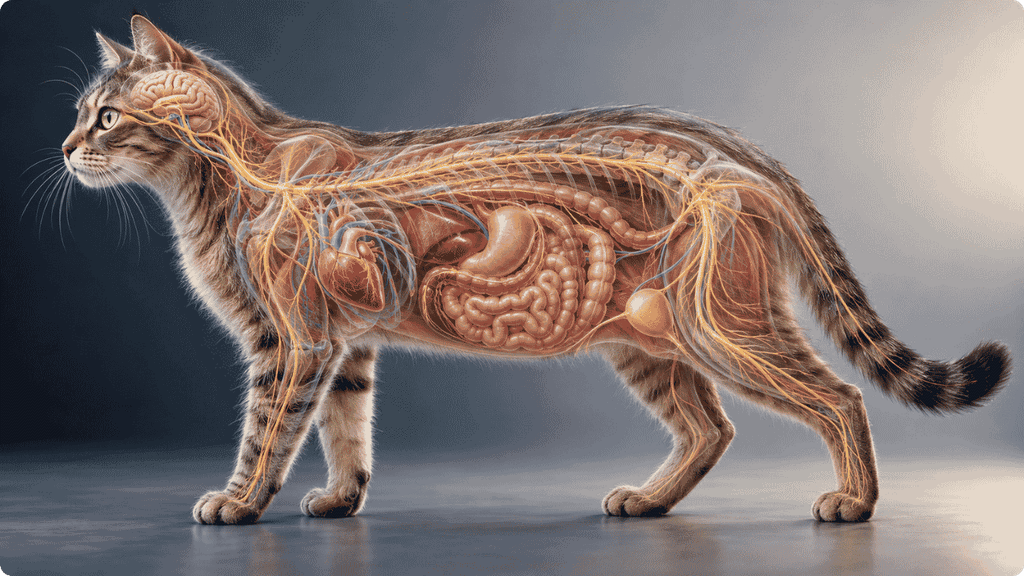
The autonomic nervous system (ANS) runs quietly in the background of every cat’s body. It manages the things that should never require conscious thought: heart rate, digestion, the movement of food through the intestines, tear and saliva production, bladder emptying, and the widening and narrowing of the pupils.
In feline dysautonomia, the neurons controlling these functions degenerate. Because the ANS reaches nearly every organ system, the damage does not stay in one place. Signs appear at the same time in the eyes, the gut, the bladder and sometimes the heart.
For an owner, that is exactly what makes the condition so disorienting. A cat does not look like it has one illness. It looks like it has four unrelated small problems at once.
The warning signs, and why the pattern matters more than any one symptom
The single most useful thing an owner can carry from this article is not a list of symptoms but the idea of a cluster. Constipation alone is common. Occasional vomiting alone is common. Several of these appearing together, across different body systems, is not.
Digestive signs are among the most frequent. Affected cats commonly show loss of appetite, vomiting or regurgitation, and constipation. Many develop megaesophagus, an abnormal enlargement of the food pipe that makes swallowing difficult, along with a dilated, sluggish intestine.
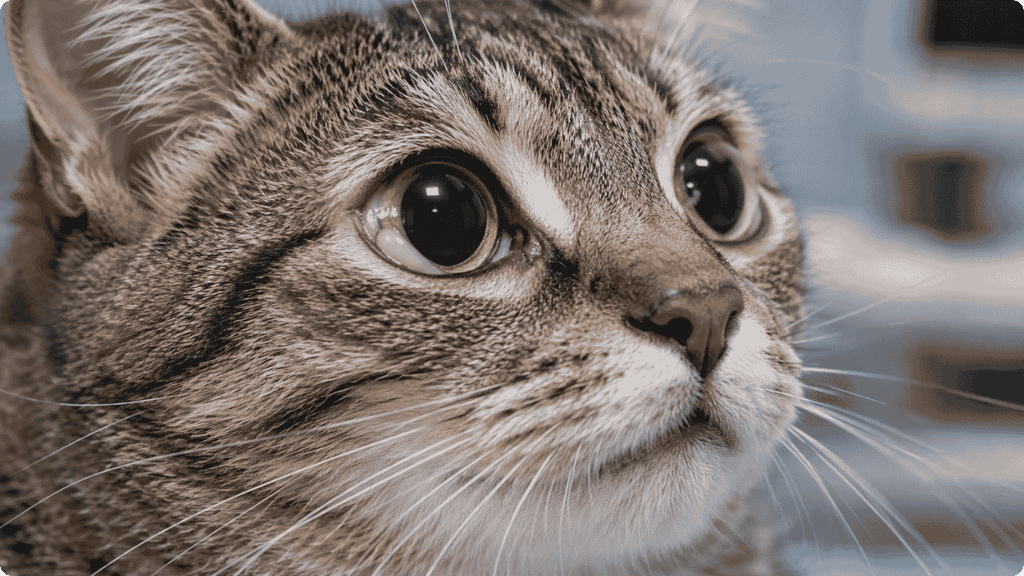
Eye signs are the most characteristic of all. Cats typically show reduced tear production, widely dilated pupils, and a pupillary light reflex that is delayed or absent altogether. The third eyelid often protrudes across the eye. Because the pupils cannot constrict properly, some cats become noticeably sensitive to light.
Urinary and other signs include difficulty urinating or incontinence, nasal discharge or crusting around the nose, weight loss, weakness and lethargy.
Less common signs include breathing problems, an abnormally slow heart rate, altered anal tone and diarrhoea. It is worth noting that a slow heart rate is a less frequent finding rather than a defining one, despite how often it is listed.
Cats of any age can be affected, but the disease is more common in younger animals, with a median age of around 3.9 years.
The cause: an honest “we don’t know”
Decades of investigation have produced theories but no confirmed answer.
The most persistent hypothesis involves toxin exposure. A 2004 study published in the Veterinary Record found an association between Key-Gaskell syndrome and infection by Clostridium botulinum type C/D, the bacterium behind botulism, which produces a neurotoxin capable of damaging nerve tissue. It remains an association rather than proof of cause.
Other proposed factors include genetic susceptibility, environmental exposures and infectious triggers. None has been established as the single explanation.
The geography is its own puzzle. The disease appeared and peaked in the UK, then declined there, while cases have since surfaced across Europe, in New Zealand, the UAE and the US. Why it clustered where it did, and why it faded, has never been satisfactorily explained.
One point deserves emphasis for worried multi-cat households: cases have occurred in cats sharing a home, including a 2023 report of two littermate kittens, but this is understood to reflect shared environmental exposure rather than a disease passing from cat to cat. Feline dysautonomia is not considered contagious.
How veterinarians reach a diagnosis
There is no single confirmatory blood test, so a diagnosis is assembled from several pieces.
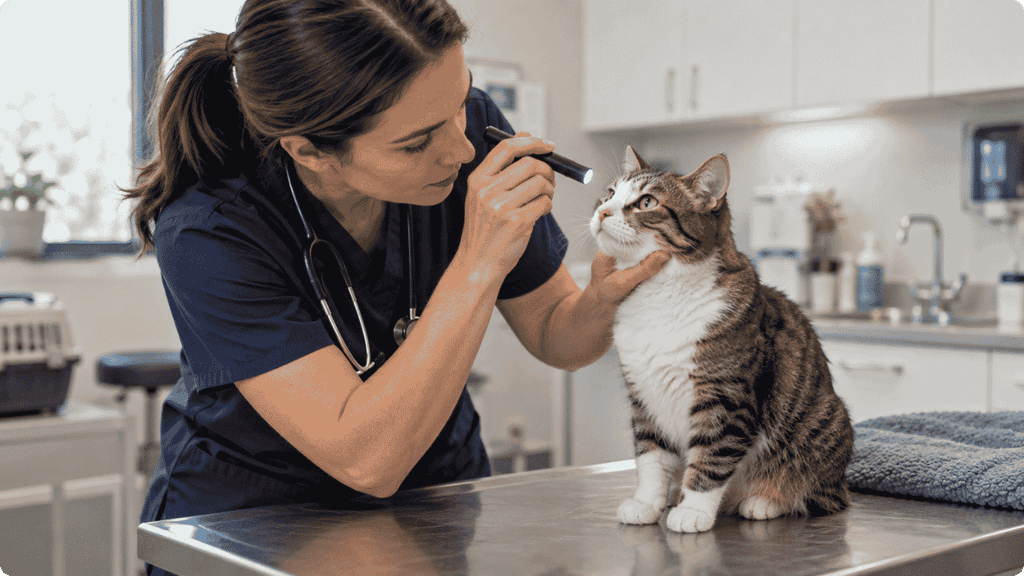
Physical examination looks for the multi-system pattern, particularly the ocular signs.
X-rays may reveal megaesophagus, a dilated stomach, widespread intestinal stasis, a distended urinary bladder, and in some cases aspiration pneumonia.
A Schirmer tear test measures tear production, with readings below 5 mm per minute suggesting the reduced lacrimation typical of the condition.
A pilocarpine test is one of the more distinctive tools. Dilute pilocarpine eye drops (0.05% to 0.1%) produce no meaningful reaction in a healthy cat, but in roughly 80% of affected cats the pupil constricts and the third eyelid retracts within about 45 minutes. The response reflects nerve hypersensitivity caused by the underlying autonomic damage.
Ruling out other causes matters too. Feline leukaemia virus can produce overlapping signs such as unequal pupils and urinary incontinence, so vets generally test for it. Cats with dysautonomia usually test negative and show additional signs that FeLV does not explain.
A truly definitive diagnosis requires histological examination of autonomic nerve tissue, which in practice usually means after death. That is one reason the condition is probably underdiagnosed in general practice.
Treatment and prognosis: the honest picture
Because the cause is unknown, there is no cure. Treatment is supportive nursing care, and in mild cases that care can be enough to see a cat through.
The priority is rehydration and then maintaining fluid balance. Nutrition is often delivered initially by intravenous feeding, later by a feeding tube once regurgitation settles. Keeping a cat upright after eating is important, because the main complication of this condition is aspiration pneumonia.
Day-to-day nursing carries real weight: expressing the bladder several times a day, artificial tears for dry eyes, warmth, steam inhalation, and help with grooming. Medicines that stimulate gut movement may be used, and antibiotics are given if secondary infection develops.
On prognosis, the data is sobering but not uniformly bleak. A 2020 retrospective study of cases published in the Veterinary Record found an 80% mortality rate. For severely affected cats the outlook is poor.
But a small proportion of cats do recover, and others learn to live with lasting deficits such as megaesophagus. Those improvements are slow, often taking up to a year. Cats with milder signs at the point of diagnosis have the better chance.
What this means for cat owners
Most cat owners will never see a case of feline dysautonomia. That is genuinely good news, and nothing here is a reason to read alarm into a single bout of constipation.
What is worth carrying is the pattern. If a cat shows several of these signs at the same time — particularly widely dilated pupils that respond poorly to light, alongside vomiting or constipation and difficulty urinating — that combination warrants prompt veterinary attention rather than a wait-and-see approach.
Rare diseases are missed not because they are undetectable but because nobody thinks to look. For a condition where early supportive care is the main thing standing between a cat and its worst outcome, an owner who notices the cluster and acts on it is offering something no test can.
Editorial note: This article is intended for awareness, not self-diagnosis. The symptoms described here occur far more often with common illnesses than with this rare condition. If your cat shows persistent, unusual, painful or rapidly worsening symptoms, consult a qualified veterinarian.
Sources
- MSD Veterinary Manual, Feline Dysautonomia, reviewed by Caroline N. Hahn, DVM, PhD (Royal (Dick) School of Veterinary Studies, University of Edinburgh). msdvetmanual.com
- Nunn F, Poxton IR, Cave TA, Knottenbelt C. “Association between Key-Gaskell syndrome and infection by Clostridium botulinum type C/D.” Veterinary Record, 2004;155(4):111-115.
- Clarke KE, Sorrell S, Breheny C, et al. “Dysautonomia in 53 cats and dogs: retrospective review of clinical data and outcome.” Veterinary Record, 2020;187(12):e118.
- Černá P, Botts MM, Watson A, Carr SV. “Dysautonomia in two littermate kittens.” JFMS Open Reports, 2023;9(1).
Pets News Network is India’s first dedicated media platform for the pet and animal industry. For breaking global pet news, brand coverage, and advertising enquiries, contact: info@petsnewsnetwork.com