
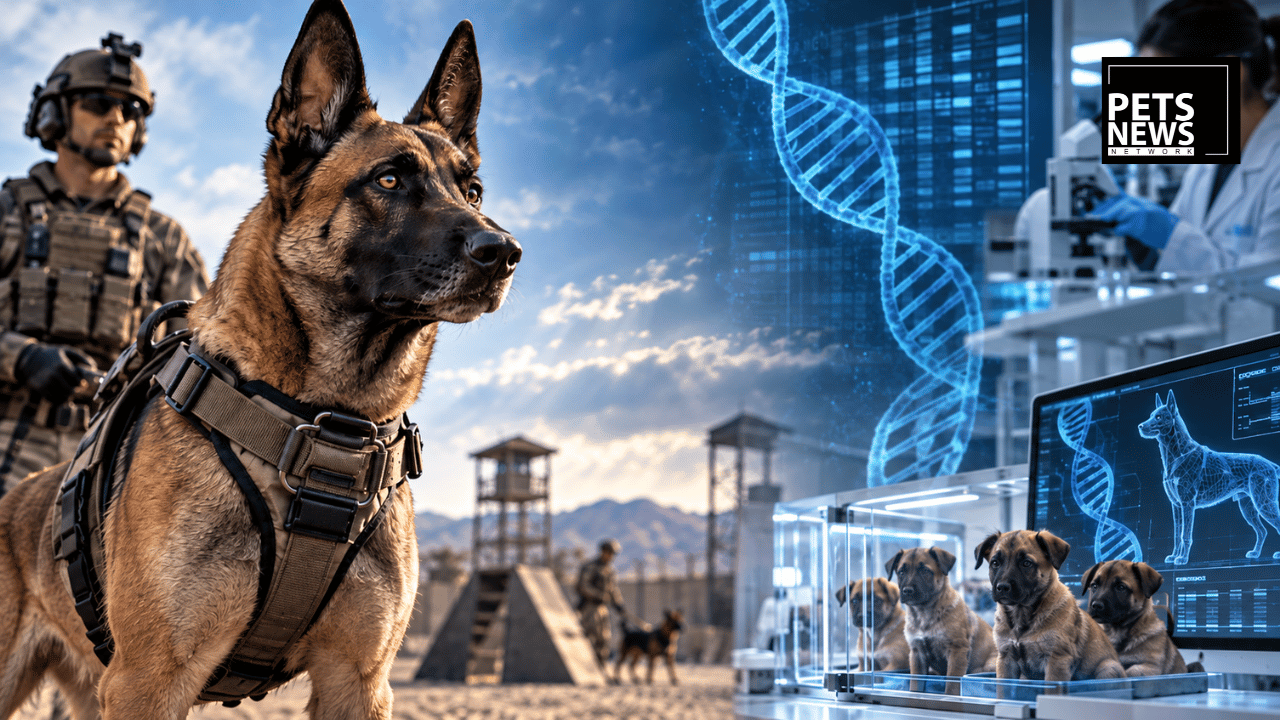

A new defence startup has raised $200 million to clone and gene-edit dogs for the United States military. The science is real, the money is real, and the problem it describes is real. What has gone unexamined in almost every report is the simplest question an animal publication would ask first: how many dogs does it take to make one cloned dog, and who are they?
What was announced
Warhound, a Texas-based defence startup, emerged from stealth on 22 October with a $200 million seed round at a reported $1.2 billion valuation.
Its chief executive is David Spirk, a Marine veteran and the Pentagon’s former chief data officer. Ben Lamm, chief executive of Colossal Biosciences, sits on the board. Palmer Luckey, founder of the defence firm Anduril, is credited with developing the concept but is reported to hold no equity.
The concept reportedly emerged in conversation between Luckey and Lamm at an entrepreneurs’ summit. Lamm has described it as something like a “Captain America dog program.”
Backers include Sequoia Capital, In-Q-Tel, ARK Invest, Franklin Templeton, 8VC, Lux Capital and Breyer Capital, among others.
The plan, in stages: identify top-performing dogs that have completed training, biobank their genetic material, clone them, and in parallel pursue targeted gene edits. The first group has been banked, and cloning of the first batch is about to begin. Births are expected in early 2027, with dogs in service within roughly two years.
The problem it says it is solving
These figures come from the company, and no independent verification of them has been published:
| US military working dogs sourced from Europe | Over 80% |
| Pentagon Military Working Dog Program | 2,200+ dog teams |
| Dogs that qualify after training | Fewer than half |
| Dogs purchased to field 100 operational animals | About 200 |
| Training and evaluation pipeline | About three years |
The company also says the US competes with other governments, including China and Russia, for a limited pool of suitable animals.
The underlying problem is credible. Dependence on foreign breeders for a security capability is a real vulnerability, and high washout rates in working dog training are well documented. But the specific numbers being quoted worldwide this week are Warhound’s own.
The dogs that make the dog
Here is the question almost nobody has asked.
Cloning a dog is not copying a file. The standard technique requires oocytes (egg cells) which must be surgically collected from donor females. The reconstructed embryos must then be implanted into surrogate mothers, who carry the pregnancy. Not every implantation produces a pregnancy, and not every pregnancy produces a live birth.
Which means every cloned dog has a number attached to it: the number of other dogs involved in producing it. Donor females. Surrogate dams. Animals that undergo procedures and pregnancies so that one genetically valuable animal can exist.
Warhound has not published that number. Neither has it said where those animals come from, how they are housed, how many cycles they are used for, or what happens to them afterwards.
PNN is not asserting a ratio. We do not have one, and neither does anyone else writing about this. That is precisely the point. A company valued at $1.2 billion on the promise of cloning dogs has not disclosed the animal cost of cloning dogs, and it has been asked about everything else.
This is the first question we would put to Warhound, and it is the one an animal publication exists to ask.
The dire wolf problem
Warhound’s scientific credibility rests substantially on Colossal Biosciences, described everywhere as the company that brought back the dire wolf.
Colossal’s own chief science officer has clarified that it did not.
Speaking to New Scientist, Beth Shapiro said of the animals: “Our animals are grey wolves with 20 edits that are cloned.” They are grey wolves (Canis lupus) carrying 20 edits to 14 genes, affecting traits such as coat colour and body size. The dire wolf, Aenocyon dirus, went extinct more than 10,000 years ago.
Nic Lawrence, a palaeogeneticist at the University of Otago, pointed out that the two genomes differ at roughly 12 million sites: “So a gray wolf with 20 edits to 14 genes, even if these are key differences, is still very much a gray wolf.”
This does not mean the technology is fake. Cloning with targeted edits is real, and it is exactly what Warhound proposes to do with dogs. It means the reputation underwriting this $200 million is built on a claim that the company’s own chief scientist has qualified.
Anyone reporting Warhound should carry that.
The money goes in a circle
This is the structural finding, and it has gone unreported in India.
Of the twelve named backers, five have also backed Colossal Biosciences. Two others back Anduril, whose equipment Warhound will use.
And Colossal owns ViaGen, the cloning company, and licenses its technology to Warhound.
So the investors, the cloning technology and the hardware are substantially one network. Palmer Luckey is reported to hold no equity in Warhound, but the company’s structure is closely bound to its founders’ other ventures.
None of this is improper. It is how deep-tech venture building often works. But a reader deserves to know that the endorsement, the science and the supply chain are not independent of one another.
The welfare provision that does exist
To the company’s credit, and almost entirely absent from Indian coverage: Warhound says the American Humane Society will certify its training programmes and help reunite retired dogs with their former handlers.
Retirement and handler reunification is a genuine issue in working dog programmes worldwide, including in India, where no uniform policy exists for what happens to police and military dogs after service. Building it in at launch is the right instinct.
It is also, so far, the only animal welfare commitment attached to the project, and it covers the trained dogs at the end of their careers, not the donor and surrogate animals at the start.
What Anduril adds
Anduril will supply the equipment layer: body armour, eye and hearing protection, and integration with its Eagle Eye situational awareness platform. The company describes these as “cybernetic augments” meant to let dogs, handlers and autonomous systems work as one.
Lamm has pushed back on the suggestion that this leads toward robot replacements: “No machine today matches a dog’s nose or its judgment in complex environments.”
He is right about that, and it is worth noting that the people building military robots agree.
What is not settled
No customers. Warhound has not announced a government contract.
No price. A “Canine-as-a-Service” subscription model is under discussion, in which agencies would pay for a continuing supply of trained dogs rather than buying individual animals. No pricing exists.
No regulatory approval described beyond the company having “briefed” various groups.
No dogs. The first litter is due in 2027. The real test is not the valuation. It is what percentage of that first cloned litter passes training, because if cloned dogs wash out at the same rate as purchased ones, the entire premise fails.
A problem India does not have
One contrast worth drawing for Indian readers.
The shortage Warhound exists to solve is specifically American: a military that buys more than 80% of its working dogs from foreign breeders.
India does not have that dependency. Indian military and paramilitary working dogs are largely bred and trained domestically, including through the Army’s Remount Veterinary Corps establishments, which run breeding and training for service dogs.
The Indian question is a different one: not where the dogs come from, but what happens to them afterwards. There is still no uniform national policy on the retirement, adoption and aftercare of Indian police and military working dogs.
A $200 million company has just committed to handler reunification for American dogs. India has not committed to it for its own
Pets News Network is India’s first dedicated media platform for the pet and animal industry. For breaking global pet news, brand coverage, and advertising enquiries, contact: info@petsnewsnetwork.com


