
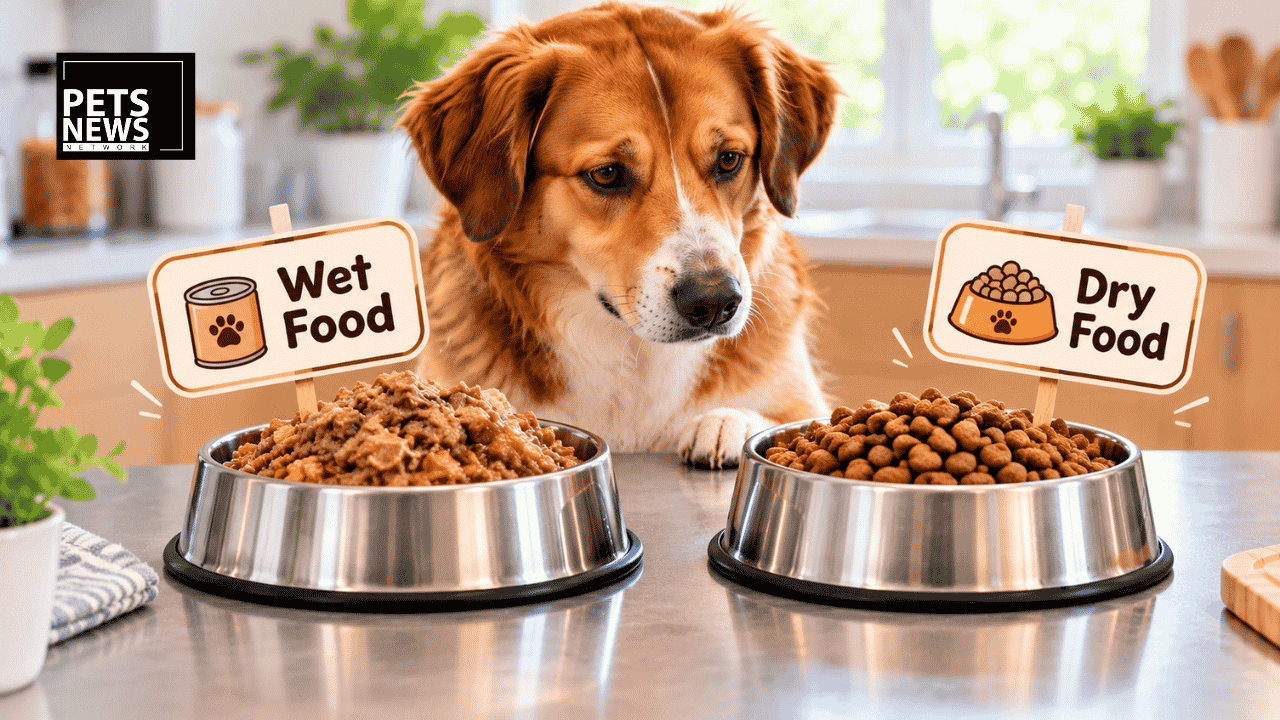

Every guide to switching between wet and dry pet food tells you to transition gradually over a week. Almost none of them tell you how much food to actually put in the bowl, and the ones that offer a rule of thumb like “one can equals one cup” are guessing. There is a correct way to do this. It takes one number from the pack and about ninety seconds of arithmetic.
A note on what this article is. Everything below reflects the published views and findings of veterinary nutrition and veterinary dental experts, drawn from the sources listed at the end. Pets News Network is presenting those expert views to its readers; we are not issuing veterinary advice of our own, and nothing here is a clinical recommendation from PNN. Nutritional needs differ by animal, by species, breed, age, weight, body condition, activity level and medical history. Every feeding decision for your pet should be made with your own veterinarian, who can examine the animal. Where expert opinion is divided, we have said so.
The problem is water
| Food type | Water content |
|---|---|
| Dry food | around 10% |
| Wet / canned food | around 75–78% |
Three quarters of a tin of wet food is water. That single fact breaks every shortcut owners reach for.
Swap 200 grams of dry food for 200 grams of wet food and you have not made an equivalent change. You have cut your pet’s daily calories by roughly three quarters.
Go the other way, matching wet food volume to kibble volume, and you underfeed just as badly. Match it by eye, the way most people do, and you are somewhere between the two with no way of knowing where.
The label trap: “as fed” versus “dry matter”
Pet food labels report nutrients as fed, exactly as the food comes out of the bag or tin, water included. This makes wet and dry foods look nothing like each other even when they are nutritionally similar.
Here is the example that makes it click, from a veterinary nutrition reference:
A canned cat food showing 6% fat on the label (with 78% moisture) works out to roughly 26% fat once the water is removed.
A dry food showing 12% fat on the label (with 7% moisture) works out to roughly 13% fat once the water is removed.
The canned food, the one that looked half as fatty, is actually the richer of the two.
If you want to run this yourself on any pack:
Nutrient % (as fed) ÷ (100 − moisture %) × 100 = nutrient % on a dry matter basis
So 6% fat in a food that is 78% water: 6 ÷ 22 × 100 = about 27.27%. [22 is (100 – 78%)] (The published example shows ~27.27% because it works from unrounded label values; the difference is rounding.)
Anyone comparing two foods using the percentages printed on the front of the pack is comparing numbers that cannot be compared.
The only number that matters: kcal
For portioning, forget percentages entirely. Work in calories.
What you need from each pack is its energy density, usually printed as kcal/kg, sometimes as kcal per cup or per tin. If it is there, everything else is arithmetic. If it is not there, you cannot portion the food accurately and you should email the manufacturer and ask.
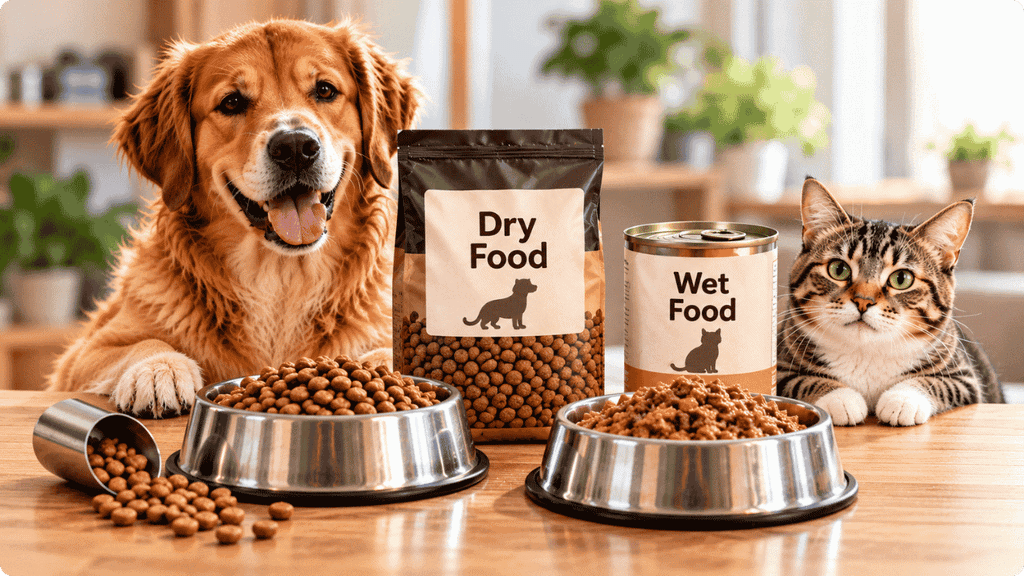
Step 1. Work out your pet’s daily calorie requirement. The method is in the next section — and the figure should be confirmed with your veterinarian, not taken from a chart on a packet.
Step 2. Convert the pack’s kcal/kg into kcal per gram. Divide by 1,000.
Step 3. Divide the daily requirement by kcal per gram to get grams per day.
A worked example
Take a dog whose veterinarian has set a daily requirement of 500 kcal. (Use your own pet’s figure; this one is illustrative.)
| Dry food | Wet food | |
|---|---|---|
| Energy density on pack | 3,500 kcal/kg | 850 kcal/kg |
| Per gram | 3.5 kcal/g | 0.85 kcal/g |
| Grams for 500 kcal | 143 g | 588 g |
143 grams of that dry food and 588 grams of that wet food are the same meal. A little over four times the weight.
That ratio is not universal. It depends entirely on the two specific products, which is exactly why “one can equals one cup” is useless advice.
Mixing the two
Mixed feeding is perfectly reasonable, and in India it is what most owners end up doing anyway. The method is the same: split the calories, not the weight.
Using the same dog and the same two foods, feeding half the day’s calories from each:
- 250 kcal from dry: 250 ÷ 3.5 = 71 g
- 250 kcal from wet: 250 ÷ 0.85 = 294 g
Total: about 500 kcal. Two foods, one correct portion.
The common mistake is adding wet food on top of a full dry ration as a topper. That is not mixed feeding. That is the dry ration plus extra calories, and it is one of the most reliable routes to a steadily overweight pet.
The transition itself
Gradual changeover over seven to ten days is the conventional approach, and it exists to give the gut microbiome time to adjust rather than to prevent fussiness.
| Days | New food | Old food |
|---|---|---|
| 1–2 | 25% | 75% |
| 3–4 | 50% | 50% |
| 5–6 | 75% | 25% |
| 7+ | 100% | — |
Those percentages are of calories, not of volume. Slow it down for a pet with a sensitive stomach, a history of digestive upset, or any current illness. Stop and call your veterinarian if there is vomiting, persistent loose stool, or refusal to eat.
Three things to be careful about
“Dry food cleans your pet’s teeth.” This is the most repeated claim in pet feeding advice and it does not hold as stated. Research summarised in the veterinary dental literature is direct: traditional hard kibble does not have the same effect on oral health as a purpose-made dental diet. What produces the benefit is large, dense kibble with around 10% insoluble fibre so it resists crumbling, often combined with additives such as polyphosphates or zinc compounds. Mechanical cleaning mainly reaches the molars, because incisors and canines tear rather than crush. Daily brushing remains the best preventive measure. If you are buying a food for dental benefit, look for the VOHC Seal of Acceptance, awarded by the Veterinary Oral Health Council for a specific plaque or tartar claim backed by clinical evidence.
Water intake, especially for cats. Cats have a low thirst drive and often do not drink enough to compensate for a fully dry diet. For a cat, the moisture in wet food is a genuine benefit rather than a marketing line, particularly for animals with any history of urinary problems. Discuss it with your vet before changing a cat’s diet.
Leaving wet food out. Wet food spoils fast, and considerably faster in Indian room temperatures than the guidance printed on imported packaging assumes. Put it down, give the animal a reasonable window, then remove and refrigerate or discard what is left. Dry food tolerates being left out; wet food does not.
Three problems specific to India
Calorie density is often missing from the pack. Many products sold here do not print kcal/kg prominently, or at all. Without it, correct portioning is impossible no matter how good the advice is. Ask the brand directly. If a manufacturer cannot tell you the calorie density of their own food, that tells you something.
Heat and humidity shorten every safety window. Storage, bowl time and leftovers all behave differently here.
Wet food costs far more per calorie. That is the real reason most Indian households feed mixed. There is nothing wrong with that, but it is a budget decision, and it should be made knowingly rather than dressed up as a nutritional one.
Before you switch: five questions
- What is my pet’s daily calorie requirement, set by a veterinarian?
- What is the kcal/kg of the food I am leaving, and the one I am moving to?
- Have I converted the portion by calories, not by weight, cups or cans?
- If I am mixing, have I split the calories rather than adding a topper?
- Does the person giving me this advice have a veterinary nutrition qualification, or a product to sell?
Get the first three right and the transition will almost certainly go smoothly. Get them wrong and the gradual changeover everyone talks about will not save you. You will simply arrive gently at the wrong portion.
Credits: The dry matter conversion example and the per-calorie comparison method are drawn from the Tufts University Cummings School of Veterinary Medicine’s Petfoodology nutrient comparison resource. Evidence on kibble and dental health, including kibble size, insoluble fibre content and the role of the Veterinary Oral Health Council, is drawn from the published veterinary dental literature summarised in standard references, including Hennet et al. (2007) and Clarke et al. (2011). Calorie figures in the worked example are illustrative; use the values printed on your own pet food packaging.
Pets News Network is India’s first dedicated media platform for the pet and animal industry. For breaking global pet news, brand coverage, and advertising enquiries, contact: info@petsnewsnetwork.com


