
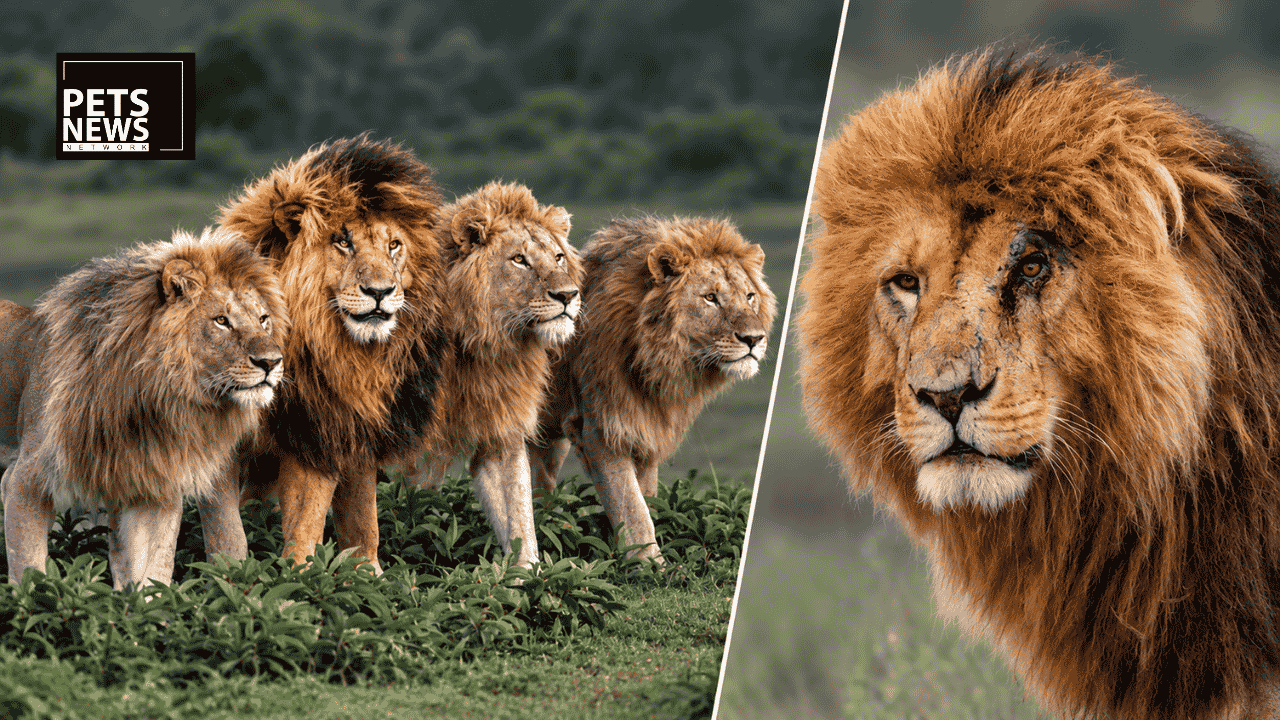

A graphic doing the rounds says Scarface the lion killed 400 hyenas and 130 rival males, and was the only lion ever to kill an adult hippo in single combat. Scarface was a real animal, and much of what surrounds him is accurate. Those three numbers are not. And the odd thing is that they make his life sound less remarkable, not more.
Who he actually was
Scarface lived in Kenya’s Maasai Mara, and became the most photographed wild lion of his generation, a fixture for guides, researchers and visitors over more than a decade.
He was one of four males, a coalition known as the “Four Musketeers”, alongside Morani, Sikio and Hunter. In 2012, the four of them took over the territory of the Marsh Pride.
This is the first correction, and it is a small but meaningful one. Posts routinely describe Scarface as a lone king. He held that territory as part of a coalition of four. Male lions in the Mara hold ground in groups precisely because a single male cannot.
He was found dead around 11 June 2021, of natural causes. The Mara Predator Conservation Programme reported it. Conservationists noted he carried several old injuries but had appeared relatively healthy.
He was the oldest lion in the Reserve at the time of his death.
A note on his age: accounts differ. Some place his birth in 2008 and his age at death at 13; others say 14. The widely shared “2007–2021” is one version, not a settled fact.
The scar
He was named for the wound above his right eye.
The most commonly accepted account is that it came from a fight in around 2011. But that explanation is not definitively documented. It is the version most sources settle on, not a recorded event with a named opponent.
What is better established is what happened afterwards: the wound reopened when he scratched it, and veterinarians stitched it. The scar stayed visible for the rest of his life.

The three claims that are not true
“He killed 400 hyenas”
There is no source for this.
The Marsh Pride was among the most intensively documented lion groups on earth. It was filmed for years by major natural history production teams, studied by Mara research programmes, and photographed constantly by professionals and visitors.
A lion killing four hundred hyenas would be one of the most extraordinary predator records ever compiled. Nobody recorded it, because it did not happen. The number appears to have been invented and then repeated until it looked like a fact.
“He killed 130 rival male lions by himself”
This one collapses on arithmetic alone.
The Maasai Mara and its surrounding conservancies hold an estimated 850 to 900 lions in total. Adult males are a minority of that population.
For one animal to have killed 130 rival males single-handedly, he would have had to remove a substantial share of the region’s entire adult male population over his lifetime, in one of the most closely watched wildlife areas in the world, without anyone noticing a demographic collapse.
“The only lion known to kill an adult hippo in a solo fight”
Here the data is unusually clear, and it is worth setting out because it tells you something real about how lions hunt.
In South Africa’s Sabi Sands reserve, surveys conducted between 1988 and 2000 recorded more than 4,000 kills by large carnivores.
Exactly one of those was a hippo killed by lions.
The best-known documented case, from 2006, involved lions that cornered a hippo in shallow water and drowned it over several hours. It was not a solitary lion.
The reason is straightforward. Luke Hunter of the big-cat organisation Panthera has said lions “can kill anything,” but that taking on hippos remains uncommon. Mike Watson of the Lewa Wildlife Conservancy puts it more bluntly: lions go for the easiest targets, and that list does not include hippos, elephants or adult giraffes.
An adult hippo weighs well over a tonne, has a bite that can break bone, and retreats to water. A lion that attacks one alone is not being brave. It is being fatally stupid, and lions that do that do not live to fourteen.
Why the real story is better
Here is what gets lost when the invented numbers take over.
Male lions in the wild do not usually grow old. A territorial male holds his ground until a younger, stronger coalition arrives, and then he is driven out, injured, or killed. Displacement is not retirement. A male who loses his territory loses his food, his pride and usually his life soon after.
Scarface held territory in one of the most contested lion landscapes in Africa and survived into his mid-teens. Photographs from his final years show an animal that had become noticeably thinner and weaker, still walking his range, carrying the accumulated damage of a lifetime of fights: torn ears, worn teeth, the eye.
He died of old age, in his own territory, which is something most wild male lions never get to do.

That is the achievement. It needed no hyenas.
Why this matters in India too
This is not a Kenyan problem. The same pattern runs through Indian wildlife content, and it is growing.
Individual Asiatic lions in the Gir landscape get the same treatment: names, invented kill counts, “King of Gir” graphics with numbers nobody can source. The same thing happens with tigers in Indian reserves, where particular animals acquire folklore that bears little relation to the research record.
The cost is not just inaccuracy. It changes what readers think conservation is about.
A public that believes lions are invincible warriors does not understand why a lion population needs protecting. The things that actually determine whether Asiatic lions survive (habitat extent, prey density, disease outbreaks, deaths on railway lines and in open wells, genetic bottlenecks from a single population) are unglamorous, and they are the entire story.
Mythology and conservation pull in opposite directions. One makes the animal seem beyond harm. The other depends on people understanding exactly how fragile it is.
How to check a post like this
Three quick tests, useful on almost any viral wildlife claim:
Ask who counted. A number like “400 hyenas” implies someone was present and recording for every incident. Who? Over what period? Published where?
Check the number against the population. If a claimed kill count is a meaningful fraction of the species’ entire regional population, it is wrong. This test alone kills most viral animal statistics.
Separate the caption from the graphic. In the post that prompted this piece, the written caption was largely accurate: Maasai Mara, Marsh Pride, the scar, natural death in 2021. The invented numbers were all in the image. People read the image and share it; the caption gets ignored.
What to carry away
Scarface was real, he was extraordinary, and he has been remembered badly.
He was one of four brothers who took a pride together. He carried a wound nobody can precisely account for. He got old in a place where male lions are not allowed to get old. And he died in his own territory of natural causes, which in the wild is close to a miracle.
Share that. It is true, and it is better.
Credits: Details of Scarface’s coalition, the Marsh Pride takeover and the scar are drawn from Angama Mara’s account of June 2021. Details of his death, age and the Maasai Mara lion population estimate are drawn from Newsweek, 14 June 2021. Data on lion predation of hippos, including the Sabi Sands survey figures and expert comment from Panthera and the Lewa Wildlife Conservancy, is drawn from National Geographic.
Pets News Network is India’s first dedicated media platform for the pet and animal industry. For breaking global pet news, brand coverage, and advertising enquiries, contact: info@petsnewsnetwork.com


