
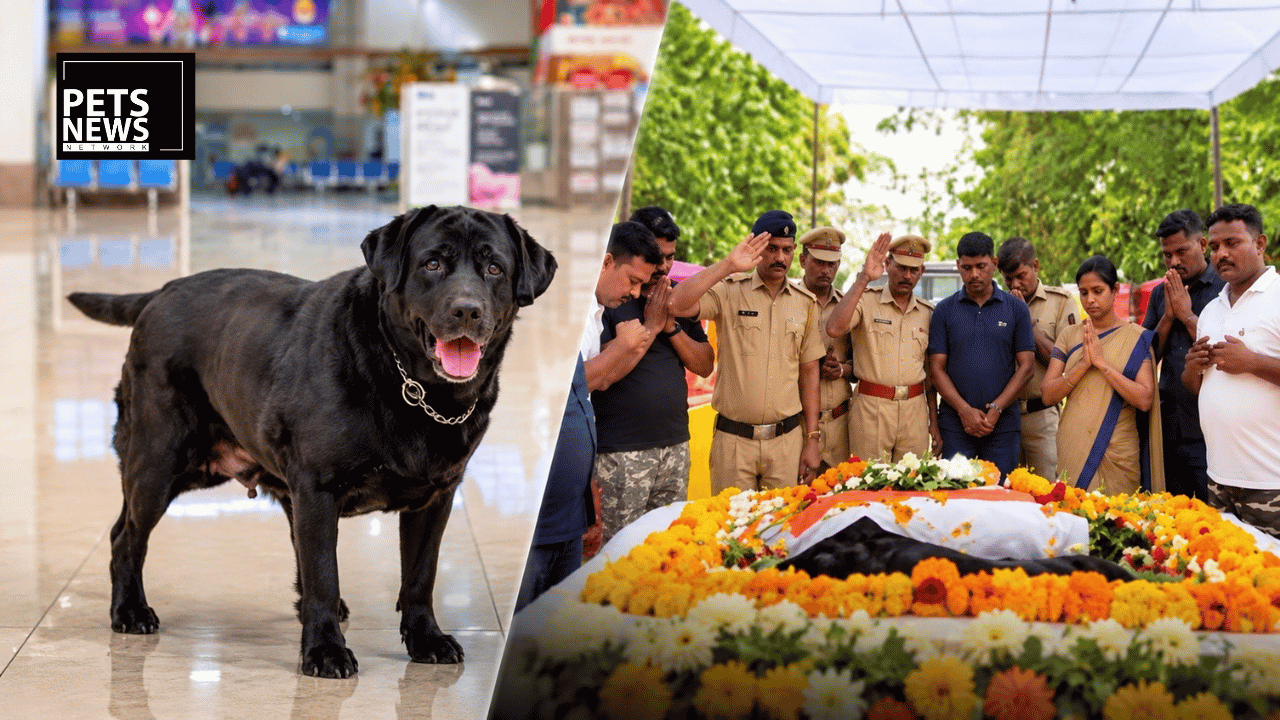

In 2023, a dog serving with the Washim police bomb squad was awarded a silver medal for her work. Her name was Steffi. On 11 October 2026 she died, and the Washim police buried her with full state honours. Her handlers wept openly. Most of the coverage has carried the tears. Very little of it has carried the medal.
What happened
Steffi served with the Bomb Detection and Disposal Squad (BDDS) of the Washim police in Vidarbha, Maharashtra.
She died on 11 October 2026. The Washim police gave her a funeral with full state honours — the formal ceremony reserved for a serving member of the force.
Photographs from the farewell showed officers in uniform unable to hold back tears. Local reporting described the grief in the department as immediate and open — she was described not as an animal attached to the unit but as a colleague and a part of the police family.
The medal nobody mentioned
Here is the detail that most of the circulating coverage has left out.
In 2023, Steffi was awarded a silver medal for her dedication and her performance in service.
That is not a sentimental description. It is a formal recognition recorded by the department — which means Steffi was not simply a long-serving animal. She was a decorated one.
A dog in a bomb squad does not receive a departmental medal for attendance. It is given for work: detections, deployments, operations where the dog’s performance mattered. The specific citation has not been made public in the reports available so far, and it is the single most worthwhile thing for a journalist to ask Washim police for.
There were two handlers, not one
Widely shared posts about Steffi’s death have named Sharad Watane as her handler, with a photograph of him breaking down.
Local reporting records that Steffi had two handlers — Sharad Watane and Kishor Dauls. Both worked with her, and the bond between the dog and both men is described as having gone well beyond duty.
This matters more than it may look. Handler partnerships in detection units are long, intense and specific. A dog learns one person’s cadence, posture and signals, and the pairing is deliberately kept stable for years precisely because rebuilding it is slow. When a working dog dies, every handler who worked that dog loses a professional partner.
Naming one and omitting the other is a small error that erases half of a working relationship. PNN is naming both.
What has not been reported
Several details that readers will reasonably want are not in any available account, and we are not going to supply them by assumption.
Her breed. Photographs show a black dog of retriever type. Most Indian BDDS dogs are Labradors, and Steffi may well have been one — but no source states her breed, and an inference from a photograph is not a fact.
Her age and exact service record. Social media posts have described her as serving for eleven years. That figure comes from a widely shared social media post and does not appear in local reporting. It may be accurate; it is not independently confirmed.
Her cause of death. Not reported.
The cases she worked. Not reported. For a decorated bomb squad dog, this is the most significant gap.
Who attended the funeral. The ceremony is described, but attending officers are not named.
This is where a phone call to the Washim Superintendent of Police’s office would turn an aggregated tribute into original reporting — her joining date, her breed and age, the citation behind the 2023 medal, and the operations she was deployed on.
What a BDDS dog actually does
Because the role tends to get flattened into “sniffer dog”, it is worth setting out what the work involves.
A bomb detection dog is trained to identify the chemical signatures of explosives — and critically, to isolate those signatures from everything else in the air. A dog’s nose breaks a smell into its components rather than receiving it as a single blended odour. That is why a trained dog can detect explosive compounds that have been deliberately masked by stronger scents, and why no machine has reliably outperformed one.
The deployment pattern in a district like Washim is not glamorous. It is VIP route checks, examining abandoned bags, sweeping venues before political visits and public events, clearing vehicles at sensitive locations, and responding to every call about a suspicious object — the overwhelming majority of which turn out to be nothing.
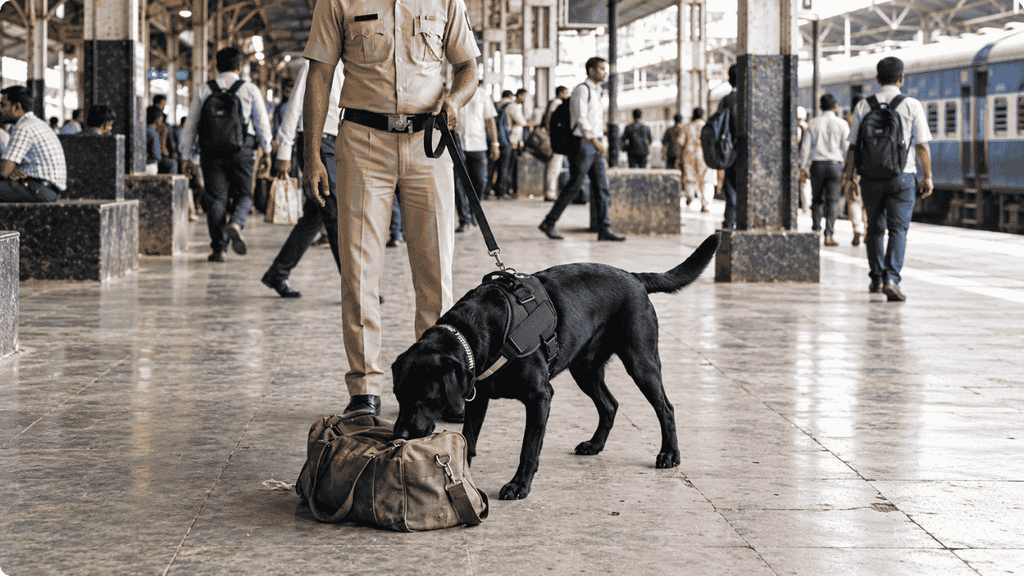
The job is mostly the absence of events. A bomb squad dog’s career is measured in the things that did not happen.
The pattern across Indian forces
Steffi’s farewell is part of a practice that has become steadily more visible across Indian police forces.
The reference point is Zanjeer, the Labrador who served the Bombay Police BDDS from December 1992 and whose detections after the 1993 Bombay blasts — explosives, grenades, weapons — made him the most widely known police dog in India. He died of bone cancer in November 2000 and was cremated with full honours.
The pattern since has been consistent. In Uttar Pradesh, Oli, an explosive detection dog with the Gonda police, died in 2022 after more than a decade of service and was given a condolence parade, with her body placed before the martyr memorial at the Police Lines. In Mumbai, Simba of the BDDS was given a ceremonial funeral in 2021.
Each of these ceremonies is the force stating something about its own structure: that the dog held a position, not a role. Many such dogs are formally ranked. Oli was admitted to the rank of constable.
A state-honours funeral is not an indulgence. It is the logical conclusion of having enlisted the animal in the first place.
The question that follows every one of these stories
There is an uncomfortable issue sitting behind the tributes, and it is worth raising while being clear that nothing here suggests it applied to Steffi.
Indian police forces have no uniform policy on what happens to a working dog after retirement. Practice varies by state and by unit. Some forces allow handlers to adopt the dog they worked with. Some retain retired dogs in kennels at the Police Lines. Some have no provision at all, and the outcome depends on whoever is in charge that year.
A dog that spends its working life bonded to one or two specific people, and is then separated from them at retirement, loses the only social structure it has known.
Steffi appears to have died in service, among the people she worked with, and was honoured accordingly. The dogs who outlive their service are the ones the system has not decided about. A national policy on retired police and military working dogs — adoption rights for handlers first, funded aftercare otherwise — is the obvious thing that does not yet exist.
The farewell
What the photographs from Washim actually show is not an unusual event. It is an ordinary grief that happens to be in uniform.
A dog who could not speak, who worked for years on a squad whose successes are invisible by definition, and who was decorated for it in 2023. Two handlers who learned her signals and gave her theirs. A police force that stood in formation for her.
Rest in peace, Steffi.
Credits: Details of the funeral, the 2023 silver medal and the names of both handlers are drawn from Pudhari (Marathi), 14 October 2026. The eleven-year service figure appears in a post by The Better India and has not been independently confirmed.
Pets News Network is India’s first dedicated media platform for the pet and animal industry. For breaking global pet news, brand coverage, and advertising enquiries, contact: info@petsnewsnetwork.com


