
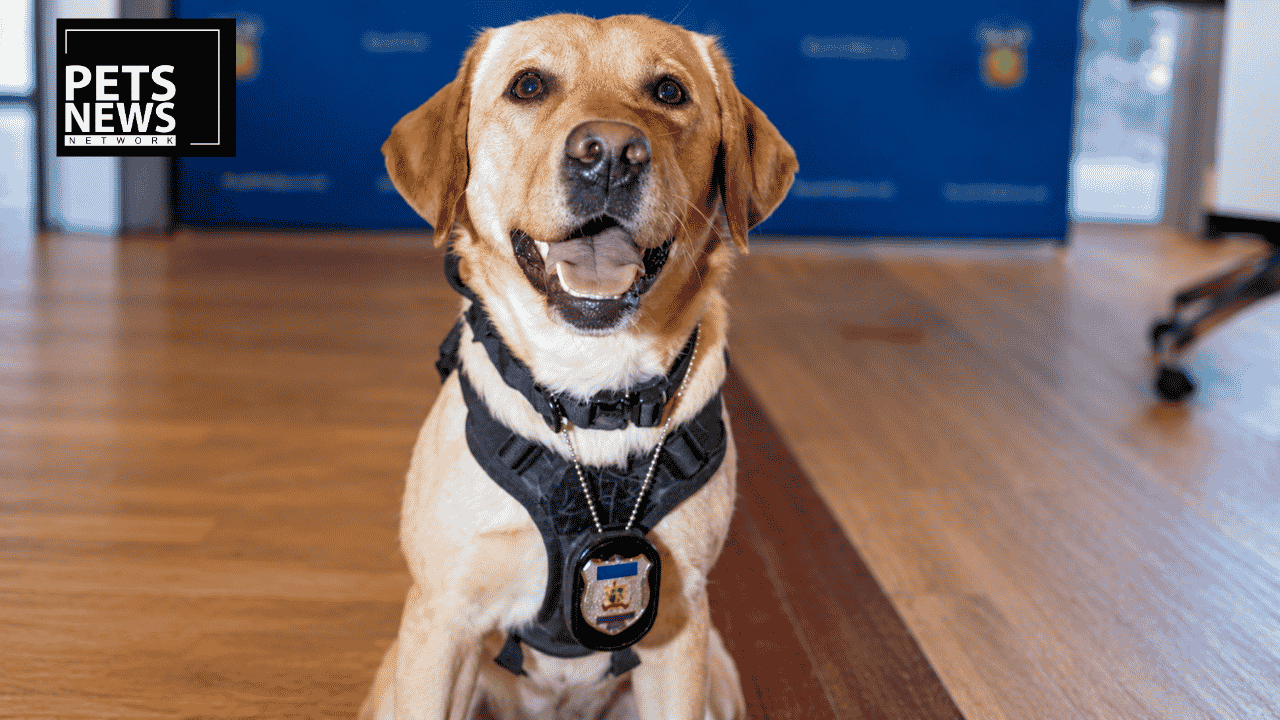

A seventy-year-old man vanished in Hawaii Volcanoes National Park. Police, park staff and a fire department helicopter searched for seven hours and found nothing. Then a three-year-old Labrador arrived and located him in about an hour. The dog exists because a charity wrote a cheque. The department had gone more than two years without one.
What happened
At 12:16 pm on Monday, Puna patrol officers received a report that David Arai, 70, of Oahu, was missing. He had last been known to be in the Volcano area and nobody had seen him for over a day.
Given his age, investigators treated it as an endangered missing-person case.
The break came when officers found Arai’s rental vehicle inside Hawaii Volcanoes National Park, which gave the search a boundary. Police and national park personnel began working the surrounding area. The Hawaii Fire Department put up a helicopter.
Seven hours passed.
K9 Trina and her handler, Officer Christopher Ross of the department’s Area II Juvenile Aid Section, joined the operation. Trina found Arai at around 7.30 pm, roughly two miles from the rental vehicle, lying on his back in bushes, slightly off the trail.
Ross described the conditions as rainy, dark and muddy, with rocks underfoot.
“The conditions were pretty bad going down that trail. And the first thing I noticed, I saw the top of his head, and he was slightly off trail in the bushes, like pretty much lying on his back.”
Arai was carried to the trailhead and taken to Hilo Benioff Medical Center, where he was treated for dehydration and exposure.
Ross, on what the outcome could have been:
“I wouldn’t want to know what would happen if we didn’t locate him.”
The number that actually matters
Most coverage has led with the seven hours the search had been running.
That figure describes the whole operation: officers, park staff, a helicopter.
Trina and Ross took about an hour.
That is the point of a trained live-find dog, and it is the detail most worth carrying. A human search team covers ground visually, in daylight if it is lucky. A scent dog works the air and the ground and does not need to see anything at all, which is why Trina was effective at night, in rain, on a muddy trail where a man was lying motionless in undergrowth off the path.
And then there is the part Ross described afterwards, which has nothing to do with training:
“We led up to him, just wanted to make sure he was okay, and Trina, when she got next to him, she licked his hand basically to let him know that we found him and that he’s safe.”
Who Trina is
She is a three-year-old Labrador Retriever, born in Sweden, who received her initial training at Ultimate K9 in Westfield, Indiana, before coming to Hawai’i.
She is a live-find human tracking canine, assigned island-wide to locate missing children and endangered adults.
The Hawai’i Police Department welcomed her at a ceremony on 24 February 2026 at the West Hawai’i Civic Center in Kona. She was in the field within weeks.

In the eight months since, she has found two missing people. A month before Arai, she and Ross located a 13-year-old girl who had run away from home in Waikoloa.
Who paid for her, and why that is the story
Reports have noted that Trina’s arrival and training were covered by a $25,000 donation. Almost none of them say who gave it.
The money came from the Hawai’i Island K9 Association, a nonprofit whose founder and chair is Tammy Passmore. That single donation covered:
- Trina’s acquisition
- Her transport to Hawai’i Island
- Training for both the dog and her handler
- A further 40 hours of training with retired Honolulu Police Department trainer Corporal Wayne Silva
The same association also funded the rebuilding of the Kona police kennels, a project begun in 2023 that included enhanced canine housing and fenced grassy recreation areas.
And here is the part that has gone largely unremarked.
Trina replaced K9 Argo, who retired in 2023.
Which means Hawai’i Island, an island with a national park, active volcanic terrain and a steady flow of visitors who hike alone, went roughly two to three years without a missing-persons dog. The capability came back not through a budget line but through a charitable donation.
Eight months later, two people have been found.
A live-find dog is not a sniffer dog
This distinction gets flattened constantly, and it matters.
Most police dogs in most countries are detection dogs, trained on explosives or narcotics, or patrol and tracking dogs working alongside enforcement. That is the bulk of police K9 work.
A live-find human tracking dog is a different specialisation with different training and a different job: locating a specific living person who is lost, injured, confused or hiding. The dog is not looking for a substance. It is looking for someone’s scent, and it has to distinguish that person from everyone else who has walked the same trail.
It is also a very different dog culturally. Trina’s job ends with a wagging tail at a stranger’s hand, not with a bite or an alert on a bag.
What this raises for India
India runs a large number of police dogs, and the overwhelming majority are deployed for detection and tracking: bomb disposal squads, narcotics units, crime-scene work. That capability is real and well established.
A dedicated live-find missing-persons dog, assigned specifically to locate lost children and vulnerable adults, is a different proposition, and far less common.
Set against the scale of missing-person cases reported in India every year, two questions follow naturally from the Hawai’i story, and neither has a published answer:
What does it cost? The Hawai’i figure gives a usable benchmark: $25,000, a little over ₹20 lakh, covering the dog, her transport, and the training of both dog and handler. That is a single, costed, auditable number for one working search capability.
Who pays? In Hawai’i, a volunteer nonprofit did, because the department had not replaced a retired dog in more than two years. An Indian district SP’s office, an animal welfare trust, or a CSR programme could fund exactly the same thing, and at that number, more than one.
This is not a criticism of Indian policing. It is an observation that a capability most people assume is expensive and exotic was restored on a single island by one charity for the price of a mid-range car.
The ending
David Arai, who was treated for dehydration and exposure and went home, has said he hopes to adopt Trina when she eventually retires from police service.
Which is, in its way, the whole thing. A dog bought with donated money, flown in from Sweden, trained in Indiana, assigned to an island she had never seen, found a stranger lying in wet bushes in the dark, and licked his hand.
He has asked to keep her.
Credits: Operational details, timings and quotations are drawn from Hawaii News Now and KHON2 reporting of 20 October 2026 and from the Honolulu Star-Advertiser of the same date. Details of Trina’s acquisition, funding, training and the Hawai’i Island K9 Association’s role are drawn from the Hawai’i Police Department’s official announcement of 24 February 2026. The rupee conversion is approximate and provided for scale.
Pets News Network is India’s first dedicated media platform for the pet and animal industry. For breaking global pet news, brand coverage, and advertising enquiries, contact: info@petsnewsnetwork.com


