
By using this site, you agree to the Privacy Policy and Terms of Use.
Accept
PNN Logo - Pets News Network PNN Logo - Pets News Network
  • World
    Three Dogs, No Evidence: What a Suspected Poisoning in Malaysia Should Teach India
    Animal Rescue & WelfareDaily DigestGlobal Pet NewsPet CarePet HealthPet Safety

    Three Dogs, No Evidence: What a Suspected Poisoning in Malaysia Should Teach India

    By
    PetsNews
    11 Min Read
    Rejected by the Police, Cast by Hollywood: Meet the Real Dog Behind Odin
    Dog BreedsEntertainmentGlobal Pet NewsPet Care

    Rejected by the Police, Cast by Hollywood: Meet the Real Dog Behind Odin

    By
    PetsNews
    September 29, 2026
    Turkey Banned Feeding Street Dogs. India Banned Street Feeding and Promised Feeding Zones — Then Didn't Build Them
    Animal Rescue & WelfareGlobal Pet NewsPet CarePet EducationPet HealthPet Safety

    Turkey Banned Feeding Street Dogs. India Banned Street Feeding and Promised Feeding Zones — Then Didn’t Build Them

    By
    PetsNews
    September 28, 2026
  • Pet Technology
    Meet Chloe: The Rescue Dog Learning to Sniff Out Cancer With a Little Help From AI
    Daily DigestPet EducationPet HealthPet InnovationPet SafetyPet TechResearchTechnology

    Meet Chloe: The Rescue Dog Learning to Sniff Out Cancer With a Little Help From AI

    Bengaluru startup Dognosis pairs trained dogs with AI to detect cancer from…

    By
    PetsNews
    10 Min Read
    Do Pets Dream? What Sixty Years of Sleep Research Actually Shows
    BlogPet CarePet EducationPet HealthPet Human BondPet SafetyResearch
    Do Pets Dream? What Sixty Years of Sleep Research Actually Shows
    Pet Conclave 2026 Comes to Hyderabad on 7 October as TPCI's National Pet Industry Committee Takes the Stage
    Events & ExhibitionsIndustry Insider
    Pet Conclave 2026 Comes to Hyderabad on 7 October as TPCI’s National Pet Industry Committee Takes the Stage
    Exclusive: Gaurav Taneja Breaks Silence on Mau's Death, Rebuts Ex-Staffer's Abuse Allegations Point by Point
    Breaking NewsEntertainmentPet CarePet Human BondPet Safety
    Exclusive: Gaurav Taneja Breaks Silence on Mau’s Death, Rebuts Ex-Staffer’s Abuse Allegations Point by Point
    Lucknow Has Sterilised 100,000 Street Dogs. Now It Is Putting Up Billboards to Find the Rest.
    Animal Rescue & WelfareAWBI, Municipal by LawsDaily DigestPet CarePet EducationPet SafetyPolicy & Law
    Lucknow Has Sterilised 100,000 Street Dogs. Now It Is Putting Up Billboards to Find the Rest.
  • Pet Insider

    How to Remove Plaque From Your Dog’s Teeth- A Simple Vet-Approved Guide.

    Two Minutes a Day Keeps the Vet Bill Away — Your Dog's Dental Care Routine Starts…

    By
    PetsNews

    Which Dogs Have the Strongest Bite Force? A Vet’s Honest Guide.

    Powerful Jaws, Misunderstood Dogs — The Truth About Bite Force Every Owner Should Know

    By
    PetsNews

    How to Check if Your Cat Has Eyelashes- What Every Cat Owner Should Know

    Look Closer — Your Cat's Eyes Are Hiding Something Important

    By
    PetsNews

    Nana Patekar Shared His Home With Five Dogs. He Never Made It a Headline.

    He never campaigned for animals. He simply shared his home with five dogs, twelve cows and…

    By
    PetsNews

    The New Rules of Pet Care: How Investors and Founders Are Shaping India’s Booming Pet Industry

    Founders With Heart, Investors With Data — Who Will Shape India's Pet Industry?

    By
    PetsNews

    Chronic Kidney Disease in Dogs: Symptoms, Treatment, Diet, and How to Give Your Dog a Better Quality of Life.

    When Your Dog's Kidneys Start to Fail — Here's What Every Pet Owner Must Know

    By
    PetsNews

    Urinary Bladder Stones in Dogs: Types, Symptoms, Diagnosis, and Treatment Guide for Pet Parents.

    That Sad, Tired Look Could Mean More Than a Bad Day — Know the Signs of…

    By
    PetsNews

    Dog Vaccination Schedule in India, The Complete Guide Every Pet Parent Needs in 2025.

    One Small Injection — A Lifetime of Protection for Your Dog

    By
    PetsNews
  • Blog Index
  • Contact US
  • My Bookmarks
Reading: India’s Tiger Reserves Will Now Be Scored on Waste Management. Last Time, Five Barely Scraped a Pass
Sign In
  • Join US
Pets News NetworkPets News Network
Font ResizerAa
  • Pet Business & Finance
  • Animal Rescue & Welfare
  • Entertainment
  • Pet Food Science
  • Technology
  • Industry Insider
Search
  • Technology
  • Entertainment
  • Animal Rescue & Welfare
  • Industry Insider
  • Pet Business & Finance
  • Pet Food Science
  • Pet Health
Have an existing account? Sign In
Follow US
© Pets News Network 2026. All Rights Reserved.
India's Tiger Reserves Will Now Be Scored on Waste Management. Last Time, Five Barely Scraped a Pass
Animal Rescue & WelfareDaily DigestPet CarePet EducationPet HealthPet SafetyWildlife

India’s Tiger Reserves Will Now Be Scored on Waste Management. Last Time, Five Barely Scraped a Pass

PetsNews
Last updated: September 29, 2026 4:30 pm
By
PetsNews
9 Min Read
Share
SHARE

Every four years, India grades its tiger reserves on how well they are run. The sixth round adds a new test — what each reserve does with its own waste — and the results of the last round explain why it matters.

Contents
What was announcedThe new criterion: solid waste managementHow the evaluation worksWhat the last report card actually saidThe weakest link is not wasteWhy any of this matters beyond the paperworkWhat to watch for

What was announced

On Friday, 25 September, Union Environment Minister Bhupender Yadav inaugurated the inception workshop for the sixth cycle of the Management Effectiveness Evaluation of Tiger Reserves (MEE-TR 2026) in New Delhi.

The exercise is run by the National Tiger Conservation Authority (NTCA) in collaboration with the Wildlife Institute of India (WII). The technical manual for the 2026 cycle was released at the inaugural session, and Minister of State for Environment Kirti Vardhan Singh also attended, along with representatives of state forest departments and tiger reserve management teams.

This cycle will assess all 58 of India’s tiger reserves, the largest coverage in the exercise’s history.

Yadav used the occasion to call for combining scientific methods and technology with local ecological and socio-economic considerations, area-based assessment of human-wildlife conflict, and site-specific landscape management adapted to individual reserves. He suggested involving local ecological and sociological experts in evaluating MEE reports, and said local youth could participate in the exercise.


The new criterion: solid waste management

The headline change in the sixth cycle is that solid waste management is now scored as a separate evaluation criterion.

Evaluators will examine what reserves do with waste generated in three distinct settings:

  • Forest chowkis — the outposts where field staff live and work, often deep inside the reserve with no municipal collection of any kind
  • Tourism activities — packaging, bottles and food waste left behind by visitors along safari routes and at entry gates
  • Wildlife rescue centres — including biomedical waste, which carries its own disposal requirements and cannot simply be buried or burnt

This is not a cosmetic addition. Waste inside a protected area is a wildlife management problem, not a housekeeping one. Food waste draws animals to roadsides, rest houses and tourist zones, habituating them to human presence and increasing the chance of conflict. Plastic gets ingested by wildlife and livestock. Improperly handled biomedical waste from a rescue centre is a disease risk to the animals being treated and to everything else in the vicinity.


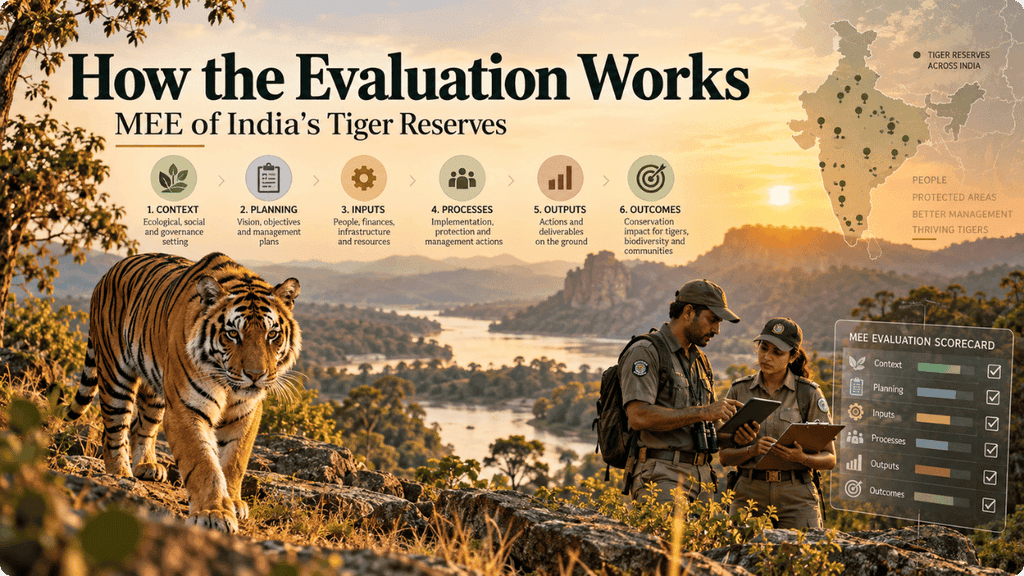
How the evaluation works

MEE is not a new exercise. India has run it since 2006, at roughly four-year intervals, using a framework adapted from the IUCN World Commission on Protected Areas.

It assesses six elements: context, planning, inputs, processes, outputs and outcomes, covering everything from the threats a reserve faces and the resources it has, through to whether its management is producing measurable conservation results.

Each reserve is visited by an independent, multidisciplinary expert team, which completes a scorecard after cross-checking supporting documents submitted by the Field Director.

The coverage has grown with the network itself:

CycleYearReserves assessed
First200628
Second201039
Third201443
Fourth201850
Fifth202251
Sixth202658

Beyond waste, the sixth cycle will cover tiger and prey conservation, habitat management, protection and wildlife crime, wildlife monitoring and health, fire and disaster management, human-wildlife coexistence, community engagement, tourism management, landscape connectivity, management planning and resource availability. The NTCA has said this round will place greater emphasis on field-based evidence, management outcomes, emerging threats, and digital and spatial information.

What the last report card actually said

This is the part missing from most coverage of Friday’s announcement, and it is the part that gives the new criterion its context.

The fifth cycle report was released at Corbett Tiger Reserve on Global Tiger Day, 29 July 2023, covering 51 of the then 53 tiger reserves. Reserves were assessed against 33 criteria, with scores pooled and converted into a percentage rating.

The overall mean score was 78.01%, with individual reserves ranging from 50% to 94%.

The grade distribution:

CategoryScore rangeNumber of reserves
Excellent90% and above12
Very Good75–89%21
Good60–74%13
Fair50–59%5

Top performers: Periyar in Kerala led the country at around 94%, followed by Satpura in Madhya Pradesh and Bandipur in Karnataka.

Lowest scores: Dampa in Mizoram came last at 50%, followed by Indravati in Chhattisgarh and Nameri in Assam.

Among the original nine Project Tiger reserves, Manas scored 85.61%, Melghat 84.85%, Corbett 78.79%, Ranthambore 73.48% and Palamau 65.91%.

So while the average looks healthy, the spread is wide. Five reserves were rated Fair, the lowest band in use, and the gap between Periyar and Dampa is 44 percentage points.


The weakest link is not waste

Here is the finding that deserves more attention than it has received.

The fifth cycle identified climate change and carbon capture as the weakest-performing area across Indian tiger reserves, scoring just 60%, the lowest of any parameter in that cycle.

India is now adding a criterion on waste management, which is welcome and overdue. But the previous round already told the authorities where the network’s largest management gap lies, and it is not garbage. Whether the 2026 cycle shows improvement on climate parameters will be one of the more revealing things in the eventual report.


Why any of this matters beyond the paperwork

There is an obvious criticism of exercises like MEE: that they generate scores, reports and press events without changing conditions on the ground.

That criticism has some force, but it misses what the exercise uniquely provides. MEE is the only mechanism that produces publicly comparable, independently assessed performance data on every tiger reserve in the country. Without it, there is no way for a citizen, a journalist or a state legislator to know that Dampa is struggling while Periyar is excelling, or that climate action is the weakest area network-wide.

The value is not in the average. It is in the outliers, and in the year-on-year comparison. A reserve that scored 50% in 2022 and scores 50% again in 2026 is a reserve where four years of intervention achieved nothing, and that is a question somebody can be asked to answer.

The same will apply to waste. Once reserves are scored on it, there will be a documented baseline. What happens after that depends on whether anyone uses the numbers.


What to watch for

When the sixth cycle report eventually lands, the questions worth asking are:

  • Did the five Fair-rated reserves improve? Dampa, Indravati and Nameri were at the bottom last time.
  • Has the climate parameter moved off 60%?
  • How badly do reserves score on the new waste criterion? A first-time measurement usually produces poor results, which is precisely what makes a baseline useful.
  • Do the seven newly included reserves — those not covered in 2022 — start low, as newer reserves with less-established systems often do?

For now, 58 reserves are about to be visited by independent teams, and for the first time those teams will be looking at what the reserve does with its own waste.


Pets News Network is India’s first dedicated media platform for the pet and animal industry. For breaking global pet news, brand coverage, and advertising enquiries, contact: info@petsnewsnetwork.com


Total Views: 5,545

You Might Also Like

Lumpy Skin Disease Resurgence 2026: What Farmers and Cattle Owners Need to Know
13-Year-Old Dies Saving His Puppy From Assam Floods
Why Is Your Cat Losing Fur and Scratching Constantly? Signs of Mange Every Pet Parent Should Know
NBA Star OG Anunoby Wants You to Take Your Cat to the Vet, Here’s Why It Matters
Blood Panel Clues in Dogs and Cats, What Your Vet’s Blood Tests Are Really Telling You
TAGGED:Bhupender Yadavconservation policyMEE-TRNTCAProject Tigersolid waste managementtiger reservesWildlife Institute of India
Share This Article
Facebook Email Copy Link Print

More Popular from PNN

A golden-brown Golden Retriever lying quietly on a dark leather couch with a tired, sad expression, representing the lethargy and discomfort experienced by dogs suffering from urinary bladder stones or uroliths.
Pet Health

Urinary Bladder Stones in Dogs: Types, Symptoms, Diagnosis, and Treatment Guide for Pet Parents.

By
PetsNews
16 Min Read
A golden-brown Golden Retriever lying quietly on a dark leather couch with a tired, sad expression, representing the lethargy and discomfort experienced by dogs suffering from urinary bladder stones or uroliths.

Urinary Bladder Stones in Dogs: Types, Symptoms, Diagnosis, and Treatment Guide for Pet Parents.

By
PetsNews
Nana Patekar Shared His Home With Five Dogs. He Never Made It a Headline.
Daily DigestEntertainmentPet CarePet HealthPet Human BondPet Safety

Nana Patekar Shared His Home With Five Dogs. He Never Made It a Headline.

By
PetsNews
9 Min Read
- Advertisement -
Ad image
Pet Health

Urinary Bladder Stones in Dogs: Types, Symptoms, Diagnosis, and Treatment Guide for Pet Parents.

That Sad, Tired Look Could Mean More Than a Bad Day — Know the Signs of…

By
PetsNews
Treatment & Health

Blood Panel Clues in Dogs and Cats, What Your Vet’s Blood Tests Are Really Telling You

Your Cat's Blood Test Could Be Saving Their Life — Here's How

By
PetsNews
Pet HealthTreatment & Health

Chronic Kidney Disease in Dogs: Symptoms, Treatment, Diet, and How to Give Your Dog a Better Quality of Life.

When Your Dog's Kidneys Start to Fail — Here's What Every Pet Owner Must Know

By
PetsNews
Pet Health

Urinary Bladder Stones in Dogs: Types, Symptoms, Diagnosis, and Treatment Guide for Pet Parents.

That Sad, Tired Look Could Mean More Than a Bad Day — Know the Signs of…

By
PetsNews
Pet Health

Dog Vaccination Schedule in India, The Complete Guide Every Pet Parent Needs in 2025.

One Small Injection — A Lifetime of Protection for Your Dog

By
PetsNews
PNN Logo - Pets News Network

Pets News Network (PNN) is India’s first dedicated news platform for the pet industry, delivering professional journalism, lifestyle content, and trusted reporting for every pet parent, professional, and animal lover.

Categories

  • Technology
  • Entertainment
  • Animal Rescue & Welfare
  • Industry Insider
  • Pet Business & Finance
  • Pet Food Science
  • Pet Health

Quick Links

  • World
  • Pet Technology
  • Pet Insider
  • Blog Index
  • Contact US
  • My Bookmarks

@COPY RIGHTS – 2026, Pets News Network. All Rights Reserved.

© Pets News Network 2026. All Rights Reserved.
PNN Logo - Pets News Network PNN Logo - Pets News Network
Welcome Back!

Sign in to your account

Username or Email Address
Password

Lost your password?