


People mark Hachiko’s birthday every November, and this year he would have turned 103. The world remembers him for the nine and a half years he spent waiting at Shibuya Station for his deceased owner. However, few people know what the post-mortems actually revealed. Two separate examinations, conducted decades apart, point to the exact same finding. Alongside terminal cancer, Hachiko carried heartworm. Mosquitoes still spread this parasite today, yet you can easily prevent it in your own dog.
The story, as the record has it
| Detail | The record |
|---|---|
| Born | Mid-November 1923, on a farm near Ōdate, Akita Prefecture. A purebred male Akita |
| Owner | Hidesaburō Ueno, professor of agriculture at Tokyo Imperial University |
| Came to Tokyo | Arrived at Ueno Station on 15 January 1924 |
| Ueno’s death | 21 May 1925, of a cerebral aneurysm, while at work |
| The waiting began | 26 May 1925 |
| How long | About nine and a half years, until his own death |
| Died | 8 March 1935, aged 11. A local shopkeeper’s wife, Haruno Takizawa, found him around 6 a.m. near Inari Bridge in Shibuya |

What killed Hachiko? What the post-mortems found
Veterinarians examined Hachiko twice.
First, doctors at Tokyo Imperial University performed a necropsy on the day he died in 1935. They attributed his death to dirofilariasis (heartworm) and old age. During the procedure, they also found four yakitori skewers in his stomach. However, those skewers had not damaged his stomach or caused his death.
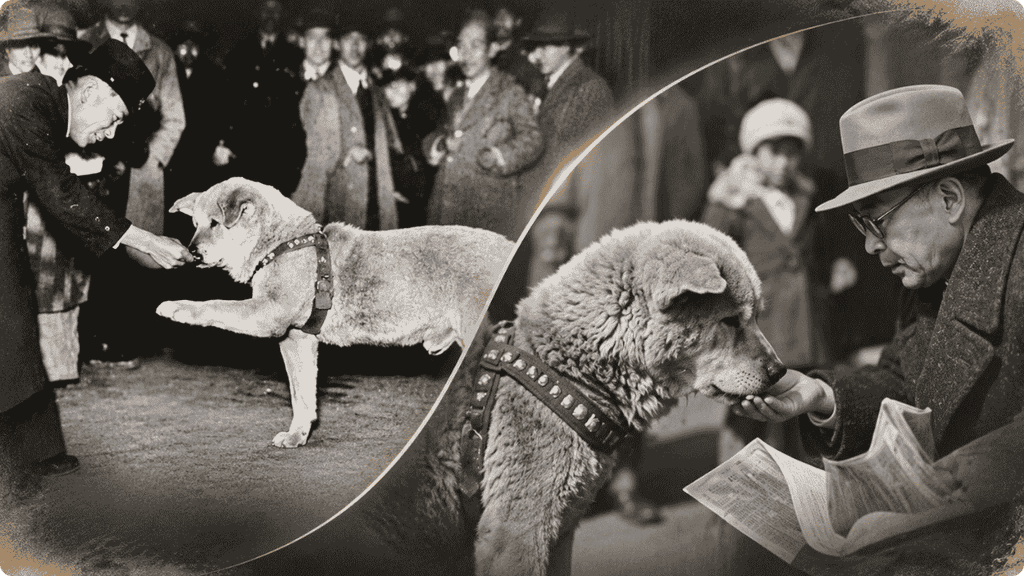
A second examination began in December 2010, and researchers released the results in March 2011. Veterinary pathologists at the University of Tokyo, including Kazuyuki Uchida, studied Hachiko’s preserved organs. They discovered terminal cancer—a possible carcinosarcoma in the lungs that had spread to the heart. Furthermore, they found Dirofilaria immitis, counting more than 30 adult worms in his heart and microfilariae in his blood. Therefore, they confirmed once again that the skewers caused no harm.
The skewer rumor was false in 1935, and it remained false in 2011. Yet, the myth outlived both scientific findings.
Ultimately, the record shows a loyal dog who spent his final years battling heartworms and cancer, while still walking to the railway station every single day.
What heartworm actually is
This part is worth reading slowly, because it applies to a living dog rather than a historical one.
Mosquitoes spread heartworm. A mosquito feeds on an infected animal and takes up microfilariae, which are immature larvae. The larvae develop inside the mosquito, and it passes them to the next dog it bites. Dogs cannot catch it directly from each other. The mosquito is the entire delivery system.
Once inside a dog, the parasite takes roughly six to seven months to mature into adult worms that tests can detect. The adults then live for years in the heart and the pulmonary arteries. Meanwhile, the females release microfilariae back into the bloodstream, where the next mosquito can pick them up.
The damage is mechanical and inflammatory. Worms occupy the vessels that carry blood from the heart to the lungs, and the inflammation they cause scars the surrounding tissue.
The signs, and why they come late
| What you may see | Notes |
|---|---|
| Cough | Often the first sign |
| Lethargy | Sleeping more, less interest in activity |
| Exercise intolerance | Tiring on a walk the dog used to manage easily |
| Weight loss | Gradual |
| Laboured breathing or excessive panting | Seen as the disease advances |
| Collapse | A late and serious sign |
Untreated, the disease can progress to right-sided heart failure and fluid in the abdomen. In the most severe form, caval syndrome, the worm burden is so heavy that it obstructs blood flow out of the heart and the dog collapses. Those cases generally need surgical removal of the worms to survive.
The cruelty of the timeline is that the early stage looks like a dog slowing down. By the time the cough is obvious, the worms have often been established for months.
Why this matters in India
Heartworm is documented in India. Published surveys have examined its prevalence in dogs in the northeastern states in particular.
The logic is simple. The disease travels in mosquitoes. Wherever mosquitoes are abundant, such as humid regions, coastal belts, standing water and the weeks after the monsoon, the vector is present in numbers. A dog in such a place is not at merely theoretical risk.
Unlike most other conditions an owner worries about, this one has a reliable preventive. Many owners are never told about it.
What heartworm prevention actually involves
Test first. Veterinary guidance is to test dogs from about seven months of age at least once a year. The standard test is antigen-based and detects proteins from adult female worms. A Knott’s test or blood smear looks for circulating microfilariae. Testing matters because preventives target larval stages. They do not kill adult worms, so starting a preventive in a dog with an established infection does not treat it.
Then prevent, consistently. Options include monthly oral chewables, monthly topical applications and injectables given every six to twelve months. Your vet will choose based on your dog and your region.
Consistency is the whole game. A missed dose opens a window for infection, and dogs that miss doses need testing more often.
Why treatment is a last resort, not a backup plan
Understanding what treatment involves explains why prevention is not simply the cheaper option.
Treatment typically combines steroids to control inflammation, doxycycline to target Wolbachia (a bacterium living inside the worms), a preventive to clear developing worms and microfilariae, and then melarsomine injections to kill the adults. Vets give these injections deep into the muscle of the lower back, and they are painful enough that dogs usually go home on pain medication.
Throughout, the dog must stay strictly rested. Exercise can dislodge dying worms, which then travel to the lungs. The risks include anaphylaxis, embolism, injection-site abscess and sudden death. Vets usually retest about nine months after treatment ends.
The damage does not necessarily reverse. Scarring can leave lasting harm to the heart and lungs, and right-sided heart failure can persist after the worms are gone. Dogs also develop no immunity, so a treated dog can be reinfected the following season.
A footnote on the statue
The bronze Hachiko outside Shibuya Station is not the one he knew. The original, by Teru Andō, was unveiled on 21 April 1934, while Hachiko was alive. Authorities removed it on 12 October 1944 for the wartime metal drive, and it was melted down in Hamamatsu on 14 August 1945.
The statue there today was made by Takeshi Andō, Teru’s son, and unveiled on 15 August 1948.
What is worth taking from a 103rd birthday
Hachiko is remembered for something he could not help: a habit of waiting that outlasted its reason.
He died of things that, in 1935, nobody could have stopped. The cancer was beyond the medicine of his time. Heartworm is not beyond ours.
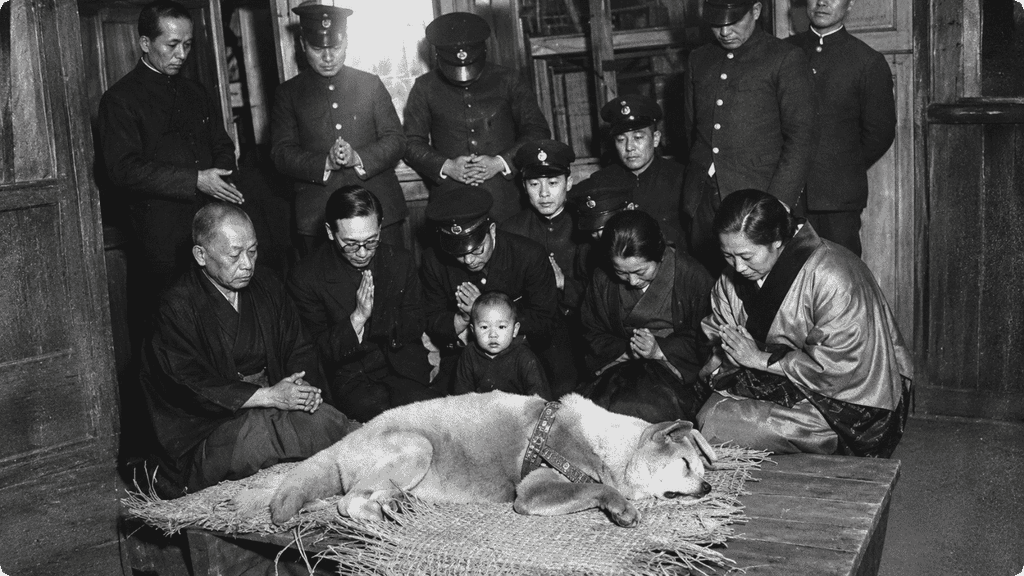
The most useful thing any owner can do with his birthday is unglamorous: ask a vet when your dog was last tested, and whether it is on a preventive. For many dogs in India the answer to the second question is no. That is the one part of Hachiko’s story that does not have to repeat.
Pets News Network is India’s first dedicated media platform for the pet and animal industry. For breaking global pet news, brand coverage, and advertising enquiries, contact: info@petsnewsnetwork.com