
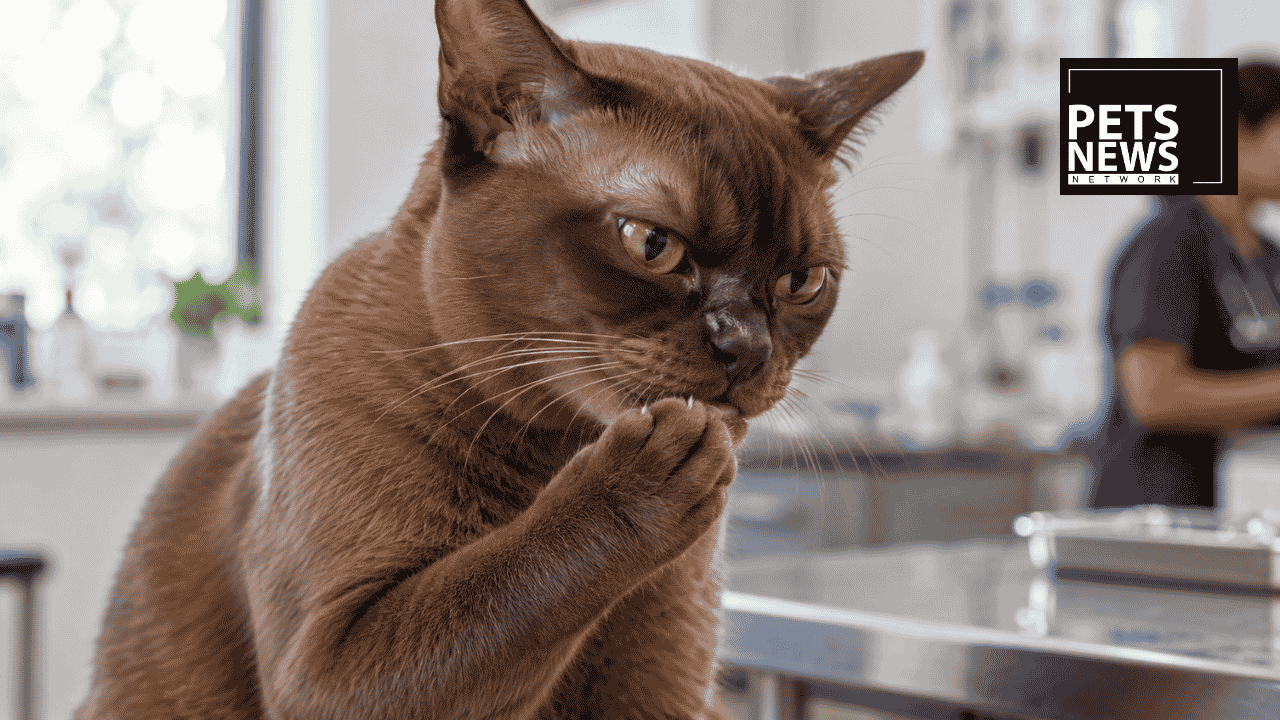

A rare pain disorder makes cats bite their own tongues. The symptoms look exactly like ordinary dental trouble — which is why knowing the pattern matters, and why a vet visit should never wait.
Why this article exists
Most cat owners will never see a case of Feline Orofacial Pain Syndrome. It is genuinely rare, and it is heavily concentrated in one pedigree breed that is uncommon in India.
So why write about it?
Because the early signs of FOPS are identical to the early signs of something far more common: dental disease. A cat pawing at its mouth, chewing strangely, or going off food is sending a signal that owners routinely dismiss as fussiness. In the overwhelming majority of cases that signal means a painful tooth. Occasionally it means something stranger.
Either way, the correct response is the same, and that is what this article is really about.
What FOPS is
There is a condition in which a cat begins attacking its own mouth — not grooming obsessively, but deliberately biting and tearing at its own tongue, lips and cheeks, sometimes badly enough to need surgical repair and a feeding tube.
This is not a behavioural quirk or an anxiety habit. Veterinary researchers classify FOPS as a neuropathic pain disorder: pain generated by the nervous system itself rather than by ongoing tissue damage. The closest human comparisons are trigeminal neuralgia and burning mouth syndrome, both considered among the more distressing chronic pain conditions in medicine.
The condition was first recognised in the early 1990s and formally described in 2001. Almost everything known about it comes from one landmark paper published in 2010 in the Journal of Feline Medicine and Surgery, in which a team led by veterinary neurologist Clare Rusbridge reviewed 113 cases. Sixteen years on, that study remains the reference point — and it is unusually honest about how much is still unknown.
The warning signs
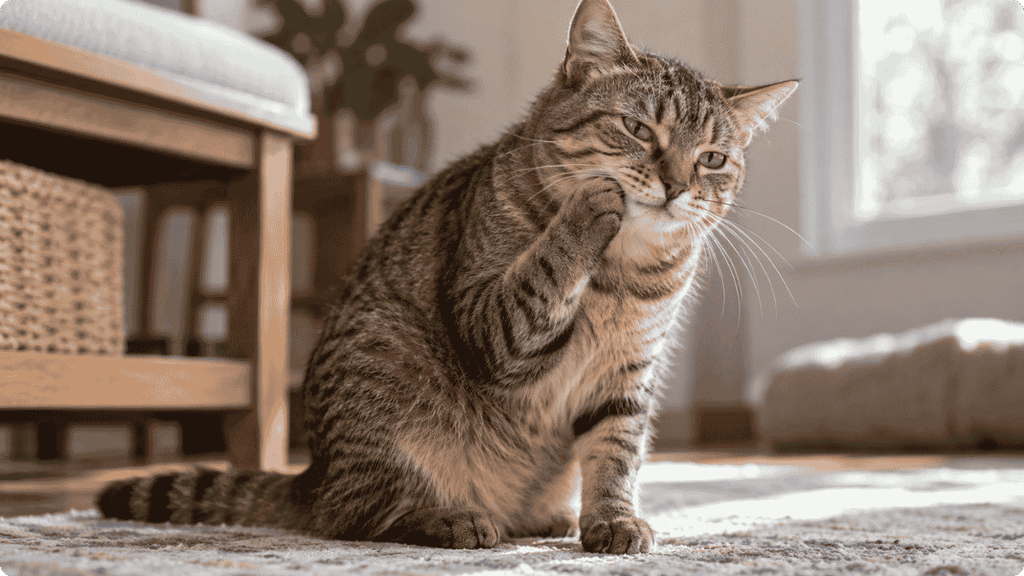
Affected cats show exaggerated licking and chewing movements and paw repeatedly at the mouth or face. The signs come in bouts, with pain-free intervals in between, rather than running constantly. In severe cases the cat progresses to mutilating its tongue, lips and the inside of its cheeks.
Two details help distinguish FOPS from ordinary oral pain.
It is one-sided. In every case in the 2010 series, the discomfort was described as unilateral or clearly worse on one side. That asymmetry suggests a nerve problem rather than generalised disease.
Mouth movements set it off. In 33 of the 113 cats, episodes were triggered by eating, and in some cases drinking or grooming. This mirrors human trigeminal neuralgia, where light touch or facial movement can trigger an attack. A few owners reported other triggers — strong perfumes in two cases, sunshine in one, cold in another.
Affected cats stay alert and can sometimes be distracted, though with difficulty. Many stop eating. A standard neurological examination usually finds nothing wrong.
The Burmese connection
Of the 113 cats studied, 100 were Burmese — about 88%. The rest included a Burmese cross, a Burmilla, six domestic shorthairs, two Siamese, a British Shorthair and a Somali.
That concentration in one pedigree breed is not coincidence. Examining pedigrees from 46 affected Burmese cats born between 1984 and 2008, researchers found common ancestors on both the maternal and paternal sides of every affected cat’s family tree. Many were closely related. The authors concluded an inherited tendency is likely, while stating clearly that the data was insufficient to work out the mode of inheritance.
FOPS is not exclusively a Burmese disease. It has been documented in other breeds, including a published case of successful treatment in a Himalayan cat. No cat should be assumed immune on breed alone.
The teething link most owners have never heard
This is the single most useful piece of information in the research for anyone buying a pedigree kitten.
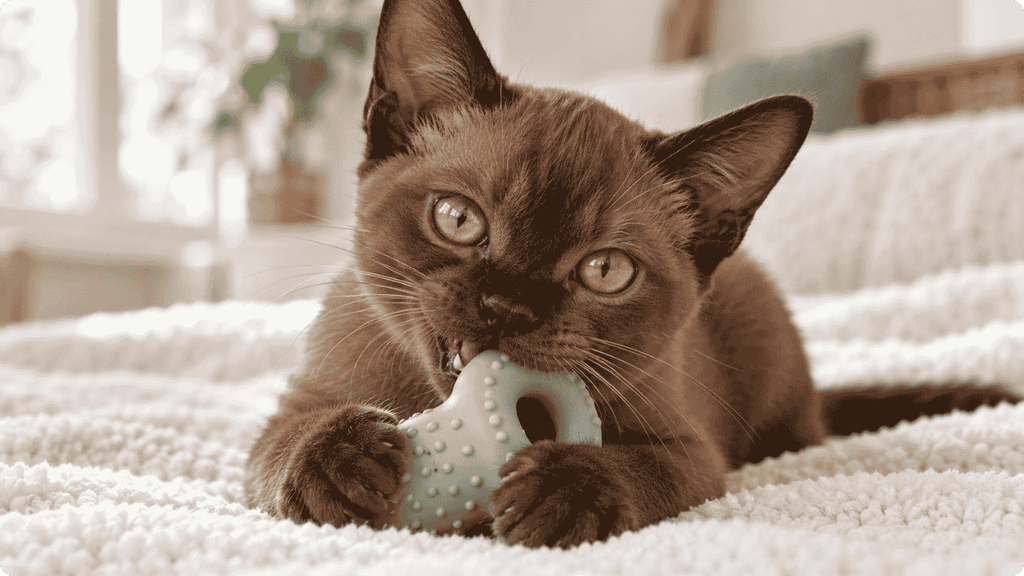
Age at first episode ranged from a few weeks old to 19 years, but the data showed a clear peak in young cats. Nineteen cats had their first episode at six months or younger, and every one of them was Burmese. Eighteen cats in the series had erupting permanent teeth when their signs began.
What the researchers heard from breeders is more troubling. Several Burmese breeders told them they already knew about the problem, and that it was often necessary to bandage kittens’ paws during teething to stop them injuring themselves. Many regarded it as a benign phase unlikely to recur — and would not necessarily mention it to prospective owners.
The study’s follow-up suggests that optimism is misplaced. Of the 18 teething kittens, 10 went on to have recurrent problems and four eventually needed permanent medication.
If you are buying a Burmese kitten, ask the breeder directly whether any cats in the line have shown mouth pain or face-pawing during teething. It is a fair question.
What triggers an episode
Researchers identified a precipitating cause in 81 of the 113 cats. In 32, no trigger could be found.
Oral lesions were the commonest factor. Seventy-one cats had some oral problem alongside the behavioural signs — 48 with periodontal disease ranging from gingivitis to tooth resorption, 18 with erupting permanent teeth, three with mouth ulcers. The working theory is that irritation to the trigeminal nerve endings sensitises a nervous system already predisposed to overreact.
The authors raise an important caveat themselves: periodontal disease is extremely common in cats generally, with one study putting the rate at 72% and higher in pedigree cats. So the association cannot be proven from this data alone.
Environmental stress was the second factor, linked to episodes in 24 cats, roughly one in five. The breakdown is more useful than the general phrase suggests:
- 14 cases involved social incompatibility — typically a multi-cat household or the arrival of a new kitten
- Eight involved another distressing event — a cattery stay, builders in the house, moving home, or the death of the cat’s primary carer
- Two followed a stay at a veterinary hospital
The authors believe this is an underestimate, because stress goes unnoticed if the right questions aren’t asked.
The multi-cat household checklist
The researchers offer practical advice that applies to any household with more than one cat, FOPS or not.
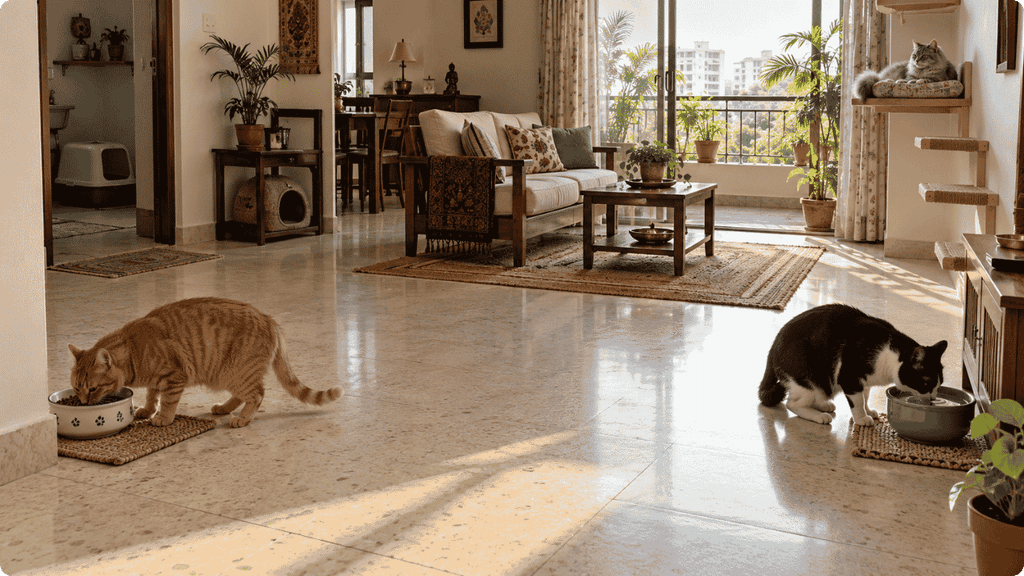
A cat needs five essential resources — food, water, resting places, litter trays, and points of entry and exit into its territory — distributed so it can reach each one freely at any time without having to interact with another cat. It also needs somewhere private to hide and a high vantage point.
In a two-cat flat, that means two of everything, placed apart. Not two bowls side by side.
One case in the paper makes the point. A 10-year-old Burmese in a multi-cat household presented with severe tongue mutilation after a fight with another cat. He was managed with behavioural modification alone — redistributing resources so every cat had free access without confrontation — and had no further mutilation episodes.
Why diagnosis takes time
FOPS is a diagnosis of exclusion. There is no blood test, scan or biopsy that confirms it. A vet reaches it by systematically ruling out every other cause of oral or facial pain.
This matters because the signs overlap almost completely with far more common and far more treatable problems: periodontal disease, tooth resorption, a fractured tooth with an exposed pulp cavity, oral tumours, foreign bodies, and viral mouth ulceration.
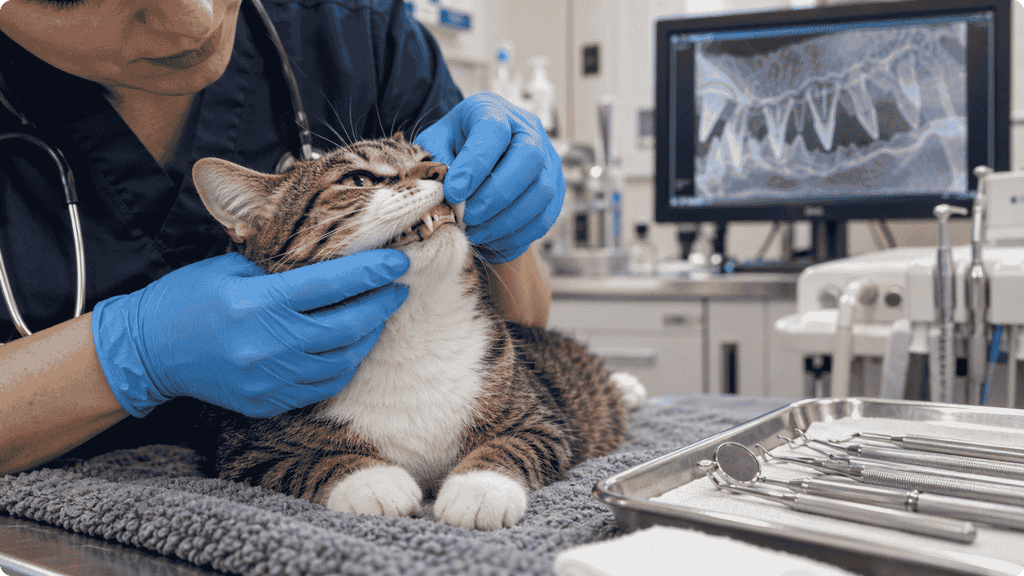
A proper workup means a thorough oral examination, usually under sedation, plus dental radiographs. The study’s authors specifically recommend X-rays because they find lesions a visual check misses. Among the 10 cats that received dental X-rays, pathology was found in seven.
One illustrative case: a five-year-old domestic shorthair presented with left-sided tongue mutilation. The cause was a fractured upper canine with an exposed pulp cavity. The tooth was removed and the pain managed with a reducing course of medication.
Treating the tooth is not an alternative to investigating FOPS. It is part of it.
What owners should actually do
Act on the pattern, not the diagnosis. If your cat starts pawing repeatedly at its mouth, chewing oddly, refusing food, or — most alarmingly — biting at its own tongue, book a veterinary appointment. Do not wait to see if it passes.
Ask for a sedated oral exam with dental X-rays, not a quick look in a consulting room. Subtle lesions are invisible otherwise.
Do not medicate at home. The drugs used for FOPS are prescription medicines with real risks, including liver complications. Several cats in the study suffered serious consequences from treatment. Nothing in this article is a dosing guide.
Protect the cat from itself, temporarily. If mutilation is happening, an Elizabethan collar, paw bandaging or soft nail caps can prevent further injury while a vet investigates. The researchers make a pointed ethical note here: preventing mutilation without treating the underlying pain is unacceptable. The collar buys time. It is not treatment.
Look at the household. If your cat lives with other cats, run through the five-resources checklist above. It costs nothing and may help regardless of what the diagnosis turns out to be.
Being honest about outcomes
Most articles on FOPS soften this part. It shouldn’t be softened.
Twelve of the 113 cats were euthanised because of the condition. A thirteenth was euthanised after developing diabetes thought to result from long-term steroid treatment. Seventy-five had recurrent or ongoing problems, averaging three episodes about two years apart.
Against that, 53 cats were successfully managed, with medication withdrawn entirely or between episodes. Among cats that first presented with dental disease, 22 of 48 had complete and sustained resolution once the dental problem was treated.
The picture is genuinely mixed. Many cats do well — and the ones who do best are usually the ones whose dental problems were found and fixed early.
That is the whole argument for awareness. Not so owners can diagnose a rare neurological condition, but so that a cat pawing at its face gets seen by a vet this week instead of next month.
Editorial note: This condition is rare, and its symptoms overlap with far more common illnesses. This article is for awareness, not self-diagnosis, and no medication should be given to a cat except on veterinary prescription. If your cat shows persistent, unusual, painful or rapidly worsening symptoms, consult a qualified veterinarian.
Sources
- Rusbridge C, Heath S, Gunn-Moore DA, Knowler SP, Johnston N, McFadyen AK. “Feline orofacial pain syndrome (FOPS): a retrospective study of 113 cases.” Journal of Feline Medicine and Surgery, 2010;12(6):498–508. doi:10.1016/j.jfms.2010.03.005 (free full text)
- Heath S, Rusbridge C, Johnson N, Gunn-Moore D. “Orofacial pain syndrome in cats.” Veterinary Record, 2001;149:660.
- “Successful treatment of a Himalayan cat with feline orofacial pain syndrome.” Veterinary Record Case Reports. doi:10.1002/vrc2.949
- “Neuropathic pain in cats: mechanisms and multimodal management.” Journal of Feline Medicine and Surgery, 2024. doi:10.1177/1098612X241246518
Pets News Network is India’s first dedicated media platform for the pet and animal industry. For breaking global pet news, brand coverage, and advertising enquiries, contact: info@petsnewsnetwork.com