
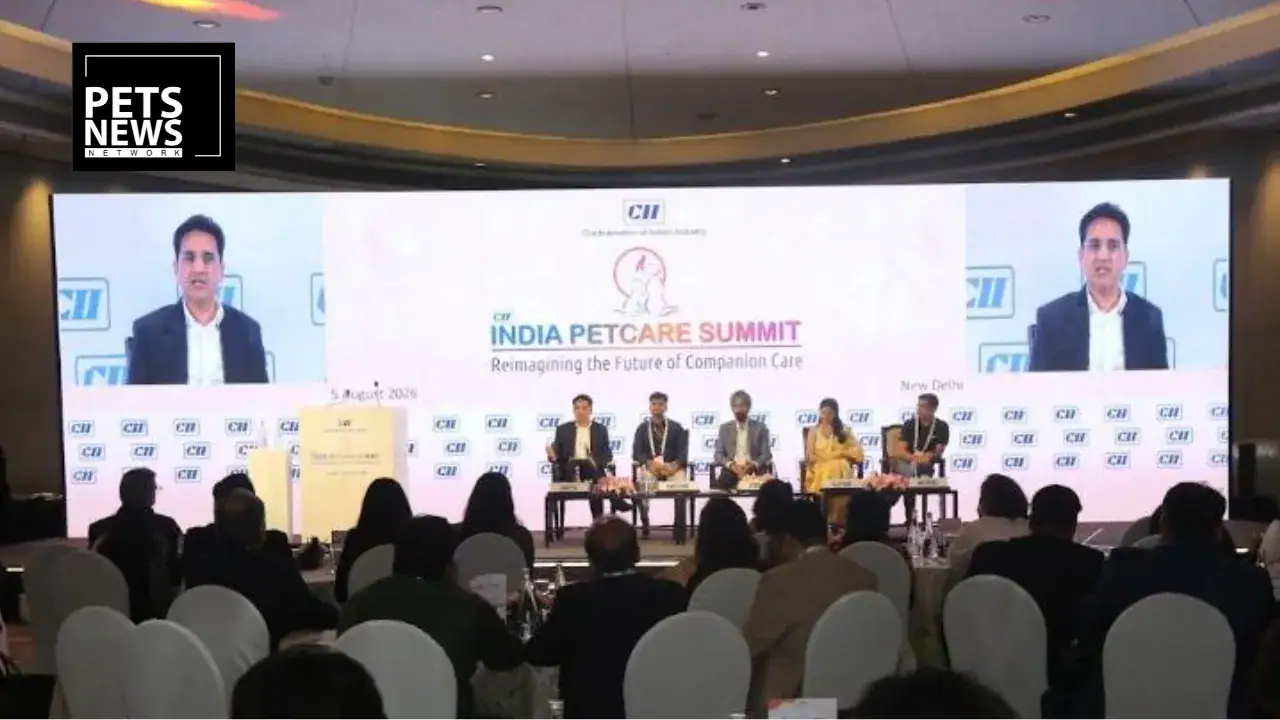

According to a Euromonitor International report unveiled at the CII India Petcare Summit 2026 in New Delhi this week, India’s pet care sector is projected to cross ₹11,000 crore by 2031, growing at 8% CAGR between 2026 and 2031. The summit, organised by the Confederation of Indian Industry under the theme “Reimagining the Future of Companion Care,” brought together government policymakers, standards regulators, veterinarians, and leaders from India’s biggest pet food and pet care companies.
First, let us say what needs to be said about events like this: they matter. Getting regulators, manufacturers, veterinarians, and policymakers in the same room — talking about standards, labelling, veterinary infrastructure, and consumer trust — is exactly the kind of conversation India’s pet industry needs to be having. More of these summits, more of this dialogue. No argument there.
But conversations need to be interrogated. Numbers need to be questioned. And the gap between what gets said in a conference room and what actually happens on the ground is something this industry can no longer afford to paper over with optimism.
The ₹11,000 Crore Question: Where Does This Number Come From?
The headline figure — ₹11,000 crore by 2031, growing at 8% CAGR — comes from a Euromonitor International report. Euromonitor is a reputable global market research firm, and its reports are widely cited across industries.
But citing a number and understanding a number are two different things.
At the time of this article’s publication, the full Euromonitor report has not been made publicly available for independent review. The methodology behind the projection — the assumptions about pet population growth, packaged food penetration rates, income growth curves, urbanisation trends, and consumer behaviour shifts — has not been published in a form that allows independent verification.
This matters. Not because the number is necessarily wrong, but because ₹11,000 crore is a number that will now be cited in pitch decks, investor presentations, government submissions, and brand strategy documents across the Indian pet industry for the next several years. When a number travels that far, its origin story needs to travel with it.
What household survey data is this projection based on? What is the current verified baseline from which 8% CAGR is being calculated? What assumptions does it make about pet population growth — and are those assumptions based on registered animals, estimated free-ranging dog populations, or something else entirely? How does it model the difference between urban premium consumption and Tier 2 and Tier 3 market behaviour?
These are not hostile questions. They are the questions any serious investor, policymaker, or industry professional should be asking before building strategy around a single projected figure.
The Other Numbers in the Room
The Euromonitor report also shared figures on packaged pet food penetration — only 9% of India’s pet dogs and 27% of pet cats are currently fed packaged pet food, it states, even though pet food accounts for 86% of the category’s total retail value.
Again, the instinct to share these figures at a summit is right. Low penetration in a growing market is a legitimate argument for sector investment. But these numbers also demand scrutiny.
India’s pet dog population estimates vary enormously depending on the source — from 26 million in some government-linked data to well over 60 million when free-ranging street dogs are included. The 9% packaged food penetration figure means very different things depending on which denominator is being used. If it is based on registered or identified companion dogs only, the market opportunity it implies is significantly different from what the same figure suggests when applied to the total estimated dog population.
The industry deserves to know which population this figure is derived from, what survey methodology captured it, and how recently the data was collected.
What the Summit Got Right
Setting aside the data questions, the conversations at the CII summit reflect exactly the right priorities.
Dr. Naveena Kumar, Animal Husbandry Commissioner at the Department of Animal Husbandry and Dairying, called for science-based nutrition standards, sustainable manufacturing, ethical breeding practices, and greater investment in veterinary infrastructure and research. Dr. Sujit Kumar Dutta, Joint Commissioner at the same department and Secretary of the Animal Welfare Board of India, pushed for skilled veterinary manpower and expanded domestic manufacturing capacity.
These are not abstract bureaucratic concerns. India has a genuine veterinary capacity problem. The ratio of veterinarians to animals — pet and agricultural — is well below what a growing companion animal market needs to function safely and responsibly. Addressing that gap requires sustained government investment in veterinary education and infrastructure. It cannot be solved by the private sector alone.
The panel on India’s pet food regulatory ecosystem — moderated by Manish Syag of Mars Pet Nutrition India — correctly identified globally aligned regulation and labelling transparency as the foundation on which consumer trust is built. Pradeep Sharma of the Bureau of Indian Standards confirmed that the ongoing revision of India’s pet food standard aims to align it with current science and global best practices. Satinder Singh of Royal Canin framed it simply: the future-ready pet care ecosystem needs to rest on three pillars — pets first, science, and trust.
Pallavi Anand of Nestlé Purina Petcare and Aman Tekriwal, co-founder of Supertails, were both right to highlight clear, standardised labelling as a priority. India’s pet parents — especially the Millennials and Gen Z cohort now driving adoption — are researching before they buy, demanding evidence before they trust, and making more informed decisions than any previous generation of pet owners. Labelling that meets them where they are is not a regulatory nicety. It is the commercial baseline for the next decade.
The demographic observation in the Euromonitor report — pet ownership growing at approximately 5% CAGR, led by younger pet parents seeking premium, health-focused products — is consistent with what every honest market observer in India is seeing on the ground. That part does not require proof. Walk into any premium pet store in Mumbai, Delhi, or Bengaluru and you will see it in the basket contents and the age of the person carrying it.
The Part Nobody Said Loudly Enough
Here is what needs to be said now, clearly and without diplomatic softening.
India’s pet industry is very good at summits. It is very good at projections. It is very good at panels with the right people in the right seats saying the right things. The CII India Petcare Summit is a quality event and the conversations happening there are important.
What India’s pet industry has not yet demonstrated — not consistently, not at scale — is the ability to translate those conversations into ground-level change within a reasonable timeframe.
The Bureau of Indian Standards revision of the pet food standard has been discussed for years. The veterinary infrastructure gap has been acknowledged at every industry event PNN can remember. The labelling transparency problem has been on the agenda since before the term “humanisation of pets” entered common usage in Indian marketing decks.
How many of these conversations have produced measurable, verifiable outcomes that a pet parent in Jaipur or a small manufacturer in Coimbatore can point to today?
Summits are where clarity begins. Execution is where it actually lives. The gap between those two places is where India’s pet industry keeps losing time it does not have.
The ₹11,000 crore projection for 2031 gives the industry five years. That is not a long runway for the regulatory, veterinary, and institutional work being described. The timeline demands urgency, not another year of well-attended panels.
The CII summit asked the right questions this week. Now the industry needs to answer them — not in the next agenda item, but in the next action taken.
Editorial Note: This article is an editorial analysis of information presented during the CII India Petcare Summit 2026, including market projections attributed to Euromonitor International. It is based on publicly available information at the time of publication. Pets News Network does not assert that the reported figures are inaccurate; rather, this analysis examines the transparency of the underlying methodology and raises questions that we believe are relevant to informed industry discussion. Should additional methodology or clarifications become publicly available, we will review and update this article as appropriate.
Pets News Network is India’s first dedicated media platform for the pet and animal industry. For breaking global pet news, brand coverage, and advertising enquiries, contact: ankur@petsnewsnetwork.com