
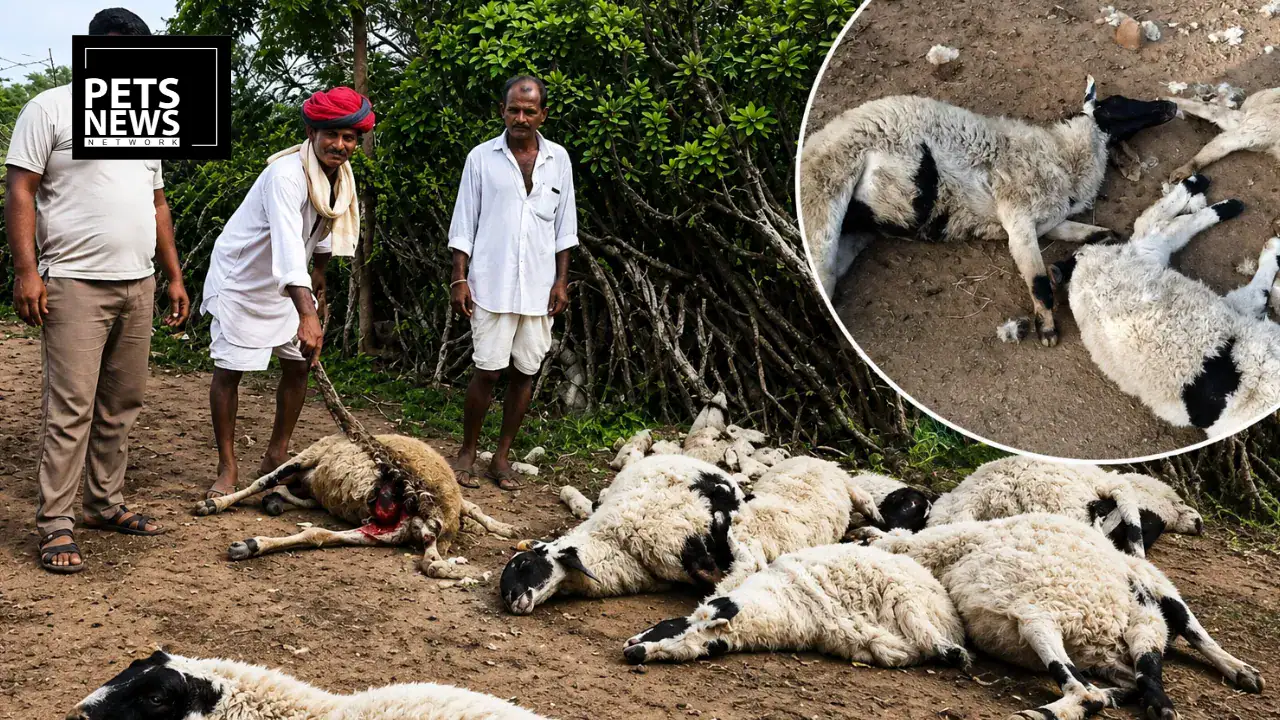

Residents of Chandgarh village, in the Badliyas region of Rajasthan’s Bhilwara district, woke up to a scene of shock and loss this week, after an unidentified predator slaughtered 16 sheep in a single overnight attack. The incident has left local livestock owners reeling and stirred fresh anxiety across nearby rural communities about the movement of wild predators close to human settlements.
For families whose livelihoods depend directly on their livestock, a loss of this scale isn’t just distressing, it’s a significant financial and emotional blow, one that has quickly reverberated through the wider village community.
What Happened in Chandgarh
According to local authorities and villagers, the attack took place overnight, with the sheep discovered dead the following morning inside their enclosure. The sheer number of animals killed in a single incident, 16 in total, points toward a predator capable of sustained, repeated attacks within a confined space, rather than an isolated single strike.
Both local authorities and villagers suspect the culprit was a leopard that strayed into the settlement from nearby forest areas, a pattern that has become increasingly familiar in parts of Bhilwara district in recent months. Similar wild animal attacks on livestock have been reported in neighbouring areas of the district recently, with leopards frequently suspected as the predator involved, reflecting a broader, ongoing pattern of human-wildlife conflict across the region’s rural belt.
Officials, including local police and veterinary teams, are expected to examine the site and the carcasses to help confirm the exact predator responsible, a standard part of the investigative process following livestock attacks of this nature in the region.
Why Predators Are Increasingly Straying Into Human Settlements
Incidents like the one in Chandgarh are rarely isolated events. Across Rajasthan and other parts of India, wildlife experts and forest officials have pointed to several converging factors that push predators, particularly leopards, out of their natural forest habitats and into villages and farmland.
Habitat fragmentation is one of the most significant drivers. As forest cover shrinks and becomes increasingly broken up by agricultural expansion, roads, and human settlement, leopards and other predators find their traditional territories reduced and disconnected, forcing them to travel through, or settle near, human-populated areas simply to survive.
Seasonal water and prey scarcity compounds the problem further. During drier months or periods of reduced natural prey availability, predators are more likely to venture toward villages, where livestock such as sheep and goats represent a far easier, more accessible food source than hunting wild prey in a shrinking forest habitat.
Proximity to riverbeds and scrub forest also plays a role in districts like Bhilwara, where forest and riverine terrain often sit close to agricultural land and rural settlements, creating natural corridors that leopards use to move between habitat patches, corridors that inevitably pass near or through villages like Chandgarh along the way.
Taken together, these factors mean that as long as habitat pressure continues and villages remain positioned near fragmented forest edges, similar attacks are likely to keep occurring, not because predators are becoming more aggressive, but because the buffer between wild habitat and human settlement keeps shrinking.
What Livestock Owners Can Do to Reduce Risk
While no single measure can fully eliminate the risk of predator attacks in areas where human and wildlife territories overlap, several practical steps can meaningfully reduce vulnerability for livestock owners in regions like Bhilwara.
Strengthening enclosures. Standard temporary pens, often made of thin fencing or loosely stacked materials, offer minimal resistance to a determined leopard. Reinforcing enclosure walls with sturdier materials and increasing their height can make a significant difference in preventing predators from leaping or breaking through.
Predator-proof enclosure designs. In regions with recurring wildlife conflict, forest departments and agricultural extension programmes have increasingly promoted predator-resistant enclosure designs, structures with covered tops, reinforced walls, and secure latching systems specifically engineered to withstand attempts by leopards and other predators to enter.
Installing basic alert systems. Simple measures like motion-activated lighting or noise-based deterrent systems near livestock enclosures can help startle and deter predators before they’re able to enter, buying crucial time for livestock owners to respond if an animal does approach during the night.
Keeping livestock closer to occupied areas. Where possible, positioning enclosures nearer to actively used family dwellings, rather than in more isolated corners of a property, can reduce the likelihood of a predator approaching undetected, since human presence and activity naturally act as a partial deterrent.
Reporting sightings promptly. Villagers who notice pug marks, livestock disturbances, or direct sightings of a leopard near settlements are encouraged to alert local forest department officials quickly, allowing wildlife teams to assess the situation, potentially set up monitoring or trapping efforts, and issue safety advisories to the wider community before further incidents occur.
Balancing Livelihoods and Wildlife Conservation
It’s worth remembering that incidents like the one in Chandgarh sit at a genuinely difficult intersection: the real, immediate hardship faced by livestock owners who depend on their animals for income, and the broader ecological reality that leopards, as a protected species, are themselves responding to shrinking, fragmented habitat rather than acting out of unusual aggression.
Addressing this tension sustainably requires more than reactive measures after each incident. Continued habitat protection, functional wildlife corridors that reduce the need for predators to pass through populated areas, and accessible compensation mechanisms for affected livestock owners all play a role in easing the pressure on both sides of this ongoing conflict.
A Community on Edge
For now, the immediate reality in Chandgarh is one of loss and heightened vigilance. Local livestock owners are likely to reinforce their enclosures and stay more alert in the coming weeks, while forest department officials continue monitoring the area for further leopard activity.
As similar incidents continue to surface across Bhilwara district, the Chandgarh attack serves as another reminder of how closely rural communities in this part of Rajasthan live alongside wildlife, and how much both preparedness and coexistence-focused planning matter in reducing the human and animal cost of these encounters going forward.
Pets News Network is India’s first dedicated media platform for the pet and animal industry. For breaking global pet news, brand coverage, and advertising enquiries, contact: ankur@petsnewsnetwork.com