
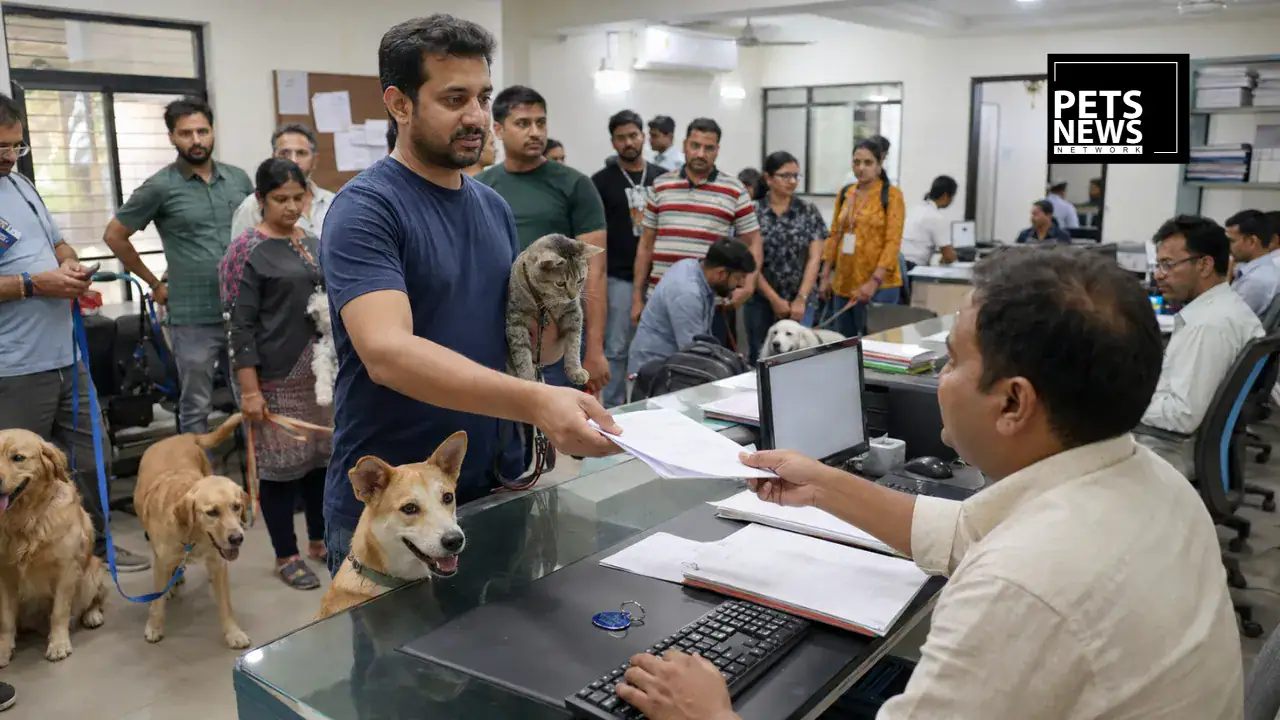

More than a year and a half after Ahmedabad made registration compulsory for pet dogs, the city is still struggling to bring a large share of its companion animals into the official civic database.
According to the latest Ahmedabad Municipal Corporation (AMC) figures, 19,816 pet dogs and 263 pet cats had been registered by August 25, 2026. Dog registrations have been collected since January 1, 2025, while mandatory registration for pet cats began only in July this year.
The programme is intended to help AMC identify owned animals, maintain vaccination records and strengthen disease-control planning, particularly around rabies. But repeated extensions, publicity campaigns and rising fees have not produced the level of participation officials had hoped for.
For Ahmedabad, the drive is becoming a test of whether a fast-growing Indian city can move from largely informal pet ownership to a more structured system of identification, vaccination tracking and civic responsibility.
Dog registration fees have climbed from ₹200 to ₹2,000
When AMC launched mandatory dog registration in January 2025, the fee was ₹200 per animal.
As deadlines were extended, it was progressively increased to ₹500, ₹1,000 and eventually ₹2,000 per dog. The ₹2,000 charge remains applicable for the current registration window running from July 1 to September 30, 2026.
The increases were intended partly to encourage pet owners to register early. Yet earlier registration data suggests cost may also have influenced participation.
By May 31, 2025, when registration still cost ₹200, more than 16,000 dogs had been enrolled. Registrations slowed sharply after subsequent fee increases, and AMC officials have previously acknowledged that the higher charge could be one reason for the weaker response.
Pet cats follow a different fee structure. They can currently be registered for ₹200 each until September 30, meaning the ₹2,000 charge applies to dogs, not cats.
Nearly 20,000 dogs registered, but the gap remains large
Estimates of Ahmedabad’s pet dog population have varied. AMC initially cited roughly 50,000 to 60,000 dogs, while officials later revised the estimate to around 30,000–35,000 after consultations with veterinarians. Recent civic reporting has again referred to a population of around 50,000.
Whichever estimate is used, the registry remains incomplete.
On August 5, when registrations stood at 19,746, civic officials said the database covered just under 40% of an estimated 50,000 pet dogs. By August 25, the total had increased only slightly to 19,816.
The slow movement is notable because AMC has promoted the programme through social media, newspapers, LED displays and veterinary clinics, while registration help desks have also been used to assist owners.
Officials have pointed to another challenge: although registration is mandatory, AMC has said it lacks a strong penalty mechanism to compel compliance, leaving the civic body largely dependent on awareness campaigns, persuasion and higher fees.
West Zone leads Ahmedabad’s dog registrations
The latest zone-wise figures show the largest concentration of registered dogs in western Ahmedabad.
West Zone leads with 5,014 registrations, followed by North West Zone with 4,120. East Zone has recorded 2,860 dogs, while South West Zone has 2,652.
South Zone accounts for 2,382 registrations, North Zone 2,008, and Central Zone has the lowest count at 780.
Commonly registered breeds include Labradors, German Shepherds, Pomeranians, Siberian Huskies, Shih Tzus, Pugs, Dobermans and Golden Retrievers. Earlier AMC datasets consistently placed Labradors at the top of the city’s registered-breed list.

Cat registration has an even longer way to go
AMC expanded the system to cats on July 9, 2026, giving owners until September 30 to enrol their pets for ₹200.
By August 25, only 263 cats had been registered.
Of these, 99 were classified as native-breed cats and 164 under other breeds. North West Zone recorded the highest number, with 64 registrations.
The figure is especially small against AMC’s estimate that Ahmedabad may have around 5,000 pet cats.
Owners are required to provide identity and address documents, photographs and vaccination records. Annual vaccination documentation is also expected to be maintained, helping the civic body build a more useful health and ownership database.
Registration is tied to Ahmedabad’s rabies-control strategy
The initiative is more than an administrative licensing exercise.
AMC has linked registration to its wider animal-management and rabies-prevention strategy. The programme aligns with India’s National Action Plan for Dog-Mediated Rabies Elimination by 2030, which aims for zero human deaths from dog-mediated rabies by the end of the decade.
For a municipal authority, reliable ownership records can help monitor vaccination, identify pets and owners, improve traceability and support responses when an owned animal is involved in a bite incident or becomes lost.
That is why the effectiveness of the registry matters beyond the registration total itself. A civic database can only support public-health planning if it captures a meaningful share of the animals living in the city.
AMC is also expanding dog shelter capacity
Alongside registration, AMC is increasing infrastructure for managing aggressive and stray dogs.
The civic body has established kennels at four locations with a combined capacity of 657 dogs.
Two additional shelters are under construction at Vastral and Lambha, together expected to create space for another 600 dogs.
The projects form part of a wider municipal approach that combines registration, vaccination monitoring, sheltering and animal-management measures. But infrastructure alone cannot close the information gap if thousands of owned animals remain outside the official registry.
A bigger urban pet-management challenge
Ahmedabad’s experience highlights a problem other Indian cities are also likely to confront as companion-animal populations grow: making a registration rule is easier than achieving widespread compliance.
Cost, awareness, convenience and enforcement can all shape whether pet parents participate. Ahmedabad’s experience also suggests that repeated fee hikes do not automatically translate into higher registration numbers.
With the current window running until September 30, 2026, AMC still has an opportunity to bring more dog and cat owners into the system.
For pet parents, registration increasingly sits at the intersection of ownership, vaccination and public responsibility. For civic authorities, a more complete database could improve planning and make animal-management policies more precise.
Ahmedabad’s next challenge is therefore not simply extending another deadline. It is making registration meaningful enough—and accessible enough—for pet owners to see it as a routine part of responsible urban pet parenting.
Pets News Network is India’s first dedicated media platform for the pet and animal industry. For breaking global pet news, brand coverage, and advertising enquiries, contact: info@petsnewsnetwork.com