
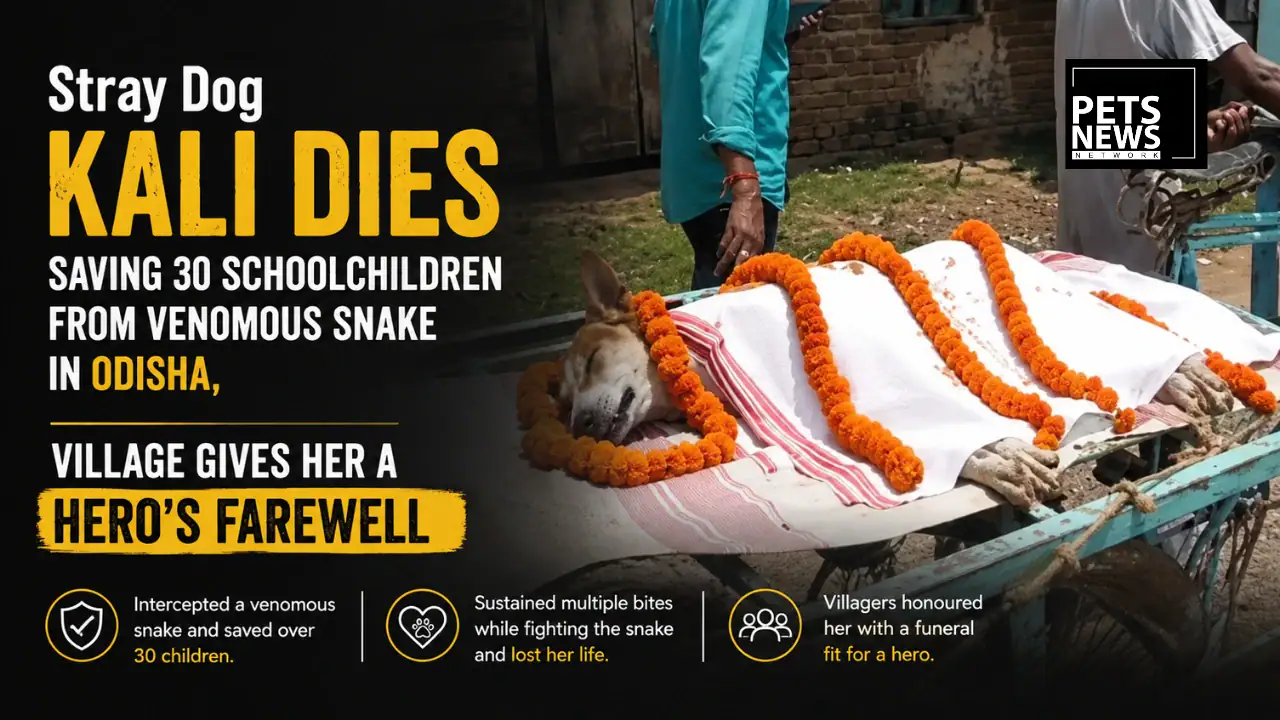

A community street dog named Kali is being remembered as a hero in Odisha’s Mayurbhanj district after she died confronting a venomous snake that had moved dangerously close to more than 30 young schoolchildren.
The incident took place in Dhirakula village under Udala block, near Sri Jagannath Sishu Vidya Mandir, where kindergarten-age children were gathered outside the school at around 8:30 in the morning.
According to local reports, the children were sitting near the school when a venomous snake approached the group.
Before it could reach them, Kali moved between the snake and the children and attacked.
What followed was a violent encounter that ended with the snake dead, no children injured — and Kali fatally envenomed.
The dog’s death prompted an extraordinary response from the village. Residents covered her body in white cloth, decorated her with flowers and carried her through the village in a funeral procession before burial.
Reports differ on the exact date, but not on what happened
Later national coverage, including reports based on ANI material, placed the incident on April 20, 2026.
However, the earliest local report located by Pets News Network was published by OrissaPOST on April 14 and datelined Udala, April 13, describing the incident as having happened on a Monday morning.
Because those timelines conflict, the exact date should be treated cautiously.
What is consistent across the reporting is the core account: more than 30 kindergarten children were outside Sri Jagannath Sishu Vidya Mandir, a venomous snake approached, Kali intervened, the snake was killed, Kali was bitten and later died, and no child was reported injured.
Later coverage widely identified the snake as a cobra, while the original local report described it more generally as a poisonous or venomous snake.
Kali moved before the danger reached the children
According to accounts from villagers and school representatives, adults were attempting to deal with the approaching snake when Kali attacked it.
School owner Ramesh Chandra Prusty told ANI-linked media that the dog pounced on the snake and prevented it from moving towards the children.
Reports say Kali sustained bites around the mouth and face while continuing to fight. Despite being injured, she remained engaged until the snake was killed.
The children escaped without injury.
Kali, however, could not survive the venom and died later.

A familiar community dog, not simply an anonymous “stray”
The word “stray” can sometimes hide the complicated place free-roaming dogs occupy in Indian communities.
Kali did not appear to belong to one household, but reports describe her as a familiar and well-liked dog around Dhirakula.
Many community dogs live without a conventional owner while still developing regular relationships with residents and children who recognise or interact with them.
In Kali’s case, villagers knew her well enough to mourn her collectively.
Accounts from the village describe her as dear to residents, and the scale of the farewell after her death suggests she was regarded as part of the social fabric of the neighbourhood rather than simply an unidentified animal on the street.
Villagers gave Kali a farewell usually reserved for humans
The aftermath was as striking as the rescue itself.
Residents placed Kali’s body on a trolley and covered her with a white cloth and flowers.
A procession then moved through the village before she was buried.
The ceremony was conducted with the participation of local residents, and the original OrissaPOST report identified Ramesh Chandra Prusti among those supervising the last rites.
Kali was a street dog, yet residents chose to honour her using rituals associated with human loss and remembrance.
Villagers were quoted as saying that Kali had saved their children and would remain in their hearts.
The story complicates India’s debate around street dogs
Kali’s story emerged at a time when street-dog management remains one of India’s most emotionally and politically charged animal-welfare issues.
Dog bites, rabies prevention, sterilisation and the presence of free-roaming dogs around public spaces are legitimate safety concerns. One heroic incident should not be used to dismiss them, but street dogs also cannot be understood only through conflict incidents.
Many live for years within neighbourhoods, developing stable relationships with the people around them and sometimes acting as informal watchdogs.
Kali’s story gives that side of the human–dog relationship unusual visibility.
Protective behaviour in dogs can emerge from social bonds
A dog confronting a snake does not necessarily mean it consciously understood every consequence of the danger facing the children.
Animals can react through territorial behaviour, prey drive, threat response or attachment to familiar people.
But whatever combination of instincts drove Kali’s response, the outcome was clear: she placed herself between a dangerous animal and a group of young children and remained in the fight despite sustaining serious bites.
That is why the community interpreted her action as protective.
For the villagers who knew her, the distinction between instinct and deliberate sacrifice mattered less than the result: the children went home safely, while Kali did not.
The school community was left with an unlikely guardian story
Several core details are supported across local and national reports.
A dog known as Kali was present near more than 30 children.
A venomous snake approached.
Kali fought it.
The snake died.
The children were unharmed.
Kali died after being bitten.
And the village organised a ceremonial farewell.
Those facts are powerful without embellishment.
From street dog to remembered protector
Dhirakula’s response to Kali also says something about how quickly the social identity of an animal can change.
Before the incident, she was one of the village’s free-roaming dogs.
After it, residents spoke about her as a protector whose actions deserved public recognition.
That shift does not solve the larger policy challenges around India’s street-dog population, but it is a reminder that coexistence between people and community animals is rarely one-dimensional.
Kali’s story belongs to the latter.
She was not a pedigreed pet, a trained service animal or a professionally trained guard dog.
She was simply a familiar village dog who, in one dangerous moment outside a small Odisha school, acted before anyone else could.
More than 30 children walked away unharmed.
The village made sure Kali did not leave without being remembered.
Pets News Network is India’s first dedicated media platform for the pet and animal industry. For breaking global pet news, brand coverage, and advertising enquiries, contact: info@petsnewsnetwork.com