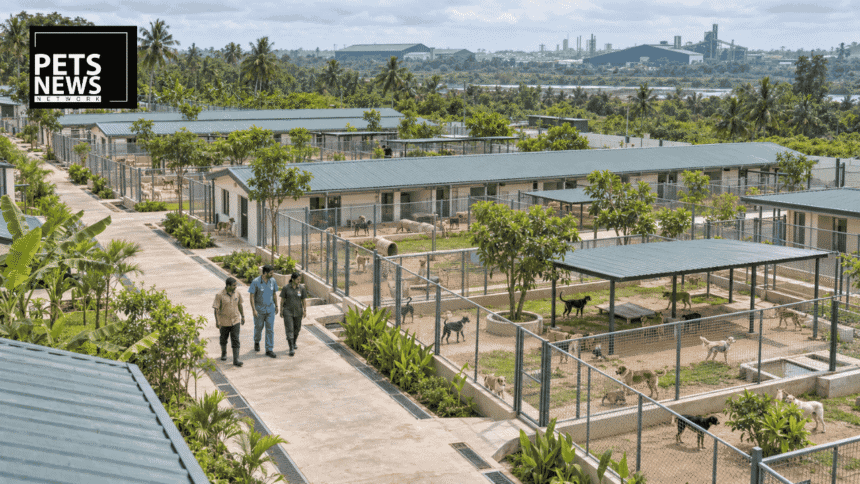
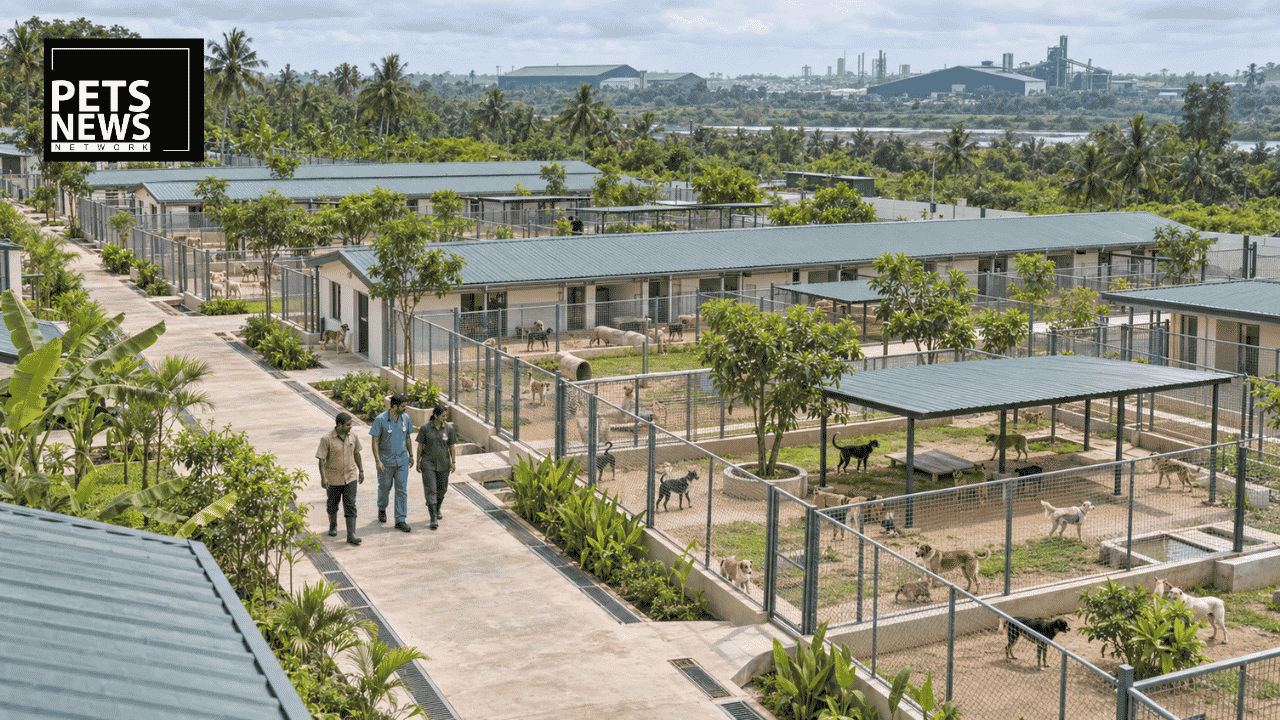

Kochi Corporation has finalised the design for its stray dog shelter at Brahmapuram. Ground levelling is done, fencing starts shortly, and the construction tender goes out within days. It is a real project with a real budget, moving faster than most municipal animal infrastructure in India. It is also a 500-dog facility in a city with roughly 12,000 stray dogs, on a site that filled Kochi with toxic smoke for twelve days in 2023. Both things are true, and the second part has gone almost entirely unreported.
What has been announced
The fencing of the site earmarked for the Kochi Corporation’s dog shelter at Brahmapuram will begin shortly. The Corporation has said levelling of the ground is complete.
The shelter is being funded from the Corporation’s annual plan fund, and it will also seek financial support from public sector undertakings such as BPCL Kochi Refinery.
Seena Gokulan, chairperson of the Corporation’s health standing committee, has said the design of the shelter has been finalised and the construction tender will be invited within a few days.
The design process itself was unusually open. The Corporation invited designs from students, experts and members of the public before settling on the final plan.
Under that design, the shelter will accommodate 500 dogs in the first phase.
What the facility will contain
The plan is more detailed than most municipal shelter proposals in India, and that deserves acknowledgement.
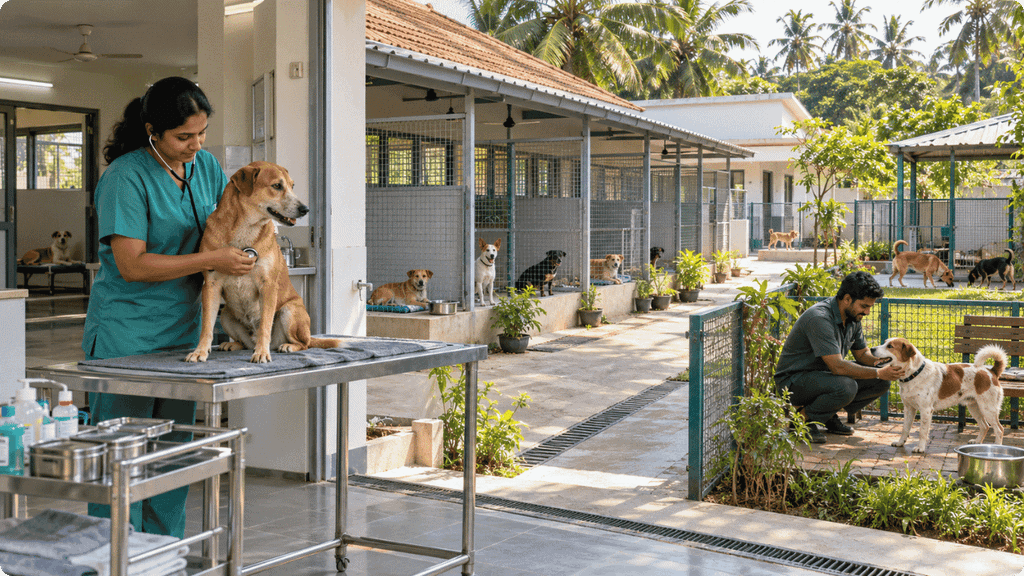
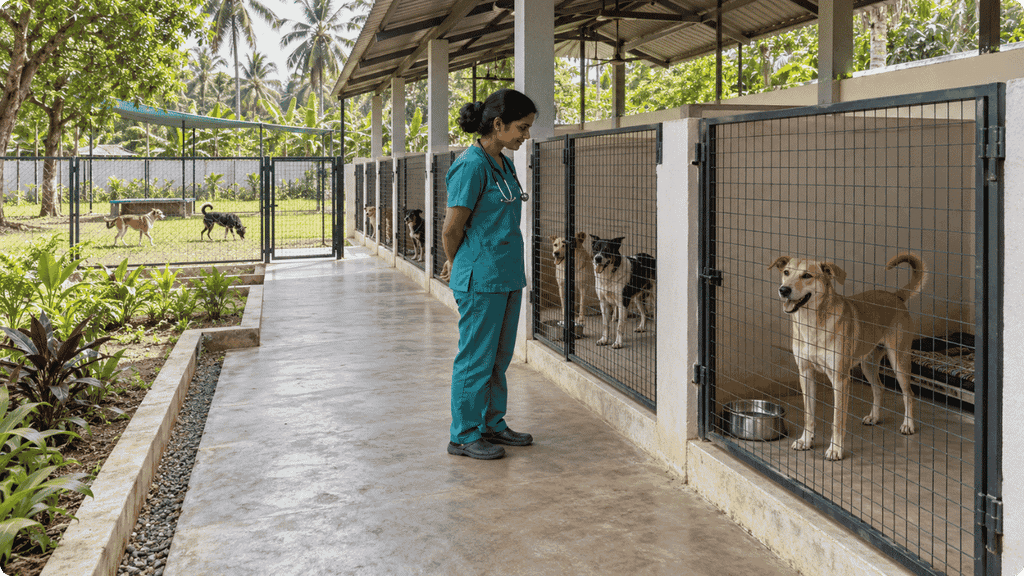
The shelter will include:
- An observation block
- A post-operative block
- A quarantine block
- A disabled ward
- Facilities for cooking food and storing medicines
- CCTV surveillance
- An adoption centre operating alongside
A quarantine block and a disabled ward are not standard inclusions in Indian municipal dog shelters. Neither is an adoption centre built into the same campus. A shelter with an adoption pipeline is a shelter with an exit route — which is the difference between a holding facility and a rehoming one.
Animals will be sterilised before being moved to the shelter. The Corporation has said construction will adhere to animal welfare board guidelines.
The first number: 500 against 12,000
In August 2025, the then chairman of the Corporation’s health standing committee, TK Ashraf, put the stray dog population within Corporation limits at roughly 12,000, of which about 8,000 had already been sterilised.
Against that, a first-phase capacity of 500 is about four per cent of the city’s stray dogs.
This is not necessarily a flaw. A shelter is not meant to hold every stray dog, and under current law it should not try to. What the number does is set expectations: this facility will not clear Kochi’s streets, and was never going to. Its realistic function is to hold aggressive and rabid animals, dogs removed from institutional premises, and animals awaiting adoption.
Reported as a solution to the stray dog problem, it will disappoint. Reported as what it is — a piece of infrastructure the city has lacked — it is a genuine step.
A correction on the Supreme Court position
Coverage of this plan has described it as following a Supreme Court ruling that mandates the removal of stray dogs from public areas.
That is not the current position.
The Supreme Court order of 11 August 2025 did direct the removal of strays in Delhi-NCR to shelters. On 22 August, a three-judge bench modified it, calling the earlier direction too harsh. Under the modified order, dogs are to be sterilised, dewormed, immunised and released back to the same area from which they were picked up — except those infected with rabies or exhibiting aggressive behaviour, who are to be kept separately.
The court separately directed that institutional premises — schools, hospitals, bus stands, railway stations — be cleared of strays, prohibited street feeding, and ordered municipal bodies to create dedicated feeding spaces in each ward. It also transferred stray dog matters pending in high courts to itself and impleaded all states.
So a shelter is squarely justified under the current directions — for aggressive and rabid dogs, for animals taken from institutional premises, and for adoption. But “removing dogs from public areas” is not what the Supreme Court now requires, and a shelter built on that premise would be built for the wrong purpose.
The second number: 185 square metres for 100 dogs
The published plan allocates 185 square metres for 100 dogs.
That works out to 1.85 square metres per dog — roughly 20 square feet, or a space about 1.4 metres square.
For context, animal welfare activists in Bengaluru recently cited the animal welfare board’s recommendation as 400 square feet for a pair of dogs, which would be around 200 square feet per animal. On that basis, the Kochi allocation is approximately a tenth of the recommended space.
That comparison comes from activists quoted in the press rather than from the guideline document itself, so it should be treated as indicative. But the underlying distinction holds regardless of the exact figure, and it is the one that matters:
An ABC centre and a shelter are not the same facility. In an ABC programme, a dog is held for three to five days after sterilisation and then released. A compact kennel is appropriate for that. A shelter houses animals for months or indefinitely, and Kochi’s own plan states dogs will be sterilised before being moved there — which confirms this is long-stay accommodation, not post-operative holding.
Twenty square feet is defensible for five days. It is a different proposition for five months.
This is the single question PNN would put to the Corporation before construction begins, and it is answerable: is the 185 sq m figure the kennel footprint alone, or does it exclude exercise yards, corridors and common areas? If exercise space is additional, the plan is far more reasonable than the headline figure suggests. If it is not, the design should be revisited before the tender closes rather than after the concrete sets.
The question nobody is asking: why Brahmapuram
Brahmapuram is not a new animal site. The Corporation built a high-tech multispeciality veterinary hospital there in 2015, at a cost of around ₹1.20 crore, under its Mission Kochi 15-8-15 ABC-ARV programme. In August 2025 it added 30 cages at the same location for aggressive strays. Locating the shelter there is a continuation, not a fresh decision.
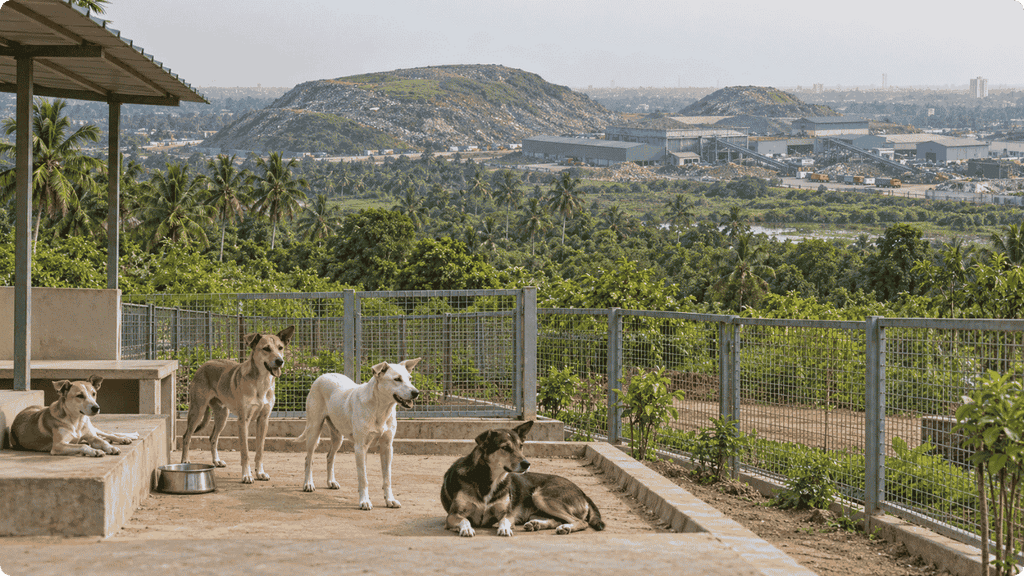
Brahmapuram is also Kochi’s legacy waste dumpyard.
On 2 March 2023, a fire broke out in the garbage mounds there. It burned for twelve days. Toxic smoke blanketed Kochi and neighbouring panchayats. The Kerala High Court observed that the fire had left the city in a “gas chamber-like situation”. The National Green Tribunal fined the Kochi Corporation ₹100 crore for its handling of solid waste at the site — a fine the High Court stayed that April. A second fire broke out at the plant on 26 March 2023.
The Corporation has worked on remediating the site since. But no published report on the shelter plan indicates that an air quality assessment has been carried out for animals housed there long-term, or what fire safety provisions exist for 500 caged animals adjacent to a legacy waste site.
This is a question, not an allegation. The veterinary hospital has operated there for a decade. But a day facility for short post-operative stays and a permanent home for 500 animals are different exposures, and the question deserves an answer on the record before the tender closes.
What to watch
The tender document. It will contain the space allocations, fire safety provisions and site specifications that the press release does not.
Whether the adoption centre is staffed. An adoption centre on a drawing is not an adoption programme. Rehoming requires people, outreach and follow-up — without which the shelter fills and stops.
The monthly compliance report. The Kerala High Court has directed local bodies across the state to file compliance reports by the 10th of each month, classified as full, part or non-compliant. Kochi’s progress on this shelter will appear in that record, which makes it unusually trackable.
Phase two. Five hundred is described as the first phase. What follows, and on what timeline, determines whether this is a facility or a plan.
Pets News Network is India’s first dedicated media platform for the pet and animal industry. For breaking global pet news, brand coverage, and advertising enquiries, contact: info@petsnewsnetwork.com