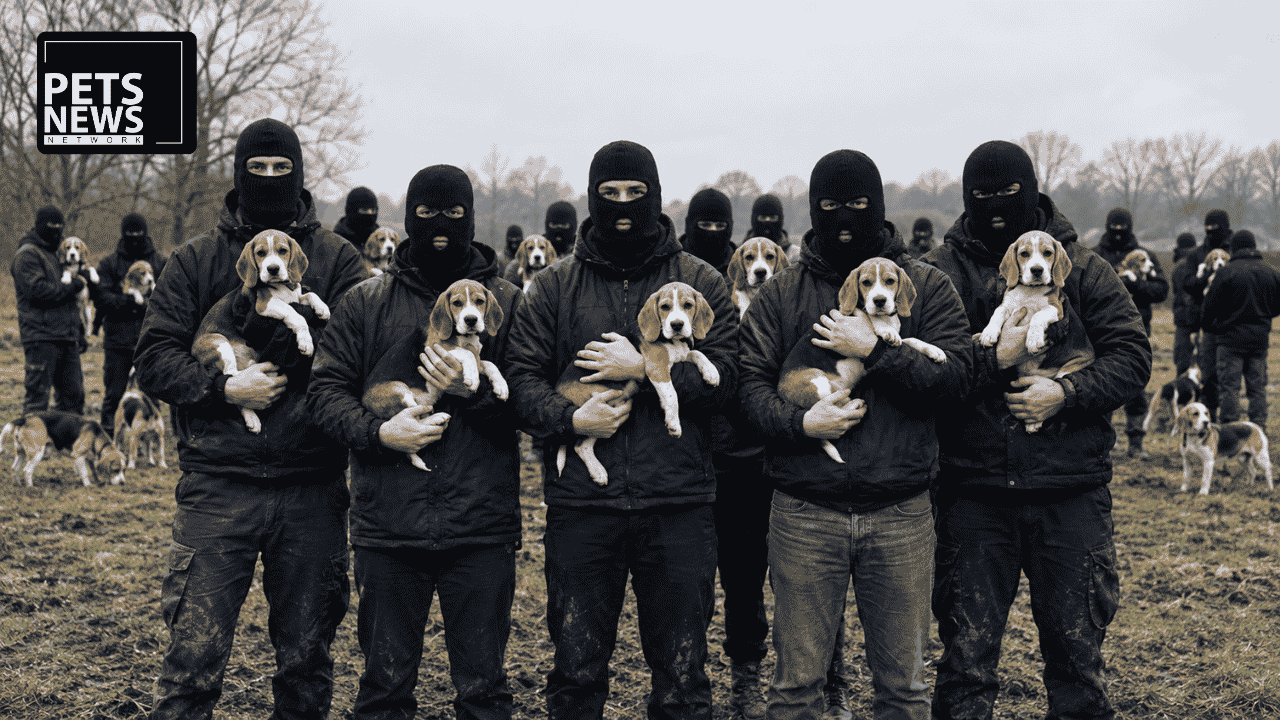

A graphic circulating on social media says there is an anonymous group that breaks into laboratories and farms to free animals. The group it describes appears to be the Animal Liberation Front. It is fifty years old, it is not anonymous in the way the post suggests, and two governments have treated it as a terrorist or extremist threat. None of that is in the graphic. Also missing: India’s draft rules governing laboratory animals are open for public objection, and the window closes on Thursday, 5 November 2026.
The group in the post is the Animal Liberation Front
| Founded | June 1976, United Kingdom |
| Founder | Ronnie Lee |
| Grew out of | The Band of Mercy, revived by Lee in 1972 |
| Reach | Reported active in more than 40 countries |
“Anonymous group” is the wrong description. The ALF has no membership, leadership or central organisation. Small cells or lone individuals act, and anyone who follows its stated guidelines may use the name. That is a name anybody can use, which also means nobody can vouch for who is doing what under it.
What the post leaves out
| United States | The Department of Homeland Security named the ALF a terrorist threat in January 2005, and in 2005 FBI and ATF officials told a Senate panel that violent animal rights extremists posed a serious terrorism threat |
| United Kingdom | Classified as domestic extremism, monitored by the National Extremism Tactical Coordination Unit, set up in 2004 |
The Animal Enterprise Terrorism Act (18 U.S.C. § 43) was signed on 27 November 2006. It covers conduct intended to damage or interfere with an “animal enterprise”, scales penalties to economic damage and criminalises intimidation. It includes a clause protecting peaceful expression, though critics argue it can still reach lawful activity. Six members of the campaign group Stop Huntingdon Animal Cruelty were convicted under its conspiracy provisions, and in 2014 two men were indicted over the release of about 2,000 foxes and mink from fur farms.
Two points in the other direction. The ALF’s guidelines tell volunteers to take all necessary precautions against harming any human or non-human animal, and the Southern Poverty Law Center has noted that no deaths have been attributed to it. Violent incidents, including a 1990 bombing that injured a 13-month-old child and a 1993 letter bomb, have been attributed to other names such as the Animal Rights Militia. But with no membership or leadership, nobody can enforce that distinction.

In India, this would not be complicated
India has no equivalent of the Animal Enterprise Terrorism Act. Entering a laboratory or farm without permission engages the ordinary criminal law directly: house-trespass, burglary, theft and mischief under the Bharatiya Nyaya Sanhita.
What is actually open this week
The Prevention of Cruelty to Animals (Control and Supervision of Experiment, Breeding and Trading of Laboratory Animals) Rules, 2026 were notified in draft as G.S.R. 864(E), dated 30 September 2026, and published in the Gazette on 6 October 2026.
| What they replace | Rules dating from 1968 and 1998 |
| Objections due | Within 30 days of publication |
| Deadline | Thursday, 5 November 2026 |
| cpcsea-mef@gov.in |
Campaigners are mobilising. Animal rights activist Gauri Maulekhi has criticised provisions that would let laboratories grade the pain level of their own experiments, let institutional committees approve mild and moderate experiments without outside review, and allow sourcing of some animals from open markets when registered breeders lack them.
What the draft says about what happens to the animals
On what happens to a laboratory animal when an experiment ends, the draft provisions as relayed to PNN are:
- Rule 1(6): the Rules apply “until the animals have been euthanized, rehabilitated to a suitable habitat or husbandry system upon completion of experimentation.”
- Rule 15(1): the Committee for Control and Supervision of Experiments on Animals (CCSEA) is to issue guidelines minimising pain before, during and after experimentation, “including rehabilitation and reuse”. Campaigners note this leaves rehabilitation and reuse to future guidelines.
- Rule 15(4): “as far as possible, death as the endpoint of an experiment shall be avoided.”
- Schedule I: the registration form asks for post-experimental facilities and, where rehabilitation is intended, the registration number of the receiving shelter.
PNN could not independently re-check these rule numbers and wording against the Gazette text, so confirm them against G.S.R. 864(E) before citing them in a submission. On that reading, rehabilitation is contemplated, but no provision requires a healthy, eligible animal to be offered for rehabilitation or adoption before euthanasia. The two sit side by side as acceptable endings, and the choice is left to the establishment.
This has been done elsewhere
Pennsylvania’s governor signed the “Beagle Bill” (Senate Bill 381) on 22 October 2026. It requires that dogs and cats used in research be given an opportunity for adoption after experiments conclude. Reports reviewed by PNN do not state a minimum offer period. It shows that a requirement of this kind can be written into law, and a consultation exists to propose such changes.
How to send an objection
Email cpcsea-mef@gov.in, with a subject line such as “Objection to the Draft Laboratory Animals Rules, 2026 (G.S.R. 864(E))”. PNN could not confirm a postal address, so check the Gazette notice if you prefer post.
- Cite the rule number from the Gazette text.
- Propose specific wording instead of describing a feeling. A drafted sentence can be adopted.
- Point to a precedent, such as a defined period during which a healthy, eligible animal is offered for rehabilitation or adoption before euthanasia.
- Keep it short. One page proposing one change is more useful than ten pages of general objection.
This is not an argument against animal research. It is an argument about what happens to a healthy dog on the day a study ends.

Why this matters more than the meme
Direct action is dramatic, illegal, and in India straightforwardly prosecutable. A one-page email citing a specific rule is lawful and is the route on offer this week that can change the text of a rule. The animals in Indian laboratories will be affected by what G.S.R. 864(E) says when it is finalised, and that is still being decided.
Pets News Network is India’s first dedicated media platform for the pet and animal industry. Provisions of the draft rules are quoted as relayed to PNN and should be confirmed against G.S.R. 864(E) as published in the Gazette of India Extraordinary. For breaking global pet news, brand coverage, and advertising enquiries, contact: info@petsnewsnetwork.com