
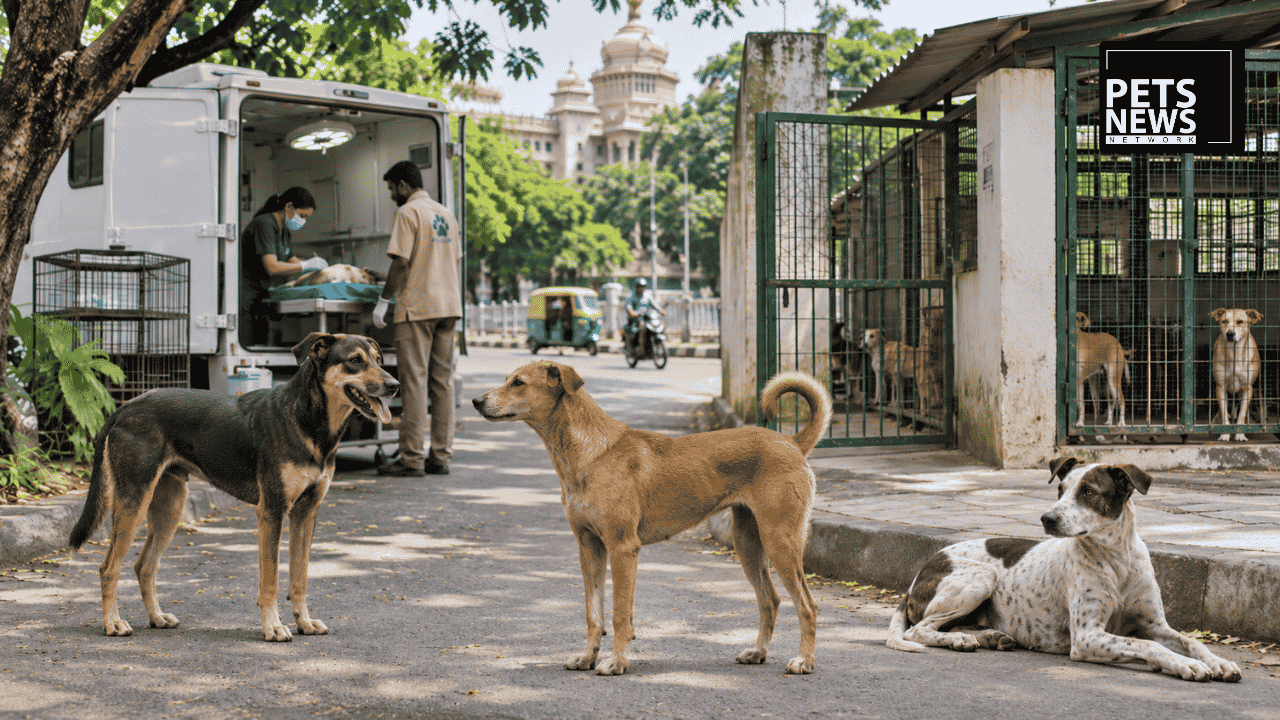

Bengaluru’s debate over community dogs has acquired a number that is difficult to ignore: eighteen. Animal welfare activists say permanently housing one dog for a year costs more than eighteen times as much as a single sterilisation procedure. They are asking Karnataka to stop treating large dog pounds as the default answer and put more money into animal birth control and anti-rabies vaccination instead. But the figure deserves scrutiny. It compares a year’s confinement with a one-time medical intervention. The more important question is what each rupee actually accomplishes for public safety, animal welfare and long-term population management.
What Bengaluru’s activists have asked for
In a letter to the Karnataka chief minister, Harini Raghavan and Nandita Subbarao urged the government to strengthen animal birth control (ABC) and anti-rabies vaccination (ARV) programmes rather than spend heavily on permanent dog pounds.
Their argument is financial as well as humane. A pound requires buildings, staff, food, cleaning, veterinary supervision and continual maintenance. Sterilisation involves a procedure and follow-up care intended to prevent future litters. Vaccination addresses rabies risk directly.
The activists want existing pounds converted into ABC clinics where appropriate, with current veterinary infrastructure used more effectively to increase sterilisation and vaccination coverage. Their letter, reported by The Times of India on 5 November 2026, does not establish that every pound is unnecessary. It challenges the wisdom of making permanent confinement the centrepiece of the response.

Bengaluru dog pounds versus ABC: the arithmetic
The reported figures are unusually specific:
| Expense or claim | Figure cited by activists |
|---|---|
| Keeping one dog in a pound | ₹3,035 per month |
| Keeping one dog for twelve months | ₹36,420, calculated from the monthly figure |
| One ABC sterilisation procedure | ₹2,000 |
| One large-scale pound’s setup cost | Up to ₹15 crore |
| GBA’s citywide annual ABC budget | About ₹9–10 crore |
Divide ₹36,420 by ₹2,000 and the result is 18.21. That is the basis of the headline claim that pounds are approximately eighteen times costlier.
But the duration is critical. A single month in a pound, at the quoted rate, is about 1.52 times the quoted sterilisation expense. The eighteen-times comparison emerges only after twelve months of housing. It is not a comparison of the cost of carrying out two equivalent procedures.
Nor is ₹36,420 necessarily the full annual cost of confinement. The reported monthly maintenance figure does not clearly specify every component included, and building a pound has its own capital cost. Conversely, a complete ABC programme requires catching, transport, surgery, recovery, recordkeeping, release and vaccination resources that may not all be captured by a single quoted procedure price.
The activists’ figures make a serious budget argument. They are not, by themselves, a complete cost-effectiveness study.
A ₹15 crore facility against a ₹10 crore programme
The second comparison may be even more revealing. The activists estimate that establishing one large dog pound could require up to ₹15 crore, while the Greater Bengaluru Authority’s entire annual ABC budget is reportedly ₹9–10 crore.
A single construction project could therefore cost more than the amount earmarked for a citywide sterilisation programme over a year. Those are different categories of expenditure: construction is a capital investment, whereas the annual ABC budget funds recurring programme delivery. The figures cannot be compared as if both purchase the same service.
Still, they raise a reasonable question of priorities. How many animals would the proposed pound accommodate? How long would dogs remain there? Would the site offer treatment and rehabilitation, or mainly long-term confinement? What annual staffing, feeding and veterinary bills would follow construction?
Until those details are public, a large headline construction budget tells residents little about value for money. A pound with clear medical and welfare functions is different from a facility that simply accumulates dogs indefinitely.

Why rabies control changes the discussion
The letter also cited 34 rabies deaths across Karnataka in 2026, while stating that zero rabies deaths had been recorded within Bengaluru’s GBA limits. The activists attributed Bengaluru’s reported outcome to its ABC and ARV programmes.
That attribution has not been independently demonstrated by the reporting available for this article. A fair assessment would need comparable surveillance records, the period and geography covered, vaccination rates, bite incidents and other public-health interventions. A reported absence of human rabies deaths does not mean dogs never bite, that transmission risk has disappeared, or that one programme alone explains the result.
Even so, there is an essential distinction between the interventions. Sterilisation controls reproduction. Anti-rabies vaccination reduces the risk of rabies transmission. Holding dogs in a pound may address particular containment or welfare needs, but a building does not automatically vaccinate the wider street-dog population.
Public safety cannot be measured only by the number of dogs removed from sight. Bite prevention, rapid treatment access, effective vaccination and reliable monitoring all matter. A strategy designed around one visible metric may leave other risks insufficiently addressed.
The debate was already underway
The November letter was not Bengaluru’s first challenge to pound-based planning. In October 2026, students and young residents campaigning as Students For Streeties publicly opposed proposed facilities for community dogs and urged authorities to prioritise sterilisation, vaccination and medical care.
The group called for clarity about construction expenditure, tenders, staffing, maintenance and implementation timelines. It also proposed using existing infrastructure for treatment, rehabilitation and responsible release, rather than prolonged confinement of healthy animals.
That earlier intervention gives the current letter context: activists are not simply objecting to one budget line. They are asking officials to explain the goals, capacity and expected outcomes of the entire model. Their objections deserve a documented response, rather than a disagreement conducted through slogans about either dog lovers or public safety.
ABC also needs independent scrutiny
There is a reason not to treat sterilisation as a magic answer. Bengaluru’s ABC record has itself faced questions. In September 2024, The Times of India reported that the former BBMP had spent roughly ₹32 crore on dog population management from 2019–20 through July 2024.
The report cited a 2023 civic dog census of approximately 2.2 lakh street dogs, compared with about 3.1 lakh in 2019. Officials linked the decline to ABC implementation, while activists alleged weaknesses in supervision and raised concerns about where sterilised dogs were released. Officials disputed allegations of mismanagement.
Those older figures cannot automatically describe the city in November 2026. They do demonstrate why accountability must apply to both camps. A lower quoted cost is meaningful only when procedures are completed safely, animals recover properly, vaccination is recorded and release practices follow applicable requirements.
The policy choice is not between expensive pounds and an ABC programme exempt from oversight. Both require measurable results.
What pounds can do that sterilisation cannot
Permanent confinement should not be mistaken for the only purpose a shelter can serve. Cities need places to examine injured animals, isolate those requiring medical observation, provide post-operative recovery and care for animals that cannot immediately return to their surroundings.
A properly equipped facility may also support veterinary treatment, short-term holding and rehabilitation. Those functions are not interchangeable with a routine sterilisation procedure, and their costs should be evaluated separately.
The case against indiscriminate long-term confinement is stronger when a pound is being proposed for dogs that are otherwise healthy and could be managed through lawful sterilisation, vaccination and community-based monitoring. The case for specialised holding is different when there is an identified medical or safety reason.
That distinction matters for animal welfare too. Crowding, disease management, exercise, sanitation, staffing and length of stay all affect whether confinement is safe and humane. A city cannot judge a shelter by construction capacity alone.
The information authorities should release
To turn the dispute into a useful public decision, the Karnataka government and the GBA should publish proposed pound capacity, construction estimates, expected occupancy and cost per dog over realistic stays. They should explain which dogs qualify for admission, what veterinary services would be available, and how release, rehabilitation or long-term care would work.
Comparable ABC data are equally important: the actual cost of completed procedures, monthly surgical capacity, vaccination coverage, complication and recovery records, and geographic gaps in delivery. Without reliable denominators, comparisons can be persuasive while remaining incomplete.
Residents also deserve to know whether the proposed facility costs would come from the same funding streams as ABC and ARV. A large infrastructure commitment does not automatically reduce the sterilisation budget; that displacement must be demonstrated through the relevant allocations.
The activists have supplied a challenge. Officials can answer it with a detailed plan and audited figures. Public reporting should also distinguish dogs receiving temporary medical care from those held for extended periods, and show whether vaccination, sterilisation, bite prevention and welfare indicators improve after new spending decisions. Otherwise, substantial expenditure could produce little demonstrable change.
The question behind the eighteen-times headline
Bengaluru faces two legitimate responsibilities: protecting people and treating animals humanely. The city must also show that spending decisions actually advance those objectives.
The activists’ ₹3,035-per-month estimate illustrates how quickly the costs of indefinite confinement can accumulate. Their ₹2,000 sterilisation comparison makes the alternative attractive, but it does not settle every medical, legal or public-safety question. Nor does the ₹15 crore figure prove a proposed pound has no legitimate role without details of its purpose and operations.
What the available evidence supports is a demand for transparency: define the problem, publish the full costs, identify the outcome each intervention is intended to achieve, and measure those outcomes over time.
Eighteen times is the number that will travel. Whether Bengaluru buys safer streets, healthier dogs and sustainable population control is the question that should remain.
Pets News Network is India’s dedicated media platform for pet and animal industry news. For news, brand coverage and advertising enquiries: info@petsnewsnetwork.com.