
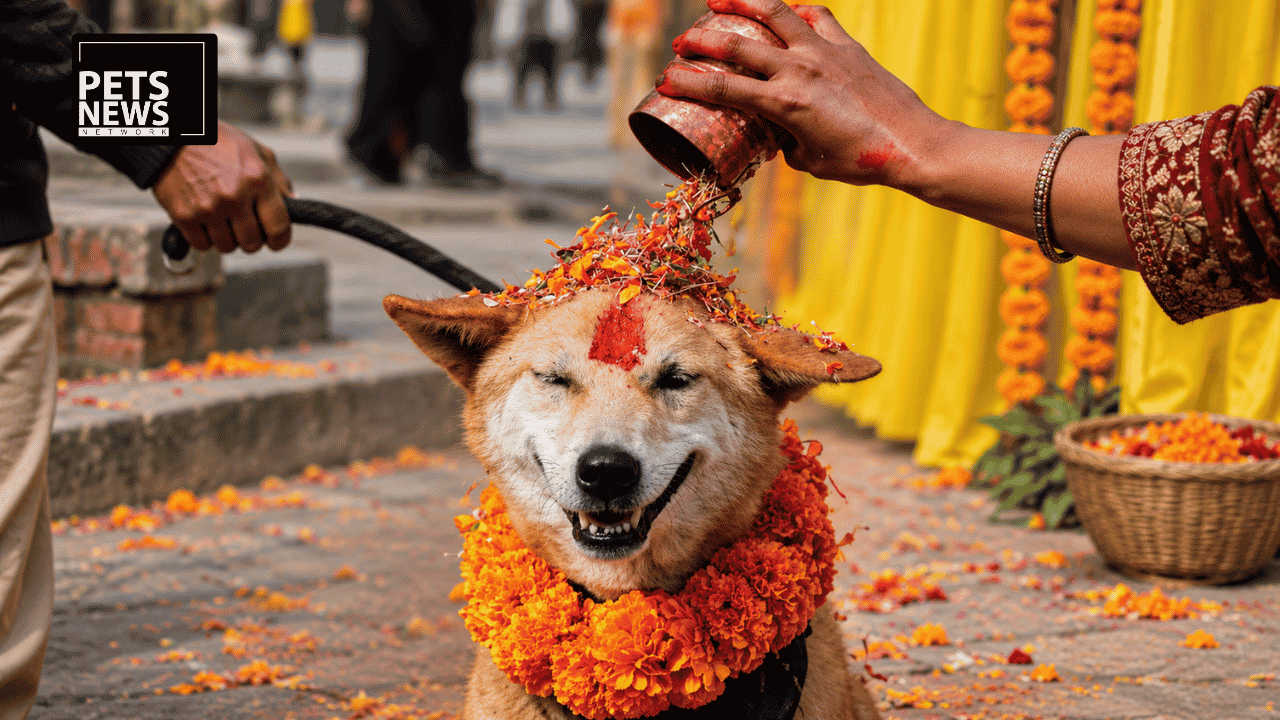

On Sunday 8 November, Nepal’s police and army marked Kukur Tihar 2026, the day of the dog, by garlanding the working dogs that search for missing people and sniff out explosives. Meanwhile, across the country, people carried marigolds and food out to the street dogs on their own lanes. That second part is what makes the festival worth reporting properly.
Kukur Tihar 2026: the day
| Festival | Kukur Tihar, the day of the dog |
| Date in 2026 | Sunday 8 November |
| Where | Nepal, and Nepali communities abroad |
| Position | The second day of Tihar, Nepal’s five-day festival of lights |
| Who is honoured | Working dogs, pet dogs and street dogs |
| The ritual | A red tika, a marigold garland, and good food |
The date shifts each year with the lunar calendar, so it moves between late October and mid-November. Nepali reports placed the 2026 observances on Sunday 8 November. However, some calendars list Saturday 7 November, so check the Nepali calendar if you plan an event.
Why dogs are honoured on Kukur Tihar
Accounts of Kukur Tihar often call dogs “messengers” or “agents” of Yama, the Hindu god of death. However, the tradition’s own texts stress a different role. Yama keeps two four-eyed dogs, Sharvara and Shyama, who guard the paths to Yamaloka. Followers therefore honour dogs as protective companions and spiritual guides, animals believed to help a soul cross over and stand before judgement.
The festival’s origin story comes from the Mahabharata, and it is one of the finest passages in the epic.
On their final journey, the Pandavas travel through the Himalayas, and a stray dog follows them. One by one the others fall, until only Yudhishthira and the dog remain. Then Indra arrives to carry Yudhishthira to heaven, but he refuses to take the dog. Yudhishthira refuses heaven instead. He will not abandon an animal that has stayed loyal to him. At that point the dog reveals itself as Dharma, the god of righteousness, whom later tradition identifies with Yama. The whole journey was a test, and Yudhishthira passes it.
A man turned down paradise rather than leave a street dog behind. That is the foundation of the day.
What happens on Kukur Tihar
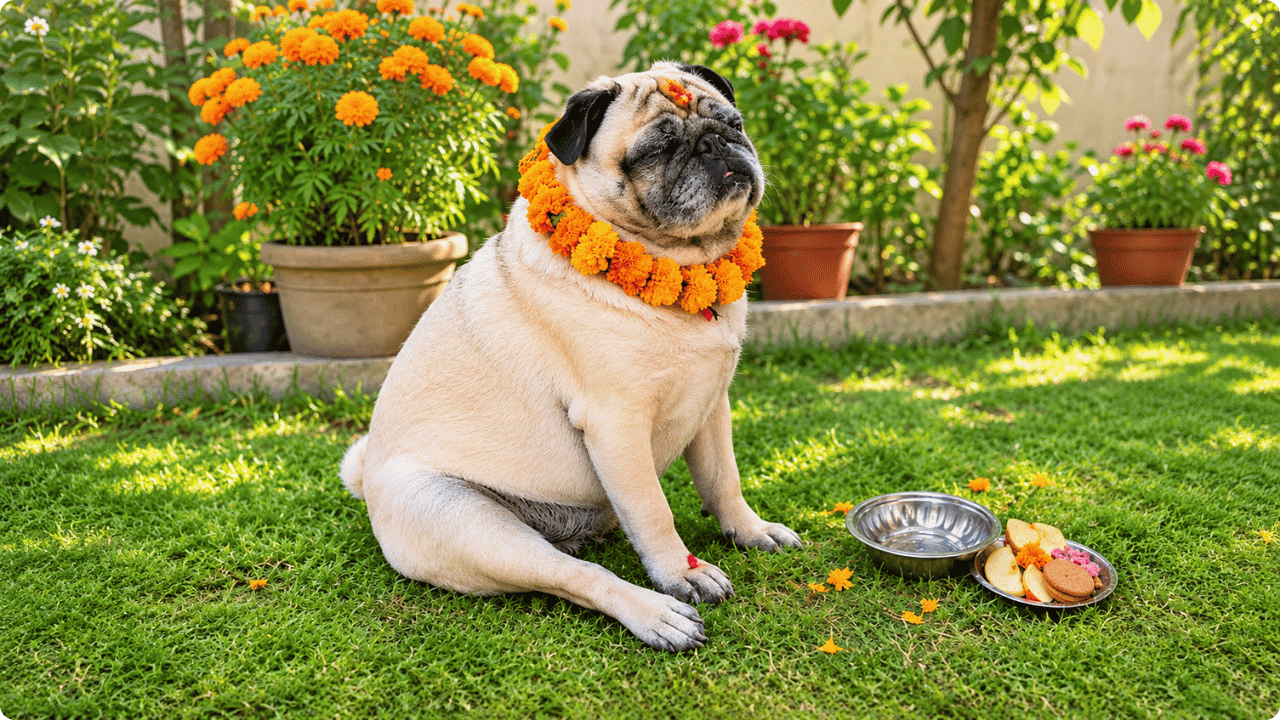
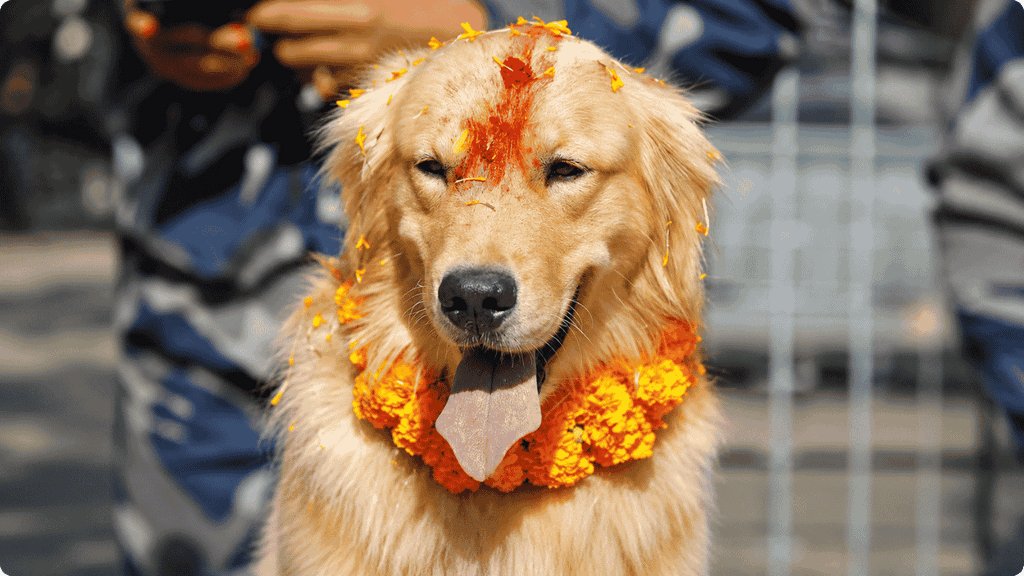
- People apply a red vermilion tika to the dog’s forehead, and often to the tops of its paws, as a blessing.
- They place a garland of marigolds or other fresh flowers around its neck.
- They offer good food: traditional Nepali dishes, dog food, and protein such as meat, milk and eggs.
The day is a public holiday in Nepal, and the practice is a real act of care, not only a symbol.
The working dogs honoured this year
Several of the animals garlanded on Sunday were not pets. They were trained working dogs.
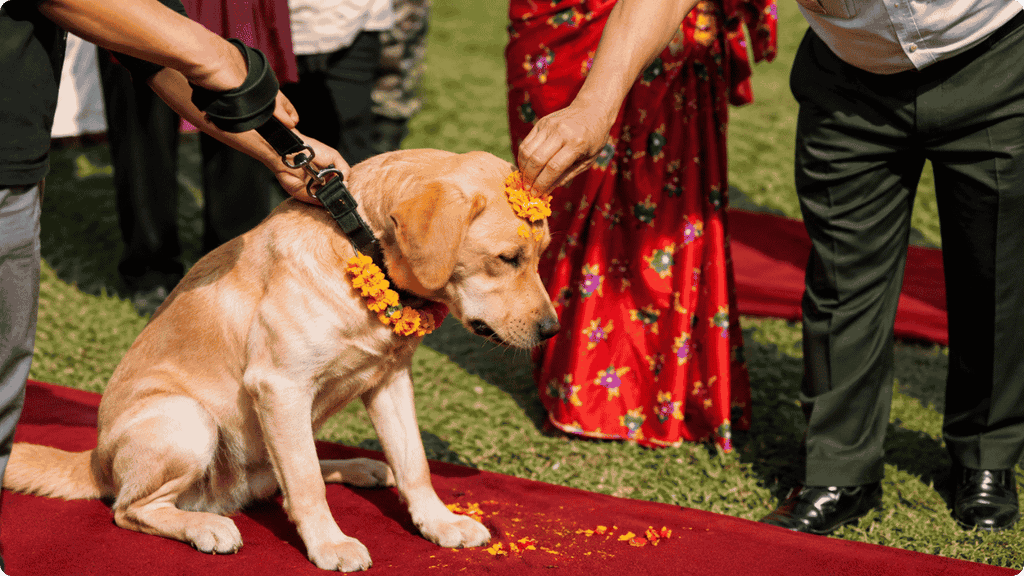
- Nepal Police. At the Police Canine Office in Maharajgunj, Kathmandu, Deputy Inspector General Om Bahadur Rana worshipped several breeds. He said sniffer dogs made it easier to locate 24 people who went missing in the August Bhotekoshi flood in Rasuwa. The canine office says it operates from 14 locations nationwide and has 107 dogs at its centres.
- Nepal Army. At the Bhairav Bahan Company in Sanothimi, Bhaktapur, trained dogs gave a skill show with racing, mock searches for missing people, scent tracking and high jumps. Major General Harendra Pathak said dogs are seen as loyal and honest animals, and that the army uses them to find bombs and explosives. He added that people worship dogs as the vehicle of Bhairab.
- Armed Police Force. In earlier years, the force has marked the day at its Animal Health and Dog Handling Subsection in Balumbu. It works with German Shepherds, Labradors, Cocker Spaniels and Golden Retrievers, trained to detect narcotics, arms and explosives. PNN has not confirmed whether the force held a ceremony this year.
So a state security force paused its work to put flowers on the animals that do its most dangerous jobs, including explosive detection. That is a religious observance, not a photo call. The dog is a participant in the festival and not a prop in it.
Street dogs are included, and that is the significant part
A festival that honoured only police dogs and family pets would be unremarkable. Kukur Tihar is not that. People garland street dogs too, and they carry tika, marigolds and food out to the dogs on their own lanes. Nobody owns or registers those animals, and nobody is responsible for them on the other 364 days of the year.
That is the hinge of the whole festival. The Mahabharata story is about a stray. Yudhishthira’s dog had no owner, no name and no status, and the moral weight of the episode rests on his refusal to treat it as disposable. Over the centuries, the day could easily have drifted towards owned animals only, the pets of people with houses and money for meat. Instead, it did not. The dog on the lane still gets the tika.
What Kukur Tihar looks like from India
India’s police, paramilitary and army units run working dogs that do the same jobs as Nepal’s: explosive detection, narcotics, tracking, search and patrol. Some have received honours, and some have died in service. However, PNN is not aware of a fixed national day on which the country stops to acknowledge them. Retirement policies, individual honours and occasional news coverage when a dog dies on duty fill that space.
The second comparison is harder. India has one of the largest free-roaming dog populations in the world, and the national conversation about those animals runs through sterilisation programmes, municipal capacity, bite statistics and court orders. That is the language of management.
Kukur Tihar does not solve any of that, and one morning of marigolds is not an animal welfare policy. Nevertheless, it is a day on which the street dog is the subject and not the problem. That framing is not something India’s calendar currently contains.
Where else Kukur Tihar is kept
Kukur Tihar has travelled with the Nepali diaspora. Nepali communities in Australia were reported marking it in 2018, and people introduced it in Mexico in 2016 to raise awareness of animal welfare. In the United States, Haymarket, Virginia, held its first Kukur Tihar celebration on 27 October 2024, and the organiser plans annual events on the last Sunday of October. In 2026, Gurkha soldiers hosted a Kukur Tihar event in Aldershot, in the United Kingdom, with proceeds going to charities in Nepal and Hampshire.
The thing to take from it
Kukur Tihar is not a cute festival, and reporting it as a photo opportunity misses it. It is a culture that wrote down, long ago, that a man who abandons a loyal dog does not deserve heaven. Then, one morning a year, it walks out into the street with marigolds and acts on that belief.
The dogs that get garlanded include the ones nobody owns. That is the part worth borrowing.
Pets News Network is India’s first dedicated media platform for the pet and animal industry. For breaking global pet news, brand coverage, and advertising enquiries, contact: info@petsnewsnetwork.com