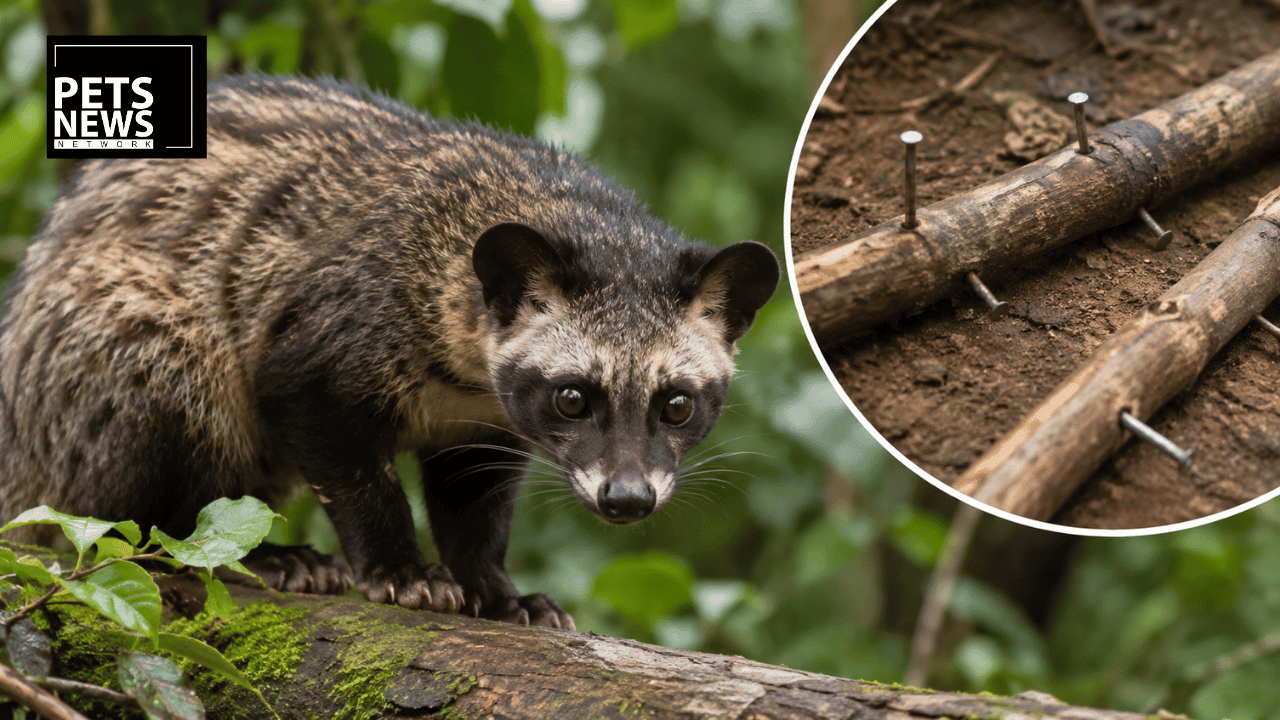

A routine forest patrol in Gondia district, Maharashtra, stopped three youths on Monday morning. According to the report, their bag held three dead young civets, and they carried wooden sticks with sharp iron nails. During questioning, they named three accomplices; consequently, officials have now detained six people. Currently, this Gondia civet poaching case remains at its initial stage, and prosecutors have not charged anyone yet. Moreover, these animals rank among India’s most widely distributed wild mammals, yet people rarely understand them, starting with the fact that they are not cats.
What the patrol found
| Point | What is reported |
|---|---|
| When | Monday morning, 16 November 2026 |
| Where | Near the Kamtha-Navargaon bridge, Gondia district, Maharashtra |
| Found | Three dead young civets in a bag, and tufts of civet hair |
| Also in their possession | Wooden sticks fitted with sharp iron nails |
| Then | Suspects named three accomplices during questioning, and police detained them |
| Total detained | Six |
| Case | Officials registered a case under the Wild Life (Protection) Act, 1972, and started an investigation |
Officials have not charged or convicted anyone yet. Specifically, police have detained six people and registered a case, which under Indian law marks the start of a legal process rather than its conclusion. Therefore, this article does not name anyone. Furthermore, the account relies on an unnamed forest official, and it does not explain how the animals died or how the suspects used the sticks.
Civets are not cats
Across India, people almost universally call these animals “civet cats.” Although the phrase appears in official statements and most news reports, it is scientifically wrong.
| Question | Answer |
|---|---|
| What family is a civet in? | Viverridae |
| What family are cats in? | Felidae |
| Who are civets closer to? | Mongooses and genets are closer relatives than any cat |
| What do they look like? | Long-bodied, short-legged, mostly nocturnal carnivores with a pointed snout and a banded or spotted coat |
| What do they eat? | Fruit as readily as rodents and insects |
| Where do they live? | Widely across India, including the edges of towns, plantations, farmland and scrub |
However, most people have never knowingly seen a civet despite living alongside them. The misleading name causes part of this confusion; for instance, a reader who hears “civet cat” pictures a wild jungle cat and never connects it to the animal crossing a plantation wall at night.

Which species? Nobody has said
The public account refers to the animals only as “civet cats.” However, two species live in this part of India: the small Indian civet (Viverricula indica) and the Asian palm civet (Paradoxurus hermaphroditus). Because they are different animals with distinct habits, “civets” remains the most accurate description until the forest department confirms the exact species. In addition, the species matters legally, since it determines which wildlife provisions and penalties apply.

Why civets are hunted
For readers wondering why poachers target a civet, researchers document several general motives, although authorities have not reported any motive for this specific case.
| Use | Background |
|---|---|
| Meat | People eat them as bushmeat in parts of South and South East Asia |
| Musk | A perineal gland produces a waxy secretion historically used in perfumery and traditional medicine |
| Pelt | Poachers trade their skins |
| Live trade | Traders capture animals for the pet trade |
Nevertheless, assuming any of these motives apply here would be premature. Indeed, official reports state no motive, and authorities have not formally charged the detained suspects.
What the law says
The Wild Life (Protection) Act, 1972 strictly protects civets, making hunting them a serious offence. Consequently, officials registered a case under this Act. However, readers should treat any specific schedule number quoted for this case with caution. Notably, the 2022 amendment restructured the schedules, reducing them from six to four, yet much circulating material still reflects the older listing. Regardless, the legal position remains clear: these are protected wild animals.
Additionally, people often confuse conservation status with legal protection. Both candidate species appear as Least Concern on the IUCN Red List. However, that designation reflects a global conservation assessment rather than an Indian legal status. Thus, a species can thrive worldwide and still enjoy full legal protection in India, meaning the offence does not soften simply because global populations remain healthy.
What the public record does not contain
- How the animals died: Officials have not stated a cause of death, nor have they confirmed a post-mortem examination.
- Which species: As noted above, officials have not identified the species.
- How many animals in total: Patrol officers recovered hair alongside the three bodies; however, investigators have not determined whether it came from those animals or others.
- What the sticks were for: Reports describe the nailed sticks without explaining how the suspects used them.
Ultimately, the public record confirms that a forest patrol stopped three people carrying a bag, inspected its contents, and detained three more suspects after questioning. Because of this routine field work by the forest team, three dead civets in Gondia led to a formal criminal case rather than passing unnoticed.
Pets News Network is India’s first dedicated media platform for the pet and animal industry. For breaking global pet news, brand coverage, and advertising enquiries, contact: info@petsnewsnetwork.com