
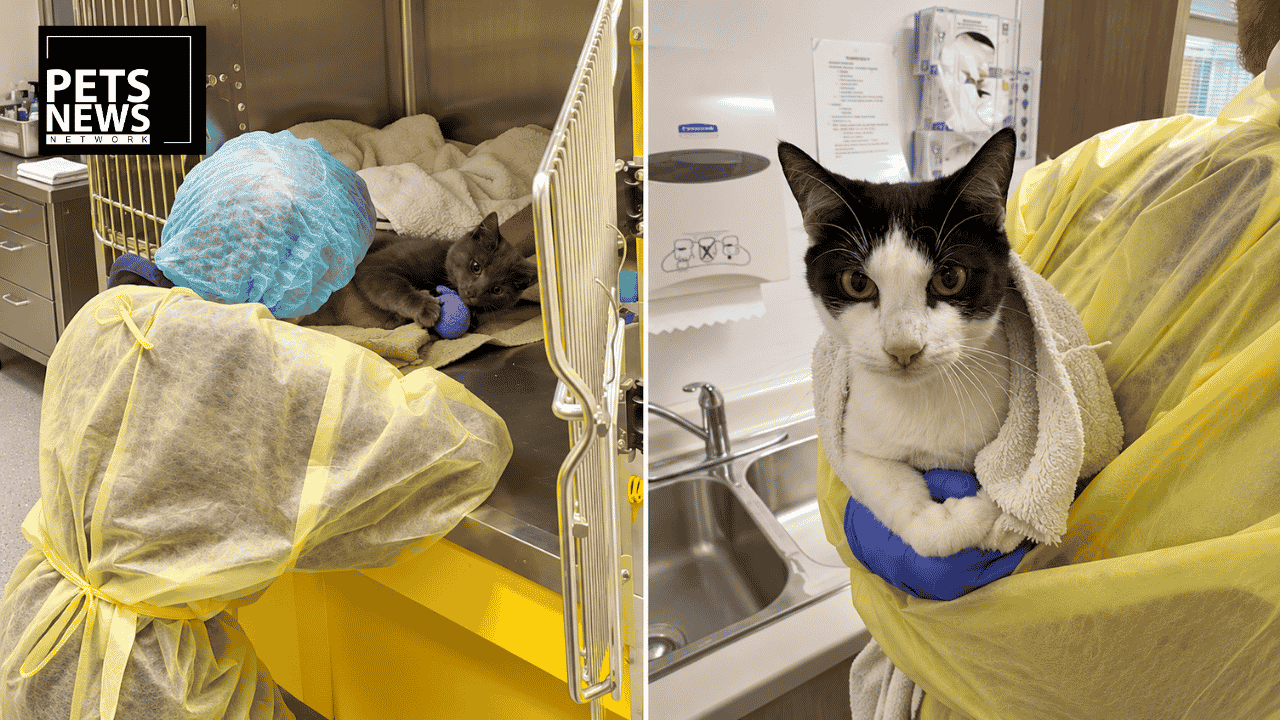

Rescuers removed a dog and fourteen cats from a single property in early October. Every one of the fifteen tested positive for the same contagious ringworm infection. That is why they went into quarantine rather than straight into foster homes, why the people handling them wear protective equipment, and why the shelter could not offer any of them for adoption for more than a month. Ringworm is the most commonly underestimated condition in animal rescue, and the reason is a number most people have never been told.
What was found
Welfare officers took the animals from a property following an early October response.
Someone had tethered Betty, a Havanese, outside without adequate food or water. Debris filled her doghouse and missing two of its sides. Her coat was matted to the point that it caused her pain and restricted how she could move.
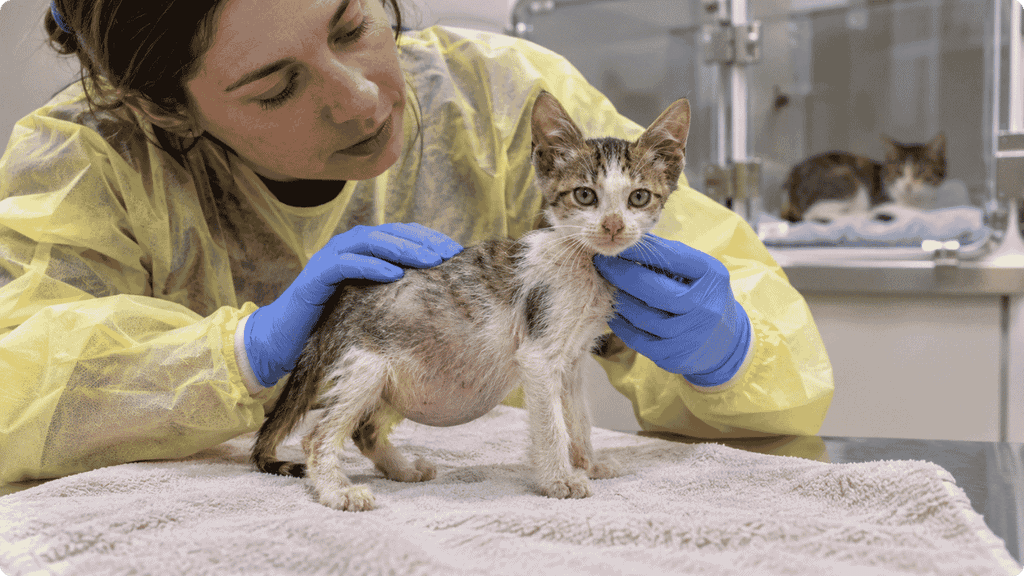
Inside the house were fourteen cats and kittens. Many were visibly underweight, with patches of missing fur and distended bellies. The house itself was filthy, with a strong smell of urine.
The rescuing organisation’s own assessment was that the owner had become overwhelmed and needed help. Authorities have reported no charges and have not identified the owner. That framing matters, and it is worth carrying rather than replacing: a very large share of cases that look like cruelty from the outside are a person losing control of a situation that grew faster than they could manage.
Staff have since groomed Betty and describe her as friendly. The cats are beginning to socialise. All fifteen remain in quarantine until a veterinarian clears them.
The ringworm infection all fifteen shared
Every animal tested positive for ringworm.
The cats also tested positive for roundworm, tapeworm, coccidia and lungworm, and vets treated them for all of them. Those distended bellies are worth understanding: in a kitten, a swollen abdomen alongside a thin body and a dull coat is the classic presentation of a heavy intestinal worm burden, not a well-fed animal.
But ringworm is the reason the group is in isolation, and ringworm is the reason this takes months rather than weeks.
Why a skin infection means quarantine and protective equipment
Ringworm is not a worm. It is a fungal infection of the skin, hair and claws — dermatophytosis — and a single organism, Microsporum canis, causes more than 90% of feline cases worldwide.
Two features make it a containment problem rather than a dermatology problem.
| It transmits to humans | M. canis is a zoonosis. People handling infected animals can and do catch it |
| It survives off the animal | Infective spores shed into the environment and persist there |
| Minimum treatment | At least ten weeks of combined systemic and topical therapy |
| When treatment can stop | Only after two sequential negative fungal cultures, taken one to three weeks apart |
| Spore survival indoors | Up to one year |
| Where spores last longest | Dry environments — humidity shortens their life, dryness extends it |
In a healthy adult cat with an isolated lesion and a working immune system, the infection can resolve on its own within one to three months. In an underweight kitten carrying four species of parasite at the same time, it does not.
Ten weeks, not ten days
This is the single most consequential thing in the article.
Most people treat ringworm for as long as it looks like there is ringworm. The lesions fade, the hair starts growing back, the animal looks well, and treatment stops.
Veterinary guidance says treatment should continue for at least ten weeks, and should not stop on appearance at all. It stops when a lab can no longer culture the fungus from the animal’s hair on two consecutive tests, spaced one to three weeks apart.
An animal that looks cured is frequently still shedding spores. That is how ringworm returns in a household weeks after everybody thought it was finished, and how it moves from the cat to the dog to the person who has been picking the cat up.
A visual check is not an endpoint. A negative culture is.
The spores are the harder half of the problem
Treating the animal is the part people expect. Treating the house is the part they skip.
Because spores persist indoors for up to a year and survive best in dry conditions, decontamination has to run alongside treatment rather than after it.
| Step | What it involves |
|---|---|
| Mechanical removal first | Daily, thorough vacuuming. Physically lifting hair and spores out matters more than any chemical |
| Disinfect regularly | In shelter and multi-animal settings, guideline advice is disinfection at least twice a week |
| Agents known to work on spores | Sodium hypochlorite (around 1.84%), quaternary ammonium (0.3%), lactic acid (3.2%), hydrogen peroxide (0.5%), and accelerated hydrogen peroxide formulations |
| Laundry and dishes | Wash at 60°C or above. Lower temperatures do not reliably kill spores |
| Restrict the area | Keep the animal to one easily cleaned room. Soft furnishings, carpets and upholstery are the hardest surfaces to clear |
This is precisely why staff handle the fifteen animals in protective equipment and keep them separate. It is not caution about the animals. It is caution about the building, the laundry, the handlers and every other animal on the premises.
And the first-line drug no longer always works
One further development belongs in any current discussion of ringworm.
A dermatophyte species named Trichophyton indotineae has emerged that is resistant to terbinafine, the drug most commonly reached for as first-line oral treatment. The resistance comes from mutations in the squalene epoxidase gene, which prevent the drug from binding its target.
| Recognised as a distinct species | 2020 |
| Identified in | 29 countries, according to public health agency tracking |
| Confirmed laboratory identifications | Rose from 237 in March 2022 to 1,692 by December 2025 |
| Documented in animals | Yes — including in dogs, in more than one country |
| Can it be identified by eye? | No. It requires laboratory identification |
Two practical consequences follow. The first is that a ringworm infection failing to respond to a standard course of terbinafine is not necessarily a compliance failure or a reinfection — it may be a resistant organism, and a vet may need a second-line agent such as itraconazole. The second is that you cannot work this out by looking. It needs a laboratory, which means it needs a veterinarian.
If you are bringing home a rescued cat or dog
None of this is an argument against fostering or adopting. It is an argument for doing it with the right expectations.
Assume ringworm is possible in any animal coming off the street or out of a crowded situation, particularly a kitten, and particularly one that is thin or patchy.
Set up one room that is easy to clean, before the animal arrives. Hard floors, minimal soft furnishings, a door that closes.
Keep the new animal separate from resident pets until a veterinarian has examined it. This is also when parasites are found, which in rescued kittens is close to routine.
Wash your hands after handling, and keep the animal’s bedding and your own laundry separate at 60°C or above.
Ask for a fungal culture, not just a visual opinion — and ask specifically what the endpoint for stopping treatment will be.
Finish the full course. Not until it looks better. Until the tests say so.
Fifteen animals came out of one house in a condition nobody would choose. The shelter will rehome them all. The month of quarantine standing between them and a family is not bureaucracy — it is the length of time it genuinely takes to make sure that what came out of that house does not go into fifteen new ones.
Pets News Network is India’s first dedicated media platform for the pet and animal industry. For breaking global pet news, brand coverage, and advertising enquiries, contact: info@petsnewsnetwork.com