
Charlotte, North Carolina, is preparing to build a $30 million adoption centre for its animal care agency. The city’s own auditors published a report in March showing that about 60% of the animals in the agency’s care are not in a shelter building at all. They are in foster homes. For anyone asking how a city animal shelter actually works, the Charlotte animal shelter story is a useful case, and the audit holds other figures worth reading.
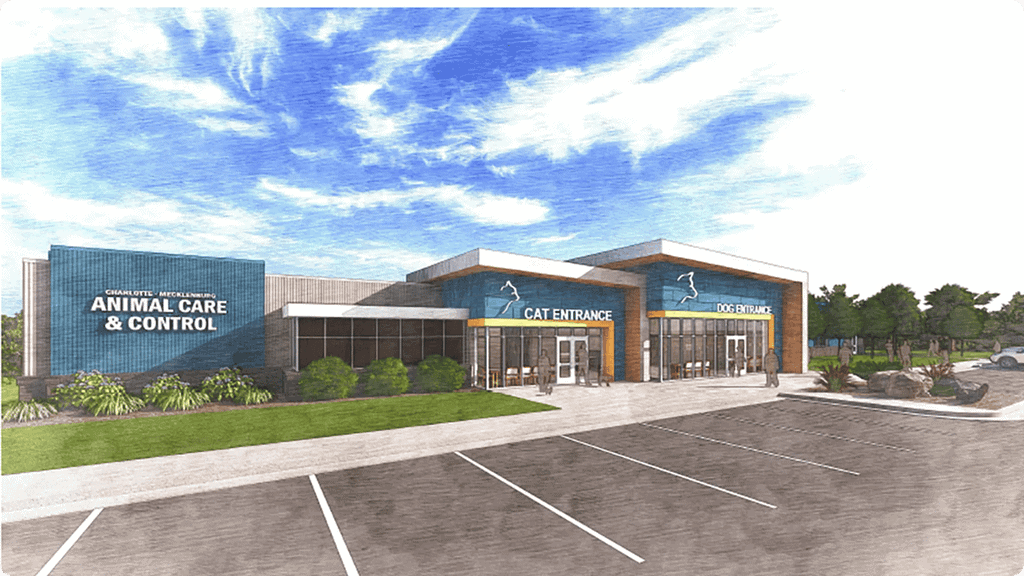
What the Charlotte animal shelter is building
| Point | What is reported |
|---|---|
| What | A new Animal Care & Control adoption centre |
| Where | 5400 South Tryon Street, Charlotte |
| Cost | $30 million |
| Size | 42,768 square feet, all-electric |
| Groundbreaking | Scheduled for Thursday 19 November, according to the city’s project page |
| Status | The project page lists it as in the design phase and gives no opening date |
| Existing main shelter | Byrum Drive, which earlier reporting said would remain the site for intake, medical evaluation, spay and neuter, and animals with greater medical need |
Most of the animals are not in a building
Charlotte’s Internal Audit published a report on Animal Care & Control on 18 March 2026, covering July 2022 to December 2024. Specifically, it found that the agency cares for about 1,000 animals a day, housing about 40% in the shelter and 60% in foster homes.
Consequently, roughly 600 animals live in private houses at any given moment, in spare rooms, on sofas, and in garages belonging to unpaid volunteers. Most readers assume a shelter’s capacity equals its building. However, in Charlotte, unpaid households run the majority of the system invisibly.
What an adoption centre does
An adoption centre is where the public meets animals they might adopt or foster. Essentially, it serves as a matching space rather than a processing facility. According to earlier reporting, staff still handle intake, medical evaluation, and surgery at the main shelter.
Therefore, the new building does not replace the existing shelter or the foster network. Instead, it adds a public space where potential adopters can meet animals, addressing a genuine constraint on adoption rates. Still, it does not change where most of the animals sleep.
Why foster capacity cannot be commissioned
A city can approve money, hire a contractor and be reasonably confident a building will exist. No equivalent process produces six hundred spare rooms. Foster capacity depends on how many households volunteer, how supported they feel, what the agency spends on supplies and veterinary backup, and whether people move house.
It is also the part most sensitive to the problem a new municipal shelter is meant to ease. Foster carers hold animals until they are adopted. If adoptions slow, foster homes fill and stop taking new animals, and intake backs up into the shelter. That is an argument for the building, and also a reason the foster network deserves as much attention in planning as the kennels.
What else the city audit found
| Measure | Finding |
|---|---|
| Live release rate | 84.3% (December 2024 to November 2025) |
| “No Kill” designation | A rate above 90%. A rate of 85% to 90% earns the “Nearly” designation |
| Return-to-owner rate | Fell from 16.5% in FY23 to 12.0% in FY25 |
| Live shelter intakes | Rose from 8,631 in FY23 to 9,708 in FY25 |
| Pet licensing compliance | About 13% of dogs and 7% of cats, an estimated 10.5% combined |
| Staffing | 81 positions in FY23 to 92 in FY25 |
| Personnel costs | From about $4.98 million in 2022 to $7.43 million in 2025 |
The audit made five findings, covering performance reporting, pet licensing compliance and contract performance measures, clinic eligibility documentation, controlled-substance logs, and the accuracy of vendor invoices.
Several of these figures connect. About one pet in ten carries a licence, so an animal that officers pick up without identification has fewer routes home. The audit noted that the licensing vendor’s contract has no established performance measures or goals for outreach and licensing rates. Return-to-owner fell while intake rose. We cannot say from the audit alone that one caused the other, but every animal that the city animal shelter cannot quickly identify occupies a kennel or a foster home instead of going home.
Staffing costs also rose faster than headcount. Positions grew about 14% between FY23 and FY25, while personnel spending rose close to 50% over a slightly different period.
The part that is easy to miss
A city that sits just below a “No Kill” designation and commits $30 million to a new adoption centre is not neglecting its animals. However, a building holds a fixed number of animals, while unpaid volunteers house roughly six hundred pets in private homes without appearing in any budget document. Any plan that treats the new municipal shelter as the answer should account for them too, as the future of the Charlotte animal shelter depends on both its buildings and its foster network.
Pets News Network is India’s first dedicated media platform for the pet and animal industry. For breaking global pet news, brand coverage, and advertising enquiries, contact: info@petsnewsnetwork.com