
A demonstration meant to highlight government inaction on a genuine public safety issue ended up generating headlines for an entirely different reason: the method protesters chose to make their point. In Nashik district’s Niphad town, a stray dog menace protest went viral this September after party workers released puppies, still inside sacks, directly onto a civic official’s office desk, an act that has since triggered a police case, a public rebuke from senior party leadership, and a wider conversation about where the line sits between legitimate protest and animal cruelty.
What Actually Happened Inside the Chief Officer’s Chamber
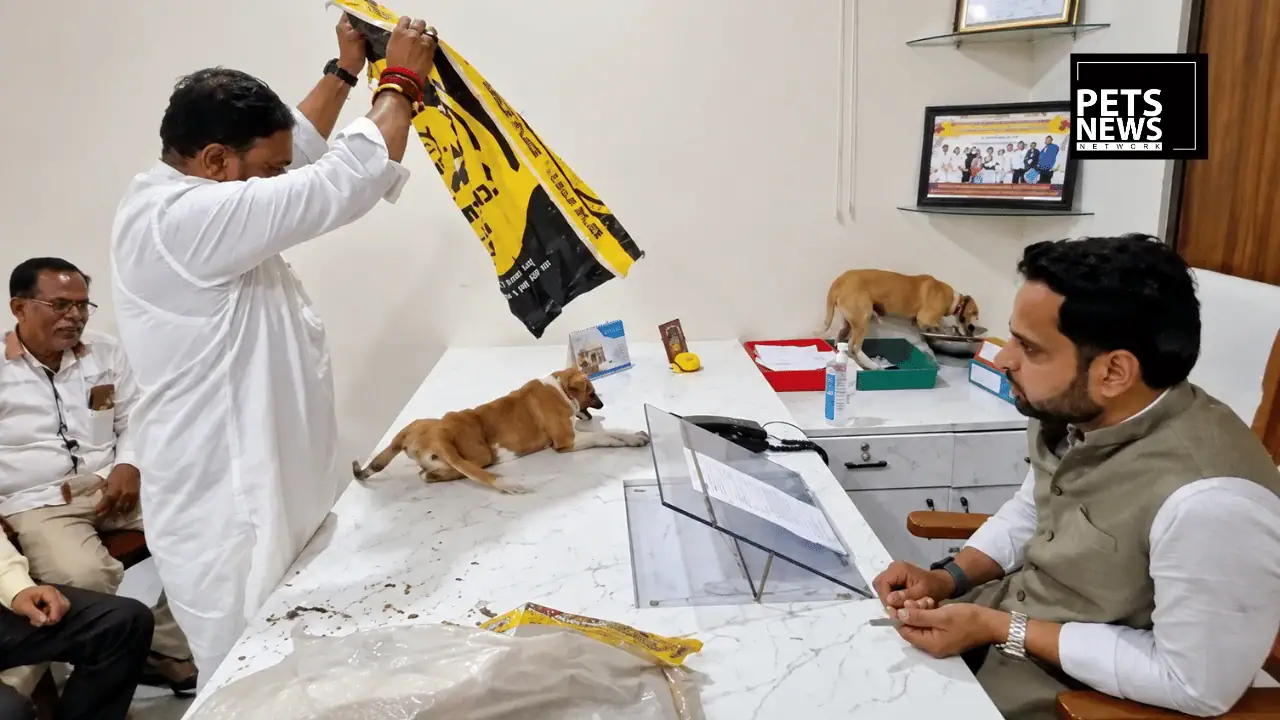
Vikram Randhave, district chief of Yuva Sena, the youth wing of Shiv Sena (UBT), led a group of party activists into the office of Dheeraj Bhamre, Chief Officer of the Niphad Nagar Panchayat. Once inside, Randhave pulled puppies out of sacks he and his group had brought along and placed them directly onto Bhamre’s desk, in full view of the stunned official.
A video of the confrontation, which quickly went viral on social media, captured Randhave addressing Bhamre directly: “We have been trying to highlight the stray dog menace to you for the last six months, but you ignored our pleas.” As part of the same protest, Randhave also placed a garland made of currency notes on the official’s desk, a symbolic gesture apparently intended to mock what protesters characterised as the civic body’s prioritisation of paperwork and tenders over actual, visible action.
When Bhamre responded by explaining that the civic body had already issued work tenders to address the stray dog issue, the assurance didn’t satisfy Randhave, who warned of further escalation: “If you fail to act, we will bring more dogs to your office next time, along with children and women affected by the problem.”
Why the Protest Happened Now
The demonstration wasn’t a spontaneous outburst, protesters framed it as the culmination of months of unanswered complaints. According to Randhave, residents of Niphad town and surrounding areas had been raising concerns about a steadily rising stray dog population, and had submitted repeated complaints citing genuine safety difficulties for children, senior citizens, women, and motorists in the area.
The timing carried added urgency given the ongoing Ganeshotsav celebrations, with protesters specifically pointing to fears among residents visiting Ganesh pandals as one immediate, tangible consequence of the unresolved stray dog situation. Randhave also directly accused the civic administration of focusing more energy on the procedural tender process than on delivering any actual, visible results for residents dealing with the problem daily.
The Legal Consequences
Following the incident, police at the Niphad police station registered a case against Randhave and his associates on two separate fronts: obstructing a public servant in the discharge of official duty, and a case specifically addressing animal cruelty, given that puppies had been transported inside sacks as part of the protest tactic.
This combination of charges reflects a straightforward legal reality: regardless of how legitimate the underlying grievance about stray dog management might be, the specific method chosen to make that point, confining puppies in sacks and using them as a protest prop, crossed into territory that Indian animal cruelty law is designed to address directly.
Aaditya Thackeray’s Response
According to reports of the incident’s aftermath, senior Shiv Sena (UBT) leader Aaditya Thackeray was disturbed after viewing video footage of the protest and issued a stern warning to the office-bearer involved. Thackeray reportedly emphasised an important distinction: questioning civic inaction on stray dog management is a legitimate concern that deserves to be raised, but using animals as props in a way that causes them distress runs directly counter to the party’s stated principles, regardless of how valid the underlying complaint might be.
In response, the office-bearer reportedly expressed genuine regret, issued an apology, and committed to avoiding similar tactics in any future demonstrations. Whether or not the specific wording of this exchange is confirmed beyond initial reporting, the broader message it reflects, that even legitimate civic grievances shouldn’t be pursued at an animal’s expense, is one animal welfare advocates have consistently pushed political and civic actors to internalise.
The Underlying Problem the Protest Was Actually About
Strip away the controversial protest tactics, and the underlying grievance driving this demonstration reflects a genuine, serious civic challenge facing Niphad and countless other Indian towns: managing a growing stray dog population without the infrastructure or personnel currently in place to do so effectively.
Local authorities have pointed to a specific, telling obstacle behind their inaction: despite publishing advertisements twice in 2026 seeking to hire veterinary doctors for the town’s stray dog sterilisation programme, the civic body received no applications at all. That detail complicates the narrative considerably, this isn’t necessarily a story of civic apathy or indifference alone, but potentially one of genuine capacity constraints, where the will to act exists on paper, but the specialised veterinary workforce needed to actually implement a functioning Animal Birth Control programme simply isn’t available or willing to take up the position.
A Difficult Balance Between Legitimate Grievance and Responsible Advocacy
This incident captures a genuinely difficult tension playing out in towns across India: residents facing real safety concerns tied to stray dog populations, civic bodies struggling with practical implementation challenges like veterinary staffing shortages, and the risk that frustration over slow-moving bureaucratic processes can tip into tactics that themselves cause animal suffering, undermining the very welfare-conscious message that effective stray dog management is supposed to serve.
Effective advocacy for better civic stray dog management doesn’t require choosing between human safety concerns and animal welfare, the two are, in fact, deeply interconnected, since a properly functioning sterilisation and vaccination programme serves both goals simultaneously. What this Niphad protest illustrates, perhaps unintentionally, is how easily that connection can get lost when frustration boils over into tactics that treat animals as props rather than as the very beings any responsible civic dog management policy is meant to protect.
What Happens Next
With a formal police case now registered and senior party leadership having publicly distanced itself from the specific protest tactics used, attention is likely to shift back toward the substantive issue at the heart of this entire episode: whether Niphad’s civic authorities can actually resolve their veterinary staffing shortage and implement a functioning sterilisation programme, the kind of concrete, visible action that might finally address the underlying stray dog concerns driving residents’ frustration in the first place.
For Randhave and his associates, the case now moving through the legal system serves as a pointed reminder that in India’s evolving legal landscape around animal welfare, using animals in protest, however sympathetic the cause, carries real legal consequences of its own.
Pets News Network is India’s first dedicated media platform for the pet and animal industry. For breaking global pet news, brand coverage, and advertising enquiries, contact: info@petsnewsnetwork.com