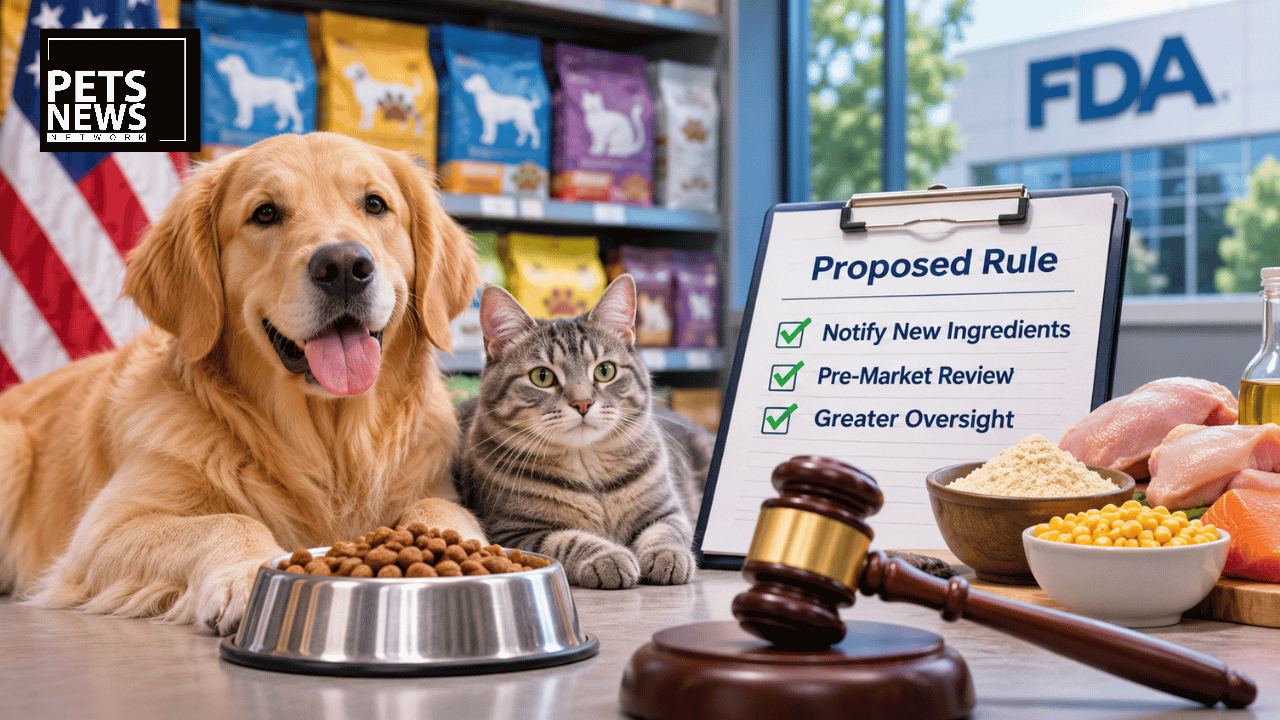

An FDA pet food ingredients rule now out for comment would close a gap that surprises most pet owners when they first hear of it. In the United States, a company can decide for itself that a new ingredient is safe for dogs or cats and put it into food without telling the regulator. The US Food and Drug Administration has proposed making notification compulsory. The comment period closes on 9 December 2026. Nothing has changed yet, but the proposal would reshape how ingredients reach the bowl.
What has been proposed
| Item | Detail |
|---|---|
| Who | The US Food and Drug Administration (FDA) |
| What | A proposed rule making notification mandatory for substances classed as “generally recognized as safe” (GRAS), covering food for people and for animals |
| Published | 11 August 2026 |
| Docket | FDA-2025-N-3262 |
| Comments close | 9 December 2026. The agency has said late comments will not be considered |
| Status | Proposal only. A final rule would follow later, with a transition period |
How it works today
In US law, a substance added to food generally needs approval as a food additive, unless it is generally recognized as safe by qualified experts for the use in question. That recognition rests on published scientific evidence or, for older ingredients, a long history of safe use.
The important detail is who makes the call. A company may reach a GRAS conclusion on its own, using its own experts. It may then tell the FDA, through a voluntary notice. However, it is not obliged to.
So an ingredient can lawfully enter pet food on the strength of a safety assessment the regulator has never seen.
What would change
| Point | Now | Under the proposal |
|---|---|---|
| Telling the FDA | Voluntary | Mandatory |
| Who must notify | Whoever chooses to | Any person introducing the GRAS substance into interstate commerce, across the supply chain |
| Ingredients already on the market | No action required | Covered, unless an exemption applies |
| Public visibility | Only for voluntary notices | A public record of filings held by the agency |
| If a company does not notify | Not applicable | The agency would treat it as a factor in deciding which substances to review first |
The agency’s acting commissioner described the aim as “closing critical information gaps and giving the FDA greater visibility into substances entering the food supply.”
Two points are easy to miss. First, the duty would not fall on ingredient makers alone; it reaches others in the chain who bring the substance into commerce. Second, as drafted, there is no direct penalty for failing to notify. The consequence is closer attention from the regulator.
The exemptions for animal food
The proposal recognises that animal food has been regulated differently from human food, with a large role for the states. It sets out circumstances in which no notice would be needed. Three matter most for animal food.
| Exemption | What it covers | The limit |
|---|---|---|
| Listed ingredients | Substances listed, and used as described, in the feed ingredient definitions of the 2024 edition of the Official Publication of the Association of American Feed Control Officials (AAFCO) | Frozen at 2024. Later editions are not covered |
| Previously reviewed uses | Uses already reviewed through the FDA’s animal food ingredient consultation process, where the agency has posted a summary with no questions | Applies only to the reviewed use |
| Streamlined submission | A one-time, simplified filing for existing substances, sent to the agency’s Center for Veterinary Medicine | Must be made within one year of the final rule taking effect, and counts only once the agency adds it to a public list |
A compliance period of about 18 months is envisaged, with the streamlined window closing some six months before it ends.
An exemption relieves a company of the duty to notify. It does not, by itself, establish that an ingredient is GRAS.
The gap that worries the feed regulators’ association
The freeze at 2024 is the most contested part of the animal food provisions.
AAFCO is the body through which US state regulators agree model rules and ingredient definitions for animal food. It now runs a newer scientific review pathway for ingredients. Under the proposal as written, an ingredient reviewed and adopted through that pathway after 2024 would fall outside the exemption, and could need a separate FDA notification as well.
AAFCO has welcomed the proposal’s recognition of its ingredient definitions. However, it has asked for the exemption to be made ongoing instead of tied to one edition, and for its newer review pathway to qualify explicitly. It says that pathway includes expert review, conflict-of-interest controls, public comment and a vote of its full membership. It accepts that the FDA should keep the power to flag a safety concern and require a notice where warranted. In short, its concern is duplication, not standards.

Who is affected most
Ingredient manufacturers and distributors would carry most of the new obligation, and companies with large existing ingredient portfolios face the heaviest workload, because the rule reaches substances already in use. Makers of complete pet foods are affected mainly through their suppliers.
The practical advice being given to pet food brands is to look hard at their supply chains now: which ingredients rest on a company’s own GRAS conclusion, which appear in the 2024 definitions, and which suppliers are prepared to file. Even without a direct penalty, a public record of who has filed could show up in retailer requirements and private-label specifications.
By the FDA’s own estimate:
- About 16 firms a year would submit animal food GRAS notices. Twelve of them already do so voluntarily; four would be new.
- About 155 streamlined submissions are expected for existing substances.
The cost question
Some companies already notify by choice. Building a notification is not a form-filling exercise. It typically involves safety studies, analytical testing, detailed characterisation of the ingredient and a scientific dossier, usually with outside researchers and regulatory advisers.
For established firms that already work this way, a mandatory system changes timelines and paperwork more than strategy. The concern is for smaller businesses bringing new ingredients to market. The FDA has itself acknowledged that the proposal could affect them disproportionately, and has asked for suggestions on reducing that barrier.
What it means for pet owners
Most owners will notice nothing. The food in the cupboard does not change, and the proposal does not suggest that any ingredient now in use is unsafe.
What changes is what the regulator knows, and what the public can find out.
- New kinds of ingredient are arriving quickly. Fermented and cultured proteins, algae oils and insect meals are all being developed for pet food. Under the present system, some may reach the market without a filing anyone can read.
- A public record would exist. Owners, vets and researchers could see that a safety case had been submitted for an ingredient.
- Species matter. Filings for animal food would have to name the target species and use levels. A substance acceptable for dogs is not automatically acceptable for cats.
Notification is not the same as approval. The FDA would be told, and could raise questions; the responsibility for an ingredient’s safety would remain with the company.
What does not change
- Pet food must already be safe, truthfully labelled and made under sanitary conditions. That is existing law.
- Recalls and enforcement against contaminated products are separate from this proposal.
- State rules on registration and labelling continue to apply.
- Countries outside the United States have their own systems. The rule would matter abroad mainly to companies that supply the US market or buy from US suppliers.
What happens next
- 9 December 2026: the comment period closes.
- The FDA reviews the comments, which may take many months. Proposals of this size are often revised.
- A final rule, if issued, would set an effective date, followed by the one-year streamlined window and the compliance period.
Whether the 2024 cut-off for ingredient definitions survives is one of the details most likely to change.
The short version
- The FDA has proposed that companies must notify it of GRAS ingredients used in pet food and animal feed.
- Today, notification is voluntary, and a company can rely on its own safety conclusion.
- Ingredient suppliers would bear most of the work; the agency accepts smaller firms could be hit hardest.
- An exemption for listed ingredients is frozen at 2024, which the feed regulators’ association wants changed.
- Comments close on 9 December 2026. Nothing is in force yet.
Pets News Network is India’s first dedicated media platform for the pet and animal industry. This article reports a proposal and is not legal advice. For breaking global pet news, brand coverage, and advertising enquiries, contact: info@petsnewsnetwork.com