

By using this site, you agree to the Privacy Policy and Terms of Use.
Accept
PNN Logo - Pets News Network PNN Logo - Pets News Network
  • World
    Your Dog's Flea Treatment Can End Up in a River. The UK Has Now Said What It Will and Will Not Do.
    Daily DigestGlobal Pet NewsGovernment PolicyIndustry InsiderPet CarePet EducationPet HealthPet Parent GuidesPet SafetyPolicy & LawResearchTreatment & Health

    Your Dog’s Flea Treatment Can End Up in a River. The UK Has Now Said What It Will and Will Not Do.

    By
    Pnn Team
    10 Min Read
    Cape Town Dog-Patrol Founder's Cruelty Cases Return to Court, With a Super Glue Allegation Behind One
    Animal Rescue & WelfareDaily DigestGlobal Pet NewsPet CarePet EducationPet HealthPet Parent GuidesPet SafetyPolicy & LawTreatment & Health

    Cape Town Dog-Patrol Founder’s Cruelty Cases Return to Court, With a Super Glue Allegation Behind One

    By
    Ankur Jain
    November 21, 2026
    Wildlife Officers Rescued More Than 90 People and Dozens of Pets From a Flooded Florida Apartment Complex
    Animal Rescue & WelfareDaily DigestGlobal Pet NewsPet BraveryPet CarePet EducationPet Human BondPet Parent GuidesPet SafetyWildlife

    Wildlife Officers Rescued More Than 90 People and Dozens of Pets From a Flooded Florida Apartment Complex

    By
    Pnn Team
    November 21, 2026
  • Pet Technology
    A Hardware Chain Will Engrave Your Dog’s Tag for $14. Here’s What the Research Says It’s Worth.
    Daily DigestGlobal Pet NewsIndustry InsiderNew LaunchesPet Business & FinancePet CarePet EducationPet Human BondPet Parent GuidesPet SafetyPet StartupPet TechResearchTechnology

    A Hardware Chain Will Engrave Your Dog’s Tag for $14. Here’s What the Research Says It’s Worth.

    Comparing a pet ID tag vs microchip for lost dogs? Research from…

    By
    Ankur Jain
    9 Min Read
    Cape Town Dog-Patrol Founder's Cruelty Cases Return to Court, With a Super Glue Allegation Behind One
    Animal Rescue & WelfareDaily DigestGlobal Pet NewsPet CarePet EducationPet HealthPet Parent GuidesPet SafetyPolicy & LawTreatment & Health
    Cape Town Dog-Patrol Founder’s Cruelty Cases Return to Court, With a Super Glue Allegation Behind One
    Wildlife Officers Rescued More Than 90 People and Dozens of Pets From a Flooded Florida Apartment Complex
    Animal Rescue & WelfareDaily DigestGlobal Pet NewsPet BraveryPet CarePet EducationPet Human BondPet Parent GuidesPet SafetyWildlife
    Wildlife Officers Rescued More Than 90 People and Dozens of Pets From a Flooded Florida Apartment Complex
    Delhi Zoo's Cameras Are Getting a ₹34 Lakh Upkeep Contract After a Year of Questions Over Its Animals
    Animal Rescue & WelfareDaily DigestGovernment PolicyPet CarePet EducationPet Parent GuidesPet SafetyPolicy & LawWildlife
    Delhi Zoo’s Cameras Are Getting a ₹34 Lakh Upkeep Contract After a Year of Questions Over Its Animals
    A Seven-Week-Old Elephant Calf With a Fractured Leg Is Due to Be Flown Across India for Treatment
    Animal Rescue & WelfareBreaking NewsDaily DigestNGOPet CarePet HealthPet LifestylePet SafetyPolicy & LawTreatment & HealthWildlife
    A Seven-Week-Old Elephant Calf With a Fractured Leg Is Due to Be Flown Across India for Treatment
  • Pet Insider

    How to Remove Plaque From Your Dog’s Teeth- A Simple Vet-Approved Guide.

    Two Minutes a Day Keeps the Vet Bill Away — Your Dog's Dental Care Routine Starts…

    By
    Ankur Jain

    Which Dogs Have the Strongest Bite Force? A Vet’s Honest Guide.

    Powerful Jaws, Misunderstood Dogs — The Truth About Bite Force Every Owner Should Know

    By
    Ankur Jain

    How to Check if Your Cat Has Eyelashes- What Every Cat Owner Should Know

    Look Closer — Your Cat's Eyes Are Hiding Something Important

    By
    Ankur Jain

    Antibiotics Are Losing Their Power. What Every Pet Owner Should Know Before Asking for a Course.

    Antibiotic resistance in pets: how antibiotic use in animals feeds drug-resistant infections, and what owners can…

    By
    Ankur Jain

    The New Rules of Pet Care: How Investors and Founders Are Shaping India’s Booming Pet Industry

    Founders With Heart, Investors With Data — Who Will Shape India's Pet Industry?

    By
    Ankur Jain

    Chronic Kidney Disease in Dogs: Symptoms, Treatment, Diet, and How to Give Your Dog a Better Quality of Life.

    When Your Dog's Kidneys Start to Fail — Here's What Every Pet Owner Must Know

    By
    Ankur Jain

    Urinary Bladder Stones in Dogs: Types, Symptoms, Diagnosis, and Treatment Guide for Pet Parents.

    That Sad, Tired Look Could Mean More Than a Bad Day — Know the Signs of…

    By
    Ankur Jain

    Dog Vaccination Schedule in India, The Complete Guide Every Pet Parent Needs in 2025.

    One Small Injection — A Lifetime of Protection for Your Dog

    By
    Ankur Jain
  • Blog Index
  • Contact US
  • My Bookmarks
Reading: Antibiotics Are Losing Their Power. What Every Pet Owner Should Know Before Asking for a Course.
Sign In
  • Join US
Pets News NetworkPets News Network
Font ResizerAa
  • Pet Business & Finance
  • Animal Rescue & Welfare
  • Entertainment
  • Pet Food Science
  • Technology
  • Industry Insider
Search
  • Technology
  • Entertainment
  • Animal Rescue & Welfare
  • Industry Insider
  • Pet Business & Finance
  • Pet Food Science
  • Pet Health
Have an existing account? Sign In
Follow US
© Pets News Network 2026. All Rights Reserved.
Antibiotics Are Losing Their Power. What Every Pet Owner Should Know Before Asking for a Course.
Daily DigestGovernment PolicyPet CarePet EducationPet HealthPet Parent GuidesPet SafetyPolicy & LawResearchTreatment & Health

Antibiotics Are Losing Their Power. What Every Pet Owner Should Know Before Asking for a Course.

Ankur Jain
Published: November 23, 2026
By
Ankur Jain
10 Min Read
Share
SHARE

Antibiotic resistance in pets is rarely mentioned when people talk about superbugs. The conversation usually stays in hospitals, or on farms. But the dog on the sofa and the cat on the windowsill are given many of the same medicines that people rely on, and the bacteria they carry do not stay with them. As the drugs that made infections treatable grow weaker around the world, what happens in an ordinary home with an ordinary pet has become part of the picture.

Contents
The scale of the problemWhere animals come inPets are part of this tooHow well-meaning owners make it worseWhat antibiotics do not treatWhat a pet owner can doWelfare is the best preventionThe short version

This article is general information and is not a substitute for veterinary advice.


The scale of the problem

Antibiotics kill bacteria or stop them multiplying. Resistance is what happens when bacteria change so that the drug no longer works. Every use of an antibiotic gives the bacteria that survive it a chance to multiply, which is why overuse speeds the process up.

MeasureEstimate
Deaths directly caused by drug-resistant bacterial infections, 2021More than 1.1 million worldwide
Deaths in which resistance played a part, 2021About 4.7 million
Forecast for 2025 to 2050About 39 million deaths directly caused by resistance over the period, if little changes
India, 2021An estimated 267,000 deaths directly attributable to resistance
Resistant infections, 2023About one in six laboratory-confirmed bacterial infections worldwide was resistant to antibiotic treatment

The figures come from the largest global study of the subject and from the World Health Organization’s surveillance. The forecast is a total across twenty-five years, not an annual toll.


Where animals come in

Most antibiotics in the world are not given to people. One widely cited estimate holds that around 73% of all antimicrobials sold globally are used in animals raised for food. A good deal of that use has been to prevent illness in crowded conditions, or to make animals grow faster, and not to treat animals that are sick.

The clearest warning came from a drug called colistin. It is a last-resort antibiotic, kept back for people with severe infections caused by bacteria that resist almost everything else. For years it was also used routinely in poultry and pig farming in many countries. Then bacteria appeared carrying a resistance gene that could be passed from one kind of bacterium to another, and it turned up in animals, in food and in people. India prohibited colistin in food-producing animals in 2019.

The reasoning that follows is simple, and it is the one international animal health bodies now promote. Animals kept in clean, uncrowded conditions, properly fed and vaccinated, fall ill less often. As a result, they need fewer antibiotics. Countries such as Denmark and the Netherlands cut farm antibiotic use sharply, through a combination of strict rules on prescribing, monitoring of use and better husbandry.

That same reasoning applies, on a small scale, to a single pet.

A veterinarian examining a dog at a clinic, illustrating the importance of proper veterinary diagnosis before prescribing antibiotics to pets

Pets are part of this too

Dogs and cats are treated with antibiotics from the same families used in human medicine, sometimes the very same drugs. They also live in close contact with people: sharing beds, licking hands and faces, sitting in laps.

A study of households in the United Kingdom and Portugal looked at what that closeness means. Researchers followed 65 households in which a dog or cat was being treated for a skin, soft-tissue or urinary infection, and tested the pets and their owners for bacteria resistant to important antibiotics.

  • In Portugal, more than half the animals and over a third of the owners carried such bacteria.
  • In seven households, genetic testing showed the pet and its owner were carrying the same resistant strain.
  • In three of those, the timing of the tests suggested the bacteria had passed from pet to owner, though the direction could not be proved.

One finding should be kept in view: none of the owners became ill, and all the animals were treated successfully. Carrying a bacterium is not the same as being infected by it. The lesson is not that pets are dangerous. It is that people and their animals share bacteria, so the way antibiotics are used in one affects the other.


How well-meaning owners make it worse

Almost nobody misuses antibiotics on purpose. The habits that feed resistance are ordinary ones.

  • Giving antibiotics without a vet. Buying a course over the counter because it worked last time, or because a neighbour recommended it.
  • Using leftovers. Half a strip saved from a previous illness, given for a new one.
  • Using human medicines. The drug may be wrong for the animal, the dose is a guess, and some human medicines are harmful to pets.
  • Stopping early or skipping doses without checking with the vet, because the animal looks better.
  • Pressing the vet for antibiotics “just in case”, when the vet has not suggested them.
  • Treating everything as an infection. Many common problems are not bacterial at all.

What antibiotics do not treat

ProblemWhy antibiotics usually do not help
Viral illnesses, including many coughs and coldsAntibiotics act on bacteria, not viruses
Most short bouts of vomiting or diarrhoeaOften caused by diet, a virus or a parasite, and often settle with supportive care
Itchy skin from allergiesThe cause is the allergy; infection is sometimes a secondary problem that a vet must confirm
Worms, fleas, ticks and mitesThese need antiparasitic treatment
Fungal infections such as ringwormThese need antifungal treatment
Pain and stiffnessAntibiotics are not painkillers

A vet may still prescribe an antibiotic in some of these situations if a bacterial infection has set in as well. That is a judgement for the vet to make after examining the animal.


What a pet owner can do

Let the vet decide. Never start an antibiotic on your own, and do not ask for one as a precaution.

Ask what the infection is. It is reasonable to ask, “Is this bacterial, and how do we know?”

Ask about testing for stubborn or repeat infections. A culture and sensitivity test identifies the bacterium and shows which drugs still work against it. It costs more at the start and can save weeks of failed treatment.

Give the course exactly as prescribed. The right dose, at the right times, for as long as the vet has said. If you are struggling to give tablets, tell the clinic; there may be a liquid or another option.

Never keep or share leftovers. Return unused medicine to the clinic or dispose of it as advised. Do not flush it or pour it down a drain.

Wash your hands after handling a sick pet, cleaning wounds, or dealing with urine and faeces, and keep an infected pet’s bedding and bowls clean.

Prevent the illness in the first place. Vaccinations kept up to date, parasite control, good food, clean water, dental care and regular check-ups all mean fewer infections and fewer courses of antibiotics. Some of what goes into managing a pet’s health without reaching for a prescription is described in our case study on care beyond antibiotics.

Tell your own doctor you have pets if you have a persistent or recurring infection. It is useful information.

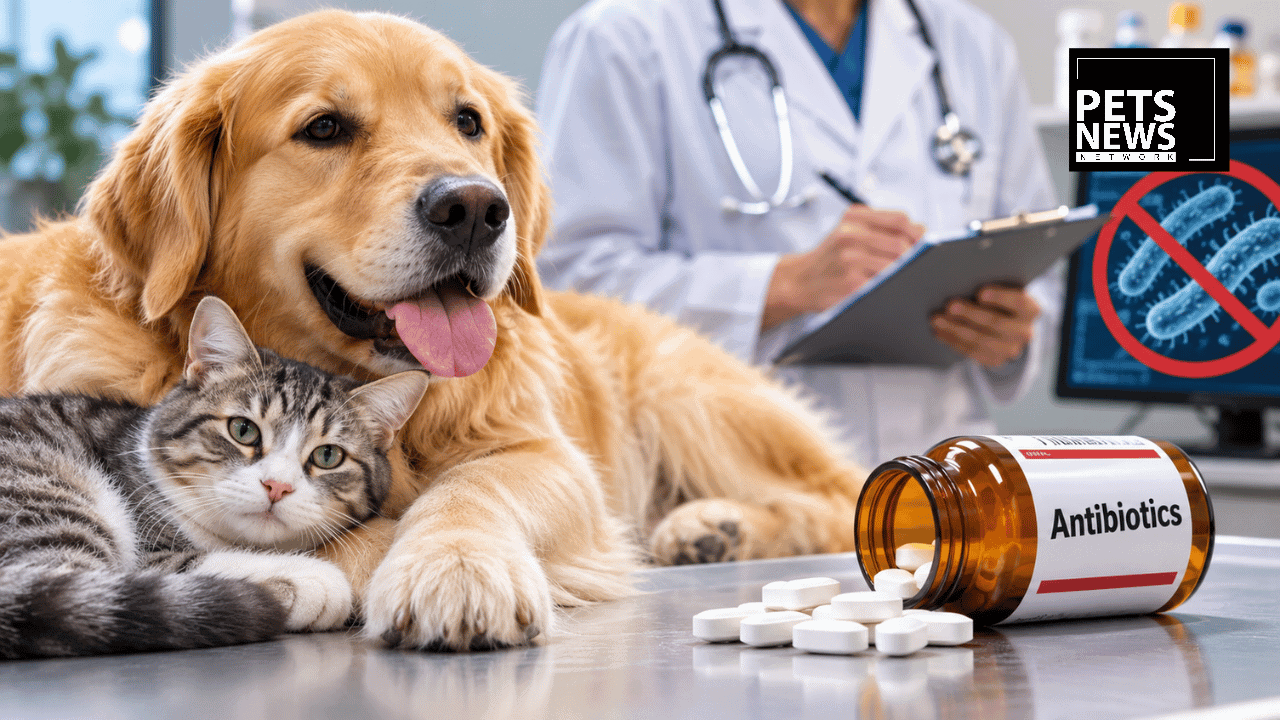
A tabby-and-white cat and a golden dog resting closely together on the floor, representing everyday pet care and preventive health to reduce antibiotic use

Welfare is the best prevention

The argument made for farms holds in the home. A pet that is well fed, kept clean, vaccinated, exercised and seen by a vet regularly is a pet that tends to fall ill less often. Fewer illnesses mean fewer antibiotics, and fewer antibiotics mean fewer chances for resistance to develop.

Good care is the kind thing to do for an animal. It is also one of the most practical ways of keeping these medicines working.


The short version

  • Resistance is rising, and was directly responsible for more than a million deaths in 2021.
  • Animals account for most antibiotic use worldwide, and pets share bacteria with their owners.
  • Antibiotics should be started only by a vet, given exactly as prescribed, and never reused.
  • Prevention, through vaccination, hygiene and good everyday care, is what reduces the need for them.

Every course that is avoided because an animal stayed healthy is one less opportunity for a bacterium to learn how to survive.


Pets News Network is India’s first dedicated media platform for the pet and animal industry. For breaking global pet news, brand coverage, and advertising enquiries, contact: info@petsnewsnetwork.com


Total Views: 5,463

You Might Also Like

After Kumamoto’s Deadly Earthquake, a Race Begins to Reunite Terrified Pets With Their Families
Tokyo-Area Governments Push to Keep Pets and Owners Together in Disaster Shelters
Coimbatore’s Street Dogs Step In to Protect a Vulnerable Woman, and Police Only Found Out by Chance
Vet Bills Are Soaring — Here’s Why Indian Pet Parents Are Rushing to Insure
Stray Dog Crisis Back in National Spotlight: 37 Lakh Dog Bite Cases, Nearly 20,000 Deaths Raise Tough Questions
TAGGED:antibiotic resistanceantibiotic stewardshipantibiotics for petsantimicrobial resistanceCatscolistinDogsdrug-resistant bacteriaOne HealthPet Healthpet medicationPet Safetypreventative pet careResponsible Pet OwnershipsuperbugsVeterinary Care
Share This Article
Facebook Email Copy Link Print

More Popular from PNN

A golden-brown Golden Retriever lying quietly on a dark leather couch with a tired, sad expression, representing the lethargy and discomfort experienced by dogs suffering from urinary bladder stones or uroliths.
Pet Health

Urinary Bladder Stones in Dogs: Types, Symptoms, Diagnosis, and Treatment Guide for Pet Parents.

By
Ankur Jain
16 Min Read
A golden-brown Golden Retriever lying quietly on a dark leather couch with a tired, sad expression, representing the lethargy and discomfort experienced by dogs suffering from urinary bladder stones or uroliths.

Urinary Bladder Stones in Dogs: Types, Symptoms, Diagnosis, and Treatment Guide for Pet Parents.

By
Ankur Jain
Antibiotics Are Losing Their Power. What Every Pet Owner Should Know Before Asking for a Course.
Daily DigestGovernment PolicyPet CarePet EducationPet HealthPet Parent GuidesPet SafetyPolicy & LawResearchTreatment & Health

Antibiotics Are Losing Their Power. What Every Pet Owner Should Know Before Asking for a Course.

By
Ankur Jain
10 Min Read
- Advertisement -
Ad image
Pet Health

Urinary Bladder Stones in Dogs: Types, Symptoms, Diagnosis, and Treatment Guide for Pet Parents.

That Sad, Tired Look Could Mean More Than a Bad Day — Know the Signs of…

By
Ankur Jain
Treatment & Health

Blood Panel Clues in Dogs and Cats, What Your Vet’s Blood Tests Are Really Telling You

Your Cat's Blood Test Could Be Saving Their Life — Here's How

By
Ankur Jain
Pet HealthTreatment & Health

Chronic Kidney Disease in Dogs: Symptoms, Treatment, Diet, and How to Give Your Dog a Better Quality of Life.

When Your Dog's Kidneys Start to Fail — Here's What Every Pet Owner Must Know

By
Ankur Jain
Pet Health

Urinary Bladder Stones in Dogs: Types, Symptoms, Diagnosis, and Treatment Guide for Pet Parents.

That Sad, Tired Look Could Mean More Than a Bad Day — Know the Signs of…

By
Ankur Jain
Pet Health

Dog Vaccination Schedule in India, The Complete Guide Every Pet Parent Needs in 2025.

One Small Injection — A Lifetime of Protection for Your Dog

By
Ankur Jain
PNN Logo - Pets News Network

Pets News Network (PNN) is India’s first independent pet-industry news service and watchdog, delivering professional journalism, lifestyle content, and trusted reporting for every pet parent, professional, and animal lover.

Categories

  • Technology
  • Entertainment
  • Animal Rescue & Welfare
  • Industry Insider
  • Pet Business & Finance
  • Pet Food Science
  • Pet Health

Quick Links

  • World
  • Pet Technology
  • Pet Insider
  • Blog Index
  • Contact US
  • My Bookmarks

@COPY RIGHTS – 2026, Pets News Network. All Rights Reserved.

© Pets News Network 2026. All Rights Reserved.
PNN Logo - Pets News Network PNN Logo - Pets News Network
Welcome Back!

Sign in to your account

Username or Email Address
Password

Lost your password?
