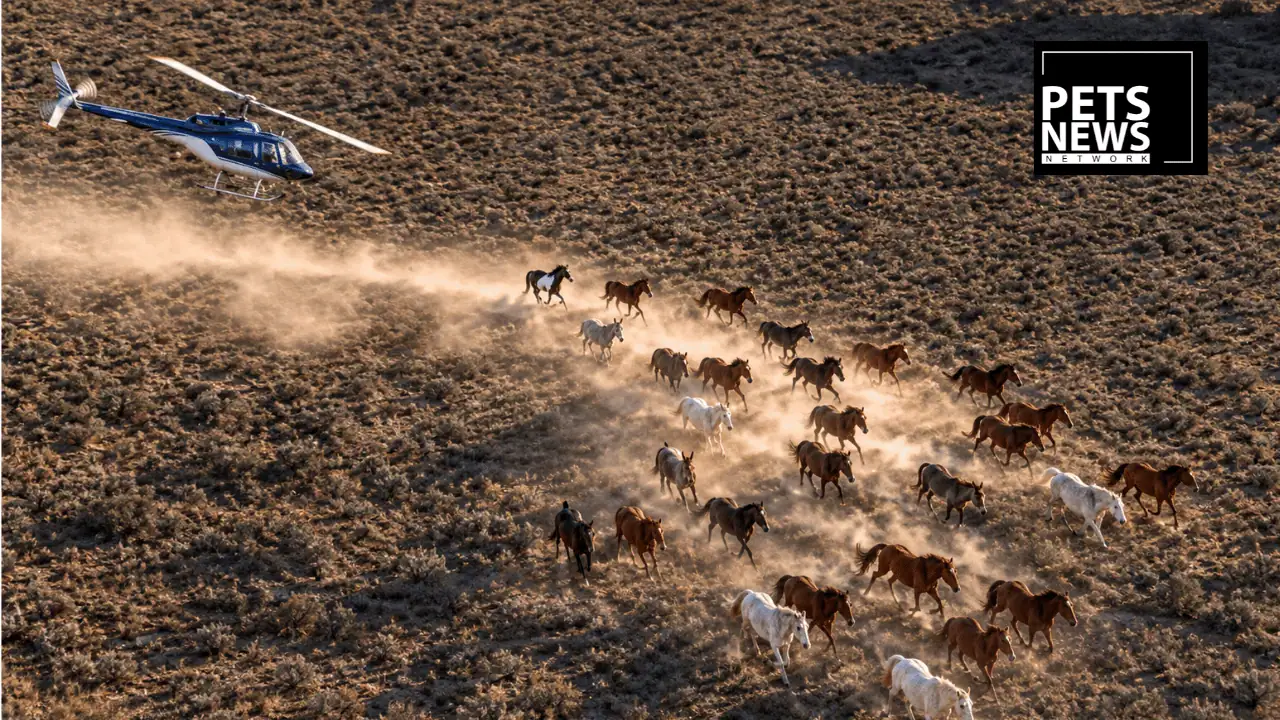

During a 2022 roundup in Nevada, a colt broke his leg while a helicopter relentlessly chased him across rough terrain for miles. Footage captured the panicked young horse struggling to keep running despite the injury. After roughly half an hour, the animal was euthanised on the spot.
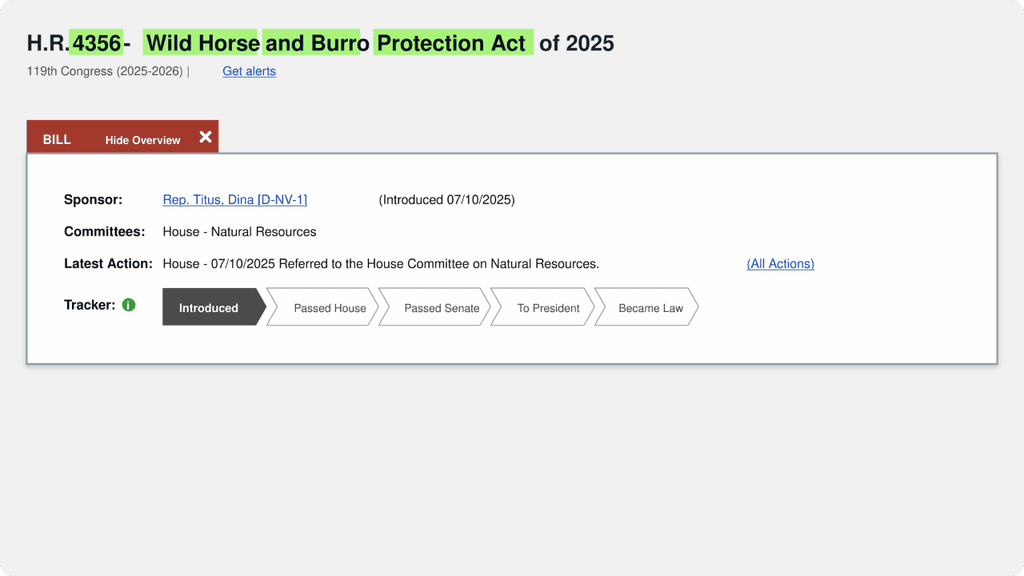
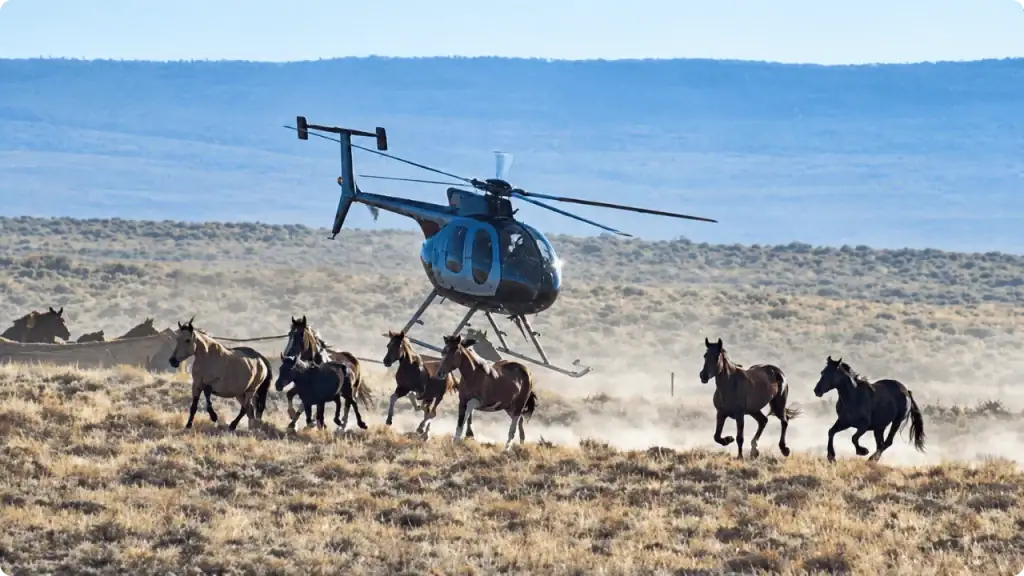
That single, documented incident has become a rallying point for a bipartisan push in Congress to fundamentally change how the federal government manages America’s wild horse and burro populations. The result is H.R. 4356, the Wild Horse and Burro Protection Act, a bill that would ground the helicopters responsible for one of the most controversial tools in US public land management.
What the Bill Actually Does
Introduced on July 10, 2025 by Representatives Dina Titus (D-NV), Steve Cohen (D-TN), and Juan Ciscomani (R-AZ), H.R. 4356 would amend the Wild Free-roaming Horses and Burros Act of 1971 to prohibit the Bureau of Land Management (BLM) from using helicopters, and in most cases fixed-wing aircraft, to round up wild horses and burros on public rangelands.
Rather than an immediate, hard stop, the bill directs the BLM to phase out aircraft-assisted roundups over a two-year transition period. During that window, any aircraft still used in gather operations would be required to carry cameras, adding a documented layer of public accountability to a practice that currently unfolds largely out of public view, often miles from any observer.
The legislation also instructs the Government Accountability Office to conduct a federal review of alternatives to aircraft-assisted gathers, examining the effectiveness and cost of other management methods, potential employment opportunities those alternatives could create, and the broader effects of aircraft, including drones, on wild horse and burro populations. As of January 2026, the bill had gathered 18 cosponsors and remains under review by the House Committee on Natural Resources. It has not yet passed either chamber of Congress.
Why Helicopters Became the Target
The case against helicopter roundups rests on both welfare and financial grounds, and the bill’s own text lays out the reasoning directly. According to its findings section, the use of helicopters to chase equines over prolonged distances, usually across rough terrain, is particularly dangerous, capable of frightening animals into deadly situations far from public view.
The welfare concerns are well documented beyond this single incident. Worked into a panic during a chase, horses can catch and break limbs colliding with trap panels, or suffer capture myopathy, a condition where extreme physical overexertion leads to organ failure and death. Animal welfare organisations tracking these operations have also pointed to family structure disruption, with roundups separating foals from mares amid the chaos of a chase, and cases of exhaustion-related deaths among more vulnerable animals.
The financial case is just as stark. According to the bill’s sponsors, at least $36.7 million was spent on roundup operations between 2020 and 2024 alone, including more than $6 million paid to helicopter-roundup contractors during fiscal year 2022. Separately, advocacy groups tracking BLM spending note the agency has spent more than $25 million in taxpayer dollars on helicopter roundups since fiscal year 2017, with the bill’s own findings citing over $69.5 million in related taxpayer costs dating back to fiscal year 2012.
Much of that expense flows to a small number of private contractors, typically livestock companies awarded multi-million-dollar contracts to remove wild horses from public land. Critics argue this creates a system where the most expensive, and most welfare-compromising, removal method has become institutionally entrenched, not because it’s the most effective approach, but because it’s the one existing contracts and infrastructure are already built around.
The Scale of the Underlying Problem
None of this dismisses the genuine ecological pressure driving the BLM’s management efforts in the first place. The agency oversees roughly 245 million acres of public land, and current wild horse and burro populations, estimated at over 70,000 to 73,000 animals on the range, significantly exceed the Appropriate Management Levels (AMLs) the BLM has designated as sustainable for those lands.
That overpopulation creates real ecological stress, competition for limited forage and water, degradation of rangeland vegetation, and knock-on effects for other native species sharing the same landscape. The BLM’s removal efforts aren’t arbitrary, they respond to a genuine population management challenge on lands that can’t indefinitely support herds well beyond their sustainable carrying capacity.
The scale of past removal efforts underscores just how aggressively the agency has been acting on that pressure. In fiscal year 2022 alone, the BLM removed 20,000 horses and burros from the wild, a historic high for the agency, with a subsequent BLM announcement indicating plans to capture 7,000 more wild horses in a single month, resulting in the permanent removal of 5,857 animals from public lands.
The Alternative the Bill’s Backers Are Pushing
Rather than disputing the need for population management altogether, H.R. 4356’s supporters argue the current method is simply the wrong tool for the job, both ethically and fiscally. The bill points to fertility control as a scientifically supported, more humane alternative, specifically referencing research from the National Academy of Sciences concluding that helicopter roundups are particularly counterproductive as a long-term management strategy.
In practice, this alternative approach centers on PZP (porcine zona pellucida) vaccines, a reversible, non-hormonal fertility control method that can be administered to mares on the range without requiring capture and removal at all. Combined with continued on-range management, including traditional horseback gathering methods where capture genuinely is necessary, and stronger habitat-focused stewardship, advocates argue this combination could achieve sustainable population control without subjecting animals to the trauma, injury risk, and expense of helicopter chases.
There’s also a systemic cost argument tied into this shift. Much of the BLM’s current Wild Horse and Burro Program budget goes not to roundups themselves, but to the tens of millions of dollars spent annually keeping captured animals in off-range holding facilities for the remainder of their lives, animals removed from the wild but never actually adopted out. Shifting resources toward on-range fertility control, rather than continual capture-and-hold cycles, could meaningfully reduce that long-term financial burden while keeping herds in their natural habitat.
A Genuine Policy Dilemma, Not a Simple Villain Story
What makes this legislative fight genuinely difficult isn’t a lack of good intentions on either side, it’s a real tension between two legitimate priorities. Public rangelands have finite ecological carrying capacity, and unmanaged population growth carries real environmental consequences. At the same time, the methods currently used to manage that population raise serious, well-documented welfare concerns that a growing bipartisan coalition in Congress now considers unacceptable to continue funding at current scale.
H.R. 4356 represents an attempt to resolve that tension by changing the tool, not abandoning the goal. Whether fertility control and on-range management can actually scale to match the ecological pressure currently being addressed through mass removals remains an open, genuinely important question, one the bill’s proposed GAO review is specifically designed to help answer.
What Comes Next
With 18 cosponsors and continued advocacy from animal welfare organisations, H.R. 4356 remains under committee review, its path to an actual House or Senate vote still uncertain. For America’s wild horse and burro herds, whether that path clears may determine if future population management looks more like a fertility control needle delivered from horseback, or another helicopter closing in across open rangeland.
Pets News Network is India’s first dedicated media platform for the pet and animal industry. For breaking global pet news, brand coverage, and advertising enquiries, contact: info@petsnewsnetwork.com