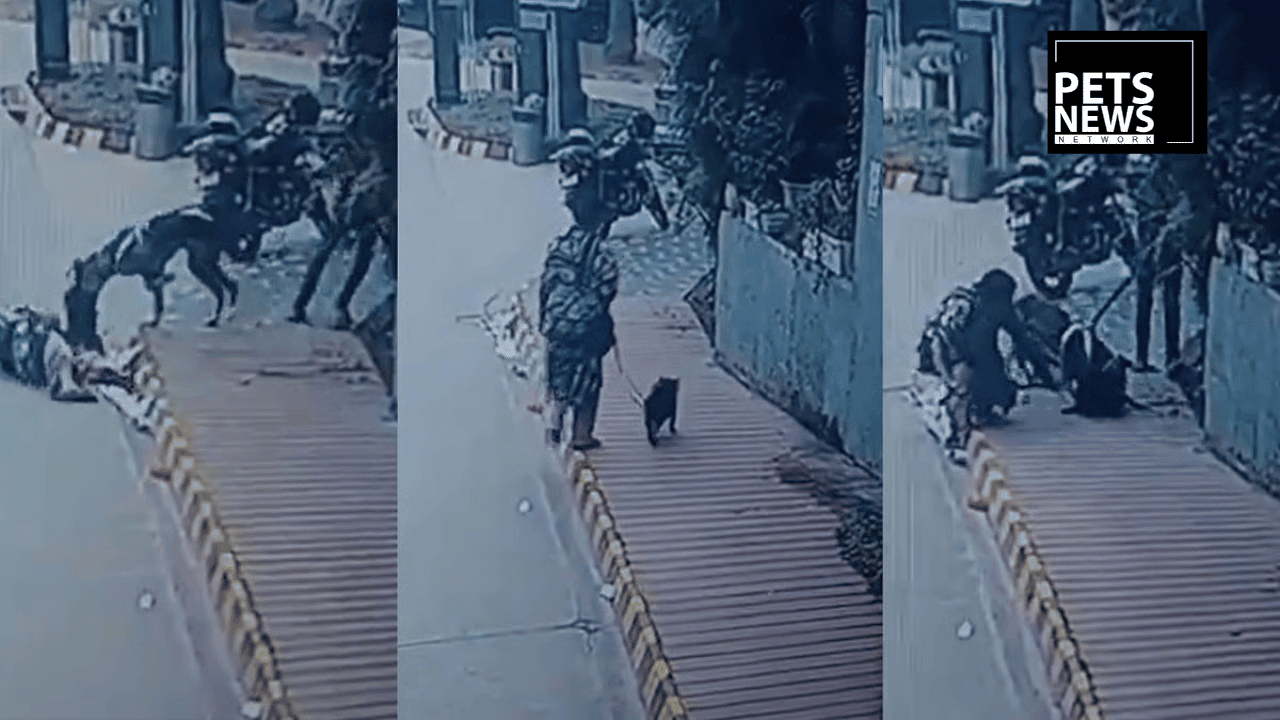

A woman was walking her pug inside her own society on a Sunday morning. Two and a quarter minutes of CCTV footage later, the dog was dead. Both animals were pets. Both had owners. Only one of them was muzzled — and that was a human decision, taken before either dog left home.
What happened
On the morning of Sunday 11 October 2026, an eight-year-old pug named Gogo was mauled to death by a Great Dane inside Grand Omaxe society in Sector 93B, Noida.
The pug’s owner, Namita, a wedding planner, was on a routine morning walk inside the compound when the attack occurred.
CCTV footage from the society, which has since circulated widely, shows the larger dog knocking her to the ground, then seizing the pug. It does not let go despite attempts by bystanders to pull it away. The pug died of its injuries.
The footage runs for roughly two and a quarter minutes.
The Great Dane was not muzzled.
Namita called the police emergency helpline on 112 and submitted a written complaint at the police station, along with a complaint to the society’s apartment owners’ association.
Two corrections worth making
Coverage of this incident has carried two errors that are worth clearing up before anything else.
It was not a prohibited breed. A widely shared post described the attacking dog as being of a “prohibited breed,” and another identified it as a Greyhound. Police have identified the dog as a Great Dane and confirmed it is not on any prohibited list.
This matters more than it may appear. Every time an incident like this happens in India, the conversation turns immediately to banning a breed — and that conversation is a way of avoiding the harder one. Great Danes are not banned anywhere in India, and banning them would not have saved this pug. What would have saved it was a muzzle, a shorter leash, or a decision to walk at a quieter hour. All three are human choices.
The status of police action is disputed. Different outlets have reported different things — one headlines that a case has been registered, another says police action is awaited, and a Hindi report quotes Phase-2 police station saying no written complaint had been received at the time of reporting.
PNN is relying on Hindustan Times‘ account for the status of the complaint. Readers should treat the legal position as developing rather than settled.
This is not a street dog story
It is worth stating plainly, because the national conversation about dogs in India has become almost entirely about street animals.
Both dogs in this incident were pets. Both had owners. Both were inside a gated residential society, on a walk, at a normal hour of the morning.
The victim was not someone who dislikes dogs. She was a pet owner, out with her own dog, in the compound she pays to live in.
Which means none of the usual arguments apply. This was not a question of ABC programmes, feeding zones, municipal failure or sterilisation coverage.
There is no municipality to blame here, no court order left unimplemented, no shortage of funds. Two pet owners walked their dogs in a private compound on a Sunday morning. One of them had made every reasonable preparation. The other had not.
The rules already exist
Here is the part most coverage has missed entirely.
Noida Authority already has a pet policy. Under guidelines framed by the Authority, pet owners in Noida are required to register their dogs or cats. Failure to register attracts a fine of ₹2,000 per month.
And crucially: if a registered pet causes injury, the owner is liable to a penalty of ₹10,000.
So the framework exists. The question this incident raises is whether it means anything.
A ₹10,000 penalty may be a reasonable figure for a bite that requires a few stitches. Whether it is a meaningful consequence when the outcome is a dead animal and an injured person is a different question entirely — and one that the Authority, not the police, would have to answer.
There is also the muzzle. Noida’s policy and most society bye-laws expect large dogs to be leashed and, where appropriate, muzzled in common areas. The footage shows the Great Dane unmuzzled in a shared space during peak morning walking hours.
What an RWA can and cannot do
Residents of Grand Omaxe have made a specific demand. One resident post circulating since the incident reads:
“The attacking dog has not been removed from the society despite strong voice of the residents. We, at Grand Omaxe request immediate evacuation of attacking dog in interest of our families & pets.”
The feeling behind that is entirely understandable. The legal position is more complicated, and pet owners should know it.
An RWA cannot evict a pet. Guidelines issued by the Animal Welfare Board of India have consistently held that resident welfare associations and apartment owners’ associations do not have the power to ban pets from a housing society, nor to force a resident to give up an animal. Courts have upheld this position repeatedly. An RWA can frame reasonable rules about the use of common areas — lifts, parks, timings — but it cannot order an animal out.
What an RWA can do is enforce. It can require leashing and muzzling in common areas, it can fine members who breach bye-laws, it can restrict access to specific shared spaces, and it can escalate a complaint to the Noida Authority and the police.
That distinction matters, because a demand the RWA legally cannot meet will produce months of conflict and no outcome. A demand it can meet — mandatory muzzling for large breeds in common areas, enforced with penalties — might actually change what happens on the next morning walk.
This was preventable, and that is the whole point
Strip away the shock of the footage and what remains is a sequence of ordinary decisions.
A dog capable of killing another animal in seconds was taken into a shared residential space, at peak morning walking hours, when other residents would predictably be out with small dogs and children. It was not muzzled. When it lunged, the person holding it could not hold it — the footage shows a woman knocked to the ground and bystanders unable to separate the animals.
Every one of those is a choice made before the dog ever saw the pug.
“My dog is friendly” is not a safety measure. It is a statement about past behaviour, offered as a guarantee about future behaviour, in an environment the owner does not control. It is the single most common thing said by owners of large dogs in Indian societies, and it was no use to anyone on Sunday morning.
A Great Dane is not an aggressive breed. It does not need to be. Size, prey drive and two minutes are sufficient, and no amount of affection for the animal alters that arithmetic.
The honest version of the muzzle argument
Muzzles have a reputation problem among Indian pet owners. They are read as a sign of a dangerous dog, or as cruel.
Both readings are wrong, and this incident illustrates why.
A basket muzzle, properly fitted, allows a dog to pant, drink and take treats. It is not a punishment and it is not a statement about the animal’s character. It is a piece of equipment that makes one specific outcome impossible.
The Great Dane in this footage may well be a perfectly even-tempered dog in every other circumstance. That is not a defence. It is the explanation for why no muzzle was used, and it is exactly the reasoning that failed.
A muzzle does not require anyone to believe their dog is dangerous. It requires them to accept that they cannot guarantee what will happen in a space they do not control. Owning an animal that can kill another in under two minutes carries obligations that do not pause because the owner has never seen it happen before.
What large-breed owners should take from this
Not as criticism. As practical reading of a situation that could involve anyone.
Know your dog’s prey drive. A small, fast-moving animal triggers something in many large breeds that has nothing to do with aggression toward people and cannot be trained away entirely. It can be managed.
Muzzle in shared spaces. Not at home, not on an empty road at 5am. In a society park at 8am, when other residents are walking small dogs, the calculation is different.
Use a proper leash and a secure harness. The footage shows the woman knocked to the ground. Control was lost before the pug was reached.
And know what happens if your dog does cause harm. In Noida that is a ₹10,000 penalty under Authority rules, plus whatever the police do, plus civil liability, plus the position you will be in with every neighbour you have. Insurance for third-party pet liability exists in India and almost nobody buys it.
For small-dog owners
Pugs, Shih Tzus, Indies and other small dogs are the most vulnerable animals in any society compound, and their owners have fewer options than they should.
- Walk at times when large dogs are not out, if a pattern exists in your society.
- Carry your dog if a large unleashed dog approaches. It is not dignified and it works.
- Do not try to physically separate two dogs mid-attack. The bystanders in the footage could not, and people are regularly injured attempting it. Loud noise, water, or an object placed between them is safer.
- Report breaches of leash and muzzle rules to the RWA in writing, before something happens. A documented complaint history is what makes enforcement possible afterwards.
Pet love, or negligence?
It is the right question, and it has an uncomfortable answer.
Nobody in this story set out to harm anything. Walking your dog is what responsible owners do, and affection for an animal is not in doubt here.
But affection is not a safety measure, and intention is not the test. An unmuzzled large dog in a shared space is a risk one person decides to accept on everybody else’s behalf — on behalf of Namita, who did not consent to it and ended up on the ground, and on behalf of an eight-year-old pug who had no say at all.
That is what separates love from responsibility. Love is what you feel about your own animal. Responsibility is what you owe to everyone else’s.
The rules in Noida already say what should have happened: registration, control in common areas, and a ₹10,000 penalty where a pet causes injury. A pug is dead because those rules were not followed.
The question now is whether anything at all is enforced — by the police, by the Noida Authority, or by the society. On the evidence of every similar case in Indian housing societies, the honest expectation is that nothing will be, and that the next incident will produce the same viral footage and the same outrage.
Unless somebody decides this one is different.
Pets News Network is India’s first dedicated media platform for the pet and animal industry. For breaking global pet news, brand coverage, and advertising enquiries, contact: info@petsnewsnetwork.com