

World Rabies Day falls on September 28 every year, marking the anniversary of Louis Pasteur’s death, the scientist whose work made the first rabies vaccine possible. More than a century later, the disease that vaccine was designed to stop remains almost entirely preventable and still almost always fatal once symptoms appear. That contradiction, a disease with a 100% survivable outcome if caught early and a near-100% fatality rate if it isn’t, is exactly what this day exists to close the gap on.
This year’s global theme, set by the World Health Organization and its partners, is “Stronger Together.” It’s a deliberate shift in framing: rabies elimination, the campaign argues, isn’t a problem any single hospital, veterinary clinic, or government department can solve alone. It requires dog vaccination programs, community awareness, surveillance systems, and coordinated policy working in tandem, a One Health approach that treats human, animal, and environmental health as one interconnected system rather than three separate concerns.
The Numbers That Make India Central to This Conversation
Nowhere is that framing more relevant than in India. According to a large-scale study conducted by the Indian Council of Medical Research–National Institute of Epidemiology (ICMR-NIE), spanning 60 districts across 15 states, India records an estimated 9.1 million animal bites and roughly 5,700 rabies deaths every year. Those aren’t small, abstract figures, they represent one of the highest rabies burdens of any country in the world, and a substantial share of the global rabies death toll comes from India alone.
The same study also found that children under 14 and adults above 60 are bitten most frequently, alongside a higher overall incidence among males, a demographic pattern that shapes exactly who needs to be reached by awareness campaigns and exactly where post-bite care needs to be fastest and most accessible.
Vaccines Are Reaching People. The Full Treatment Isn’t.
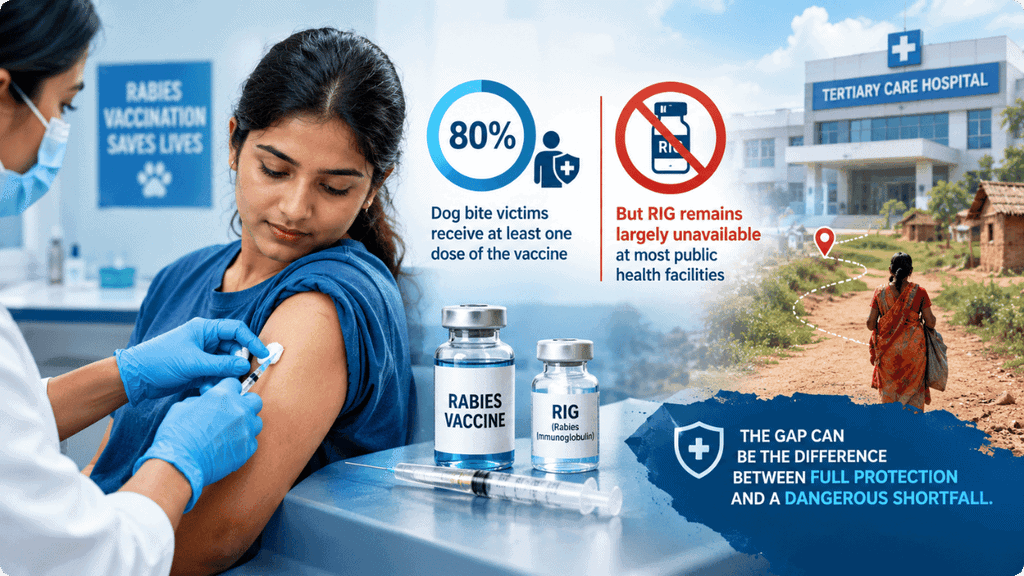
One of the more encouraging findings from the ICMR study is that vaccine uptake among dog bite victims is relatively high, around 80% of people bitten received at least one dose of the anti-rabies vaccine. That’s a meaningful public health achievement on its own.
But it isn’t the whole picture. Full post-exposure prophylaxis (PEP) for a serious bite isn’t just the vaccine series, it also requires rabies immunoglobulin (RIG) for higher-risk wounds, and this is where the system still falls short. RIG remains largely unavailable at most public health facilities and is concentrated mainly in tertiary care hospitals like AIIMS Delhi and a handful of major medical colleges. For a rural bite victim, or anyone outside a major city, that gap can mean the difference between complete protection and a dangerous shortfall in treatment, even after doing everything right by seeking care quickly.
What Veterinarians Keep Emphasising
Talk to practising veterinarians in India about rabies, and a few themes come up consistently, more consistently, in fact, than almost any other single public health topic in companion animal care.
The first is that pet owners routinely underestimate how quickly protection can lapse. A rabies vaccine isn’t a one-time formality ticked off in a puppy’s first year; it requires an annual booster to stay effective, and a missed or delayed booster is one of the most common, entirely avoidable gaps veterinarians see when reviewing a pet’s vaccination history after a bite incident.
The second is around the golden window after any bite or scratch. Veterinary guidance is unambiguous on this point: the wound should be washed with soap and running water for a full 15 minutes, not a quick rinse, as this single step measurably reduces viral load at the exposure site before any vaccine or medical treatment even begins. This applies regardless of whether the biting animal is a pet, a stray, or wildlife, and regardless of how minor the wound looks.
The third, and perhaps the most persistent point veterinarians raise, is that community-level vaccination matters as much as individual pet care. A single well-vaccinated household pet living in a neighbourhood with a large unvaccinated stray population is still part of a system where transmission can spread through the broader animal population and eventually reach humans. This is precisely why veterinary bodies and animal welfare organisations continue to push for sustained municipal and community dog vaccination drives, not just clinic-level advice to individual pet owners, as the more durable long-term solution.
The 2030 Target, and What Stands Between Here and There
India has committed to eliminating dog-mediated rabies deaths by 2030 under its National Action Plan for Rabies Elimination (NAPRE), aligning with the global “Zero by 30” ambition that rabies organizations worldwide have rallied around for years. It’s an achievable goal on paper, human rabies deaths are, after all, virtually 100% preventable with timely intervention, but the ICMR findings make clear that the remaining gap isn’t about the science. It’s about access, consistency, and reach: getting RIG stocked beyond tertiary hospitals, sustaining mass dog vaccination coverage high enough to actually break local transmission chains, and making sure awareness about what to do after a bite reaches the people most likely to be bitten in the first place.
Mass dog vaccination remains the single most effective lever available. Vaccinating at least 70% of a local dog population is generally considered the threshold needed to interrupt rabies transmission in that area entirely, a target that requires sustained, well-funded, and genuinely nationwide vaccination drives rather than periodic, geographically uneven campaigns.
What This Means for Pet Owners, Right Now
For anyone reading this as a pet owner rather than a policymaker, the practical takeaway is simple and doesn’t require waiting on any national programme:
- Keep your dog or cat’s anti-rabies vaccination current. A single missed annual booster can leave a genuine gap in protection, both for your pet and for anyone your pet interacts with.
- Know what to do immediately after any bite, whether it’s your own pet, a stray, or someone else’s animal: wash the wound thoroughly with soap and running water for a full 15 minutes, and seek medical attention the same day rather than waiting to see if symptoms develop.
- Don’t assume a domestic, vaccinated pet removes all risk. Stray and community animal populations remain the primary transmission route in most parts of India, which is part of why community-level vaccination drives matter as much as individual pet care.
- Support or participate in local vaccination camps where they’re available. Every dog vaccinated in a community is one fewer possible link in a transmission chain that could otherwise reach a child, an elderly neighbour, or another animal.
A Day That’s Really About Every Other Day
World Rabies Day itself is a single date on the calendar, but the disease it’s built around doesn’t pause for observances. India’s path to eliminating rabies deaths by 2030 runs through ordinary, unglamorous work: consistent vaccine cold chains, stocked immunoglobulin outside major cities, sustained public awareness, and pet owners who don’t let a booster shot slip. “Stronger Together” is, in that sense, less a slogan than a fairly literal description of what’s actually required, no single hospital, clinic, or campaign closes a gap this large alone.
Pets News Network is India’s first dedicated media platform for the pet and animal industry. For breaking global pet news, brand coverage, and advertising enquiries, contact: info@petsnewsnetwork.com