
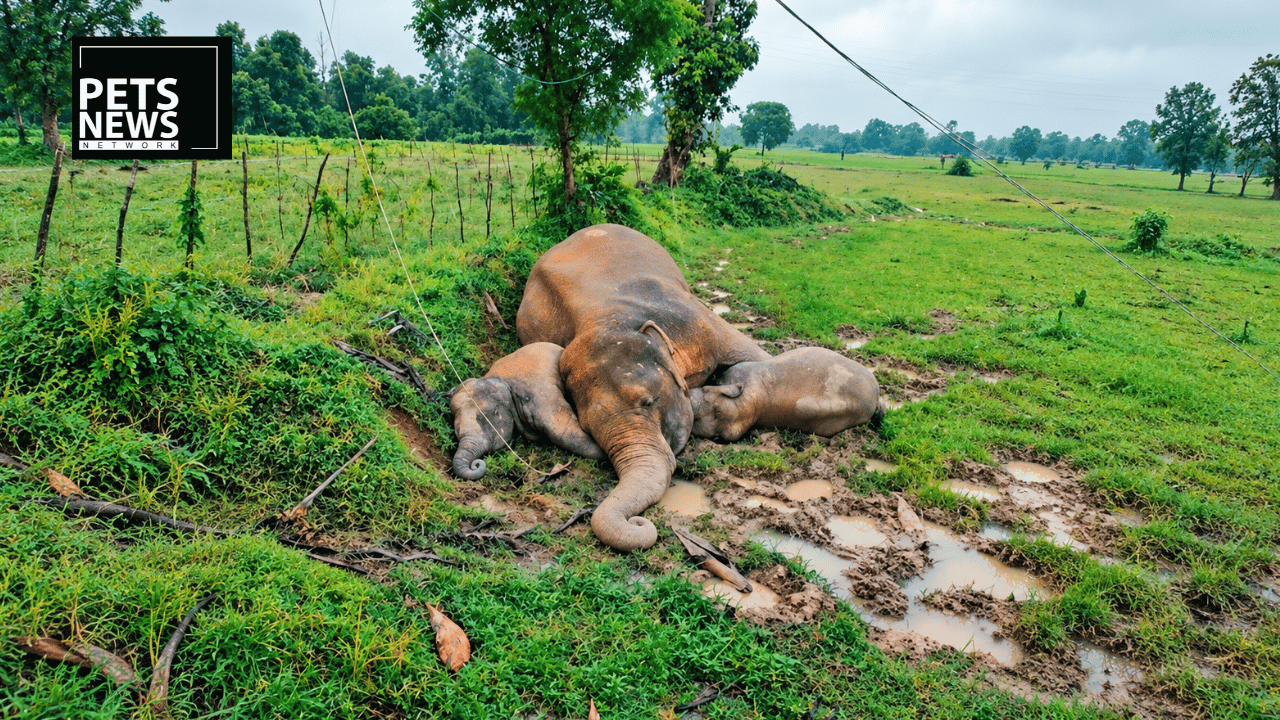

Three elephants died on Sunday morning in a West Bengal paddy field. The cause is the single largest killer of India’s elephants, it is almost entirely preventable, and in three out of four cases nobody is ever held responsible.
What happened at Salboni
On the morning of Sunday, 28 September, villagers in Salboni, in West Bengal’s West Midnapore district, found the bodies of three elephants lying in a paddy field. A mother and her two calves.
A herd had been passing through the area overnight. An electric pump had been installed to irrigate the farmland, with a live wire running across the ground. Forest officials believe the three animals died after coming into contact with it.
Villagers alerted the local forest department office. Officials reached the site, began an investigation, and sent samples for post-mortem. The exact cause of death will be confirmed after the autopsy.
One detail is still unsettled in the reporting and worth flagging honestly: most accounts describe a live wire connected to an irrigation pump, while some report the deaths as following the snapping of a high-tension electricity line. Those are materially different scenarios, one an infrastructure failure, the other illegal fencing. The forest department’s investigation will determine which.
What is not in dispute is the region’s history.
Jangalmahal knows this story
Salboni sits in Jangalmahal, a forested belt across West Bengal’s western districts that is one of the state’s most significant elephant landscapes. Herds move through it between forest patches, and their routes cross farmland.
A state forest department official, speaking to reporters, was blunt about what happens next.
“In the past, elephants died in these forest areas due to electrocution,” the official said. “There has been a common tendency among farmers in the region to surround their farmlands with electric wires to protect their crops.”
The department has tried to stop it. “Earlier, there had been instances of penalising the offenders on this count,” the official added. “However, the fencing activity has continued.”
Last month, a middle-aged tusker died after contact with an illegally energised fence around farmland in the Falakata block of Alipurduar district, in north Bengal.
The scale: this is India’s biggest elephant killer
The Salboni deaths are not an aberration. They are the standard mechanism by which India’s elephants die at human hands.
Government data tabled in Parliament shows that between 2019-20 and 2023-24, India lost 528 elephants to unnatural causes. Of those:
- 392 died of electrocution — roughly 75% of all unnatural elephant deaths
- 73 in train accidents
- 50 to poaching
- 13 to poisoning
The pattern holds across years. An earlier parliamentary answer covering 2014-15 to 2018-19 recorded 490 unnatural deaths, of which 333, or 68%, were electrocutions. Ministry figures show 600 elephants killed by electrocution in the decade from 2009 to 2019.
State-wise, the burden falls on the eastern and southern elephant belts. In the 2019-24 period, electrocution killed 71 elephants in Odisha, 55 in Assam, 52 in Karnataka, 49 in Tamil Nadu, 32 in Chhattisgarh, 30 in Jharkhand and 29 in Kerala.
India holds around 30,000 wild Asian elephants, close to 60% of the global population. Losing several hundred to a preventable cause in five years is not a rounding error.
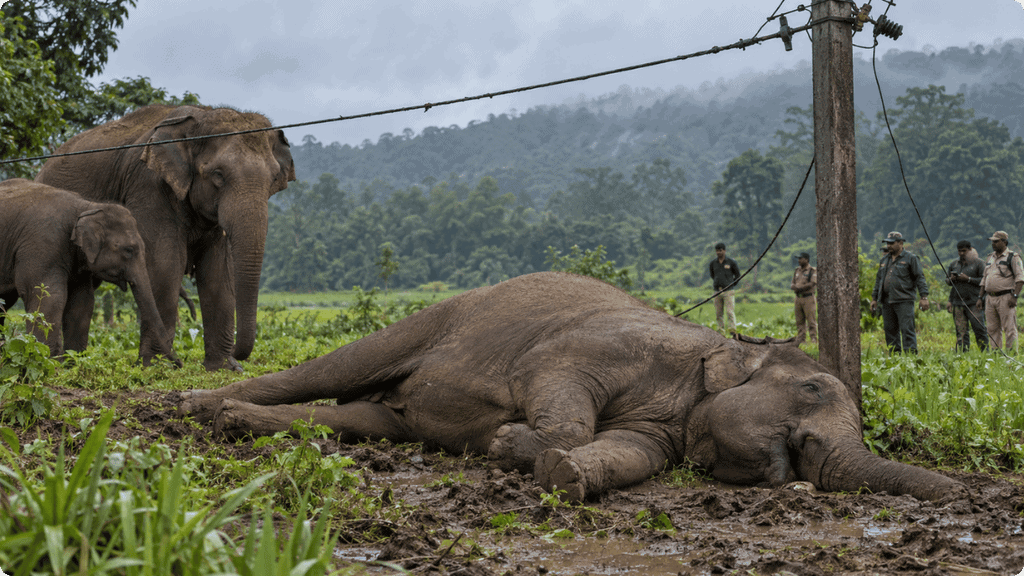
Almost nobody is prosecuted
Here is the part that explains why the practice continues despite being illegal.
Killing an elephant is a serious offence. The Asian elephant carries the highest level of protection under the Wildlife (Protection) Act, 1972, and causing its death, including through an illegally energised fence, is punishable with imprisonment and fine.
In practice, that rarely happens. A former principal chief conservator of forests, B K Singh, told The Indian Express that in around 75% of electrocution cases, those responsible are never arrested.
“I do not remember any case in the last one decade where anyone has been prosecuted for the electrocution of an elephant,” he said.
A Karnataka forest official quoted in the same report noted that elephants come into contact with fence lines put up by private landowners, and that annual electrocution deaths in the state were still running at five or six.
The West Bengal official’s remark, that penalties were imposed before and the fencing continued anyway, says the same thing from the other direction. Enforcement exists on paper. It has not changed behaviour.
Why farmers do it anyway
It would be easy to write this as a story about cruelty. It isn’t, mostly.
A herd of elephants moving through standing paddy can destroy a season’s income in a single night. For a smallholder in Jangalmahal, that is not an inconvenience, it is the difference between solvency and debt.
The human cost runs the other way too. Parliamentary data shows human-elephant conflict caused 2,853 human deaths in India over five years, reaching a five-year high of 628 in 2023-24. West Bengal accounted for 436 of those deaths, behind only Odisha and Jharkhand.
So the farmer stringing a wire around his field is usually not a poacher. He is someone protecting a crop and, in his own estimation, his family’s safety, using the cheapest tool available, a hook thrown over an overhead line, or a wire run from an irrigation pump.
That is exactly why penalties alone have failed. A fine imposed after an elephant dies does nothing about the crop loss that motivated the wire in the first place.
What actually works
Conservation practice has reasonably well-established alternatives, and where they are funded properly they reduce both crop damage and elephant deaths.
Properly regulated solar fencing. Solar-powered fences deliver a short, non-lethal pulse designed to deter rather than kill. They are legal, they work, and the difference between a solar fence and an illegally energised one is the difference between a deterrent and a death trap. Karnataka’s forest department has deployed these along with trenches and railway barricades in conflict zones.
Fast, adequate crop compensation. This is the lever that matters most and the one most often broken. If compensation for elephant crop damage is slow, partial or tangled in paperwork, farmers stop applying and start improvising. Any serious effort to end illegal fencing has to begin with making the legal remedy actually work.
Early warning systems. Karnataka set up a round-the-clock information centre to alert villagers to elephant movement. Knowing a herd is coming lets people protect crops and keep out of the way without electrifying anything.
Habitat and corridor protection. Officials have repeatedly cited shrinking habitat and fodder shortage, worsened by invasive species like lantana, as reasons elephants enter farmland at all. A herd in a paddy field is often a herd with nowhere better to go.
The question Salboni leaves behind
Three elephants died on Sunday. A mother and her two calves, which means a breeding female and the next generation gone in one incident, in one of West Bengal’s most important elephant landscapes.
An autopsy will establish the cause. An investigation may or may not identify who rigged the wire. On past form, in three out of four such cases, nobody will be prosecuted.
But the more useful question is not who to punish. It is why, in a region where the forest department openly acknowledges that farmers routinely electrify their fields, the state has not yet made the legal alternatives, solar fencing, prompt compensation, movement alerts, easier and cheaper than a live wire.
Until that changes, Jangalmahal will keep producing this story, and the only variable will be how many elephants are in the field the next morning.
Sources: Incident details from IANS reporting, 27 September 2026, as carried by The Hans India, Mangalorean and other outlets. National elephant mortality data from Government of India replies in Parliament, as reported by PTI and analysed by Factly. Prosecution figures from The Indian Express, via The Federal. Karnataka mitigation measures from Deccan Herald.
Pets News Network is India’s first dedicated media platform for the pet and animal industry. For breaking global pet news, brand coverage, and advertising enquiries, contact: info@petsnewsnetwork.com