


A first-term MP in Nepal’s post-protest parliament asked a question most of her colleagues avoid — not whether animals should be sacrificed, but why they are chased, beaten and killed by untrained hands before they are.
What was said
On 2 October 2026, Member of Parliament Ashika Tamang raised the issue of animal sacrifice and cruelty during Dashain in Nepal’s House of Representatives.
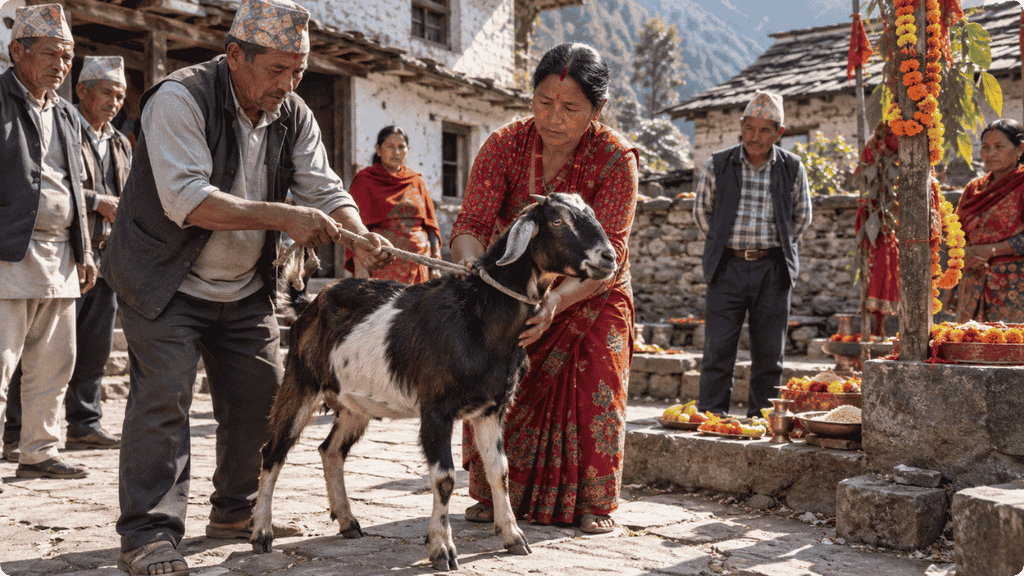
Addressing the Speaker, she said Dashain is a festival of celebration for most people but a time of suffering for animals. She described specific practices: animals chased along the ridges of fields, poked with swords, and beaten with sticks.
She noted that she had grown up in this same society and had seen thousands of animals sacrificed publicly.
Her central argument was about law. Other countries, she said, have strict legal punishment for cruelty to animals, while Nepal’s legal provisions for animal welfare remain weak.
And her question to the government: how long will a policy continue of taking benefit from animals while paying no attention to their actual care and welfare?
The headline on the Nepali report translates as: “When will the custom of killing animals during Dashain stop?”
What she did not say
This matters, because the story has already begun to shift in retelling.
Tamang’s reported remarks concern cruelty in the handling and killing of animals — the chasing, the swords, the sticks, the absence of any humane standard. Some social media summaries have extended this to cruelty “carried out for entertainment purposes.” That phrase does not appear in the reported account of her speech, and PNN has not been able to verify it.
Nor did she, in the reported remarks, call for a ban on religious sacrifice. She asked why Nepal’s animal welfare law is weak and how long the government intends to leave it that way.
That is a narrower and more answerable question than the one international campaigners usually pose about Dashain, and it deserves to be reported as she asked it.
Who is asking
Ashika Tamang is not a long-standing animal rights campaigner working the issue from outside.
Born in 1992 in Malekhu, Dhading, she is an actress and social activist who worked for several years as a nurse in Germany before relocating permanently to Nepal in 2024. Following the 2025 Gen Z protests that brought down the previous government, she was nominated by the Rastriya Swatantra Party to contest from Dhading-1 in the 2026 general election, and now sits in the House of Representatives.
So the question is being asked by a first-term MP in a parliament reshaped by a protest movement, in a government now headed by Prime Minister Balendra Shah. That context explains the timing. Questions that were politically untouchable for decades are being put on the record by people who have no long party history to protect.
She is right about the law
This is the part worth examining, because it is checkable.
Nepal has no single, comprehensive Animal Welfare Act. Protection is scattered across several statutes:
- The Muluki Criminal Code, 2074 (2017) contains the main cruelty provisions. Section 289 protects cows and oxen, with imprisonment of up to three years for killing or injuring them. Sections 290 and 291 cover other cruelty and killing in public — carrying penalties of up to three months’ imprisonment or a fine of up to NPR 5,000, and in the latter case up to one month or NPR 5,000.
- The Animal Slaughterhouse and Meat Inspection Act, 2055 (1999) requires that slaughter for human consumption take place in licensed premises with ante-mortem and post-mortem inspection by a veterinary officer, and prescribes humane slaughter methods.
- The Animal Health and Livestock Services Act, the Nepal Veterinary Council Act and the National Parks and Wildlife Conservation Act cover livestock health, veterinary standards and wildlife respectively.
- An Animal Welfare Directive (2016) sets out protections from hunger, fear, pain and disease — but a directive is not binding legislation.
Legal analysts in Nepal have been making Tamang’s point for years. A Nepali Times commentary noted that fines under the Penal Code are minimal, enforcement is weak, and police do not take cruelty reports seriously unless humans are directly affected. Academic work on the subject describes the framework as fragmented, with weak institutional coordination and limited enforcement capacity.
A fine of NPR 5,000 is the legal ceiling for most animal cruelty in Nepal. That is the figure behind her question.

The international obligation nobody mentions
Nepal has been a member of the World Organisation for Animal Health since 1997. Member states are expected to uphold the internationally recognised freedoms for animals, including freedom from pain, injury and disease, and freedom from fear and distress.
Commentary in Nepali media has made the practical point that follows from this. A complete ban on religious sacrifice may not be achievable or even appropriate. But a legal requirement that animals be killed by a method causing least pain, by trained people, is entirely achievable — and would address most of what Tamang described.
The problem she identified is not primarily that animals are killed. It is that they are chased, injured and killed badly, by people with no training, outside any regulated facility, and that nothing in Nepali law meaningfully prevents it.
Why this is India’s question too
It would be comfortable to read this as a Nepal story. It isn’t.
India has the Prevention of Cruelty to Animals Act, 1960 — the comprehensive law Nepal lacks, and one that Nepali commentators explicitly cite as a model. On paper, India is far ahead.
In practice, the gap between provision and enforcement is the same argument in a different jurisdiction. The PCA Act’s penalty for a first general offence remains a fine as low as ₹50, unamended since 1960. The National Crime Records Bureau recorded animal cruelty cases as a separate category for the first time only in its Crime in India 2024 report, logging 9,039 cases nationally — a figure animal welfare groups describe as a fraction of the real scale.
And ritual animal slaughter is not a foreign phenomenon. It occurs across several Indian states, with the same questions about who performs it, how, and under what standard.
So Tamang’s question — how long will we take benefit from animals while ignoring their welfare — lands on both sides of the border. India has the better statute. Whether it has meaningfully better outcomes for the animal being killed is a separate matter.

What would actually change things
The pattern in both countries points to the same three gaps.
Enforceable standards for the act of killing itself. Not whether an animal may be sacrificed, but whether the person doing it is competent, whether the method minimises suffering, and whether anyone is accountable if it doesn’t.
Penalties that function as deterrents. NPR 5,000 in Nepal and ₹50 under India’s PCA Act are not deterrents. They are administrative inconveniences.
Police and veterinary training. Both countries report the same failure — complaints that go nowhere because the officers receiving them do not regard animal cruelty as a real offence, and because no veterinary evidence is collected.
None of that requires anyone to stop observing Dashain, or any other festival.
A note on how this story gets told
Dashain sacrifice attracts a particular kind of international coverage — petitions describing “frenzied massacres” and “blood-thirsty gods,” written largely by people outside the societies concerned. That framing achieves very little except to make the subject harder to discuss within those societies.
What makes Tamang’s intervention significant is that it is none of those things. It came from inside the House of Representatives, from someone who grew up in the community she is describing, and it was aimed at legislation rather than at belief.
That is a conversation that can actually go somewhere.
- A note on sourcing: This report is based on Bajarko Chirfar’s Nepali-language account of the parliamentary proceedings, published 2 October 2026. The outlet’s English version carries a disclaimer stating it was machine-translated; quotations here are rendered from the Nepali original and are therefore paraphrased rather than presented as verbatim English quotes.
Pets News Network is India’s first dedicated media platform for the pet and animal industry. For breaking global pet news, brand coverage, and advertising enquiries, contact: info@petsnewsnetwork.com