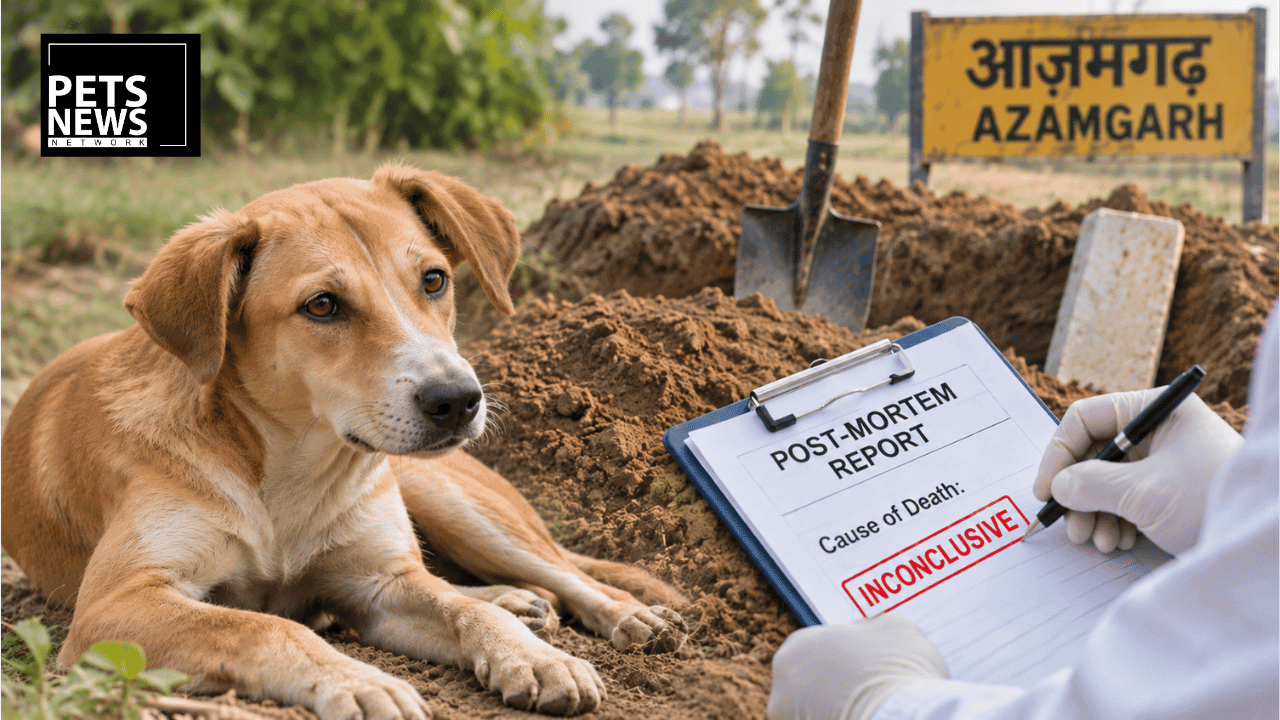

In Azamgarh, a dog exhumed 19 days after she was buried has told investigators nothing. Police in the Uttar Pradesh district opened the grave of a pet dog on Wednesday so that veterinary officers could examine her, in a case where her owner alleges that three neighbours beat her to death. The body was too decomposed for the cause of death to be established. The case continues on other evidence, and how it got here matters to anyone who keeps an animal.
What is known
| Detail | What is on record |
|---|---|
| Where | Nuruddinpur village, under Jiyanpur Kotwali police station, Azamgarh district |
| The allegation | On 30 October 2026, at about 6:30 pm, three people from the same village beat a pet dog to death |
| Complaint | Submitted at the police station on 10 November 2026; an FIR was registered on its basis |
| Exhumation | Wednesday, 18 November 2026, in the presence of police and veterinary officers |
| Time in the ground | 19 days |
| Post-mortem result | Cause of death could not be determined |
According to the complaint, the owner heard his dog crying out, went towards the sound and found three neighbours beating her inside their boundary. He alleges that she was then thrown aside, and that when he objected he was threatened with being killed himself.
These are allegations. No arrest or charge has been reported, and this article names neither the accused nor the complainant.

What the vets found
A team of three veterinary officers examined the body after it was lifted. One of them, Dr Omprakash Anand, said that because the dog had been buried for 19 days the body had decomposed, and the cause of death could not be clearly established. A report is to be handed to the police.
That outcome was close to inevitable. A post-mortem depends largely on soft tissue: bruising under the skin, bleeding into the chest or abdomen, a ruptured organ. These are the signs that help separate a beating from illness, poisoning or an accident, and they are among the first things lost as a body breaks down. After almost three weeks in soil, there is very little left to read.

The evidence that remains
The case has not ended with the post-mortem. The officer in charge of Jiyanpur police station, Sanjay Kumar Singh, said that a video of the dog being beaten is available, that the FIR and the investigation rest on it, and that the post-mortem findings will be added to the investigation. Sub-Inspector Santosh Kumar Singh is the investigating officer.
So the weight of the case now sits on a recording and on what witnesses say, not on medical proof. That can be enough. However, it is a narrower base than a prompt post-mortem would have given.
Three things that are not on record
Why eleven days passed between the alleged killing and the complaint. No account explains it.
Which sections the FIR invokes. Local accounts describe the case as registered under the animal cruelty law, but no section number has been published. Whether the Bharatiya Nyaya Sanhita has also been applied is therefore not known.
Any motive. None has been stated, and none should be guessed at.
What the law provides
Two laws can apply when an animal is deliberately killed.
| Law | Provision | Maximum punishment |
|---|---|---|
| Prevention of Cruelty to Animals Act, 1960 | Section 11 (cruelty) | A small fine for a first offence |
| Bharatiya Nyaya Sanhita, 2023 | Section 325 (killing or maiming an animal) | Up to five years’ imprisonment, a fine, or both |
The difference is large, and it is shaped at the moment the FIR is written. Section 325 has been in force since 1 July 2024 and is a cognizable offence, meaning the police can register a case and investigate without first obtaining a magistrate’s order. It is explained in full in our guide to Section 325.
A complainant is entitled to a free copy of the FIR, which shows the sections applied, and can ask in writing for Section 325 to be included where an animal has been killed.
If your animal is killed: what to do, in order
The Azamgarh case shows, step by step, what delay costs. For any owner who ever faces this, the order of actions matters more than anything else.
1. Do not bury or cremate the body yet. This is the hardest instruction to follow and the most important. The body is the main evidence.
2. Go to the police the same day. Give a written complaint, keep a signed and stamped copy, and ask for the FIR number. State plainly that the animal was killed, by whom if known, where and when.
3. Ask for a post-mortem by a government veterinary officer. Request it in writing through the police. A post-mortem done within a day or two can show injuries that will not be visible later.
4. Keep the body cool while you wait. Wrap it and keep it in the coolest place available, on ice if possible. Do not wash it.
5. Secure every recording. Save the original video file from the phone or CCTV system it was made on, with its date and time. Do not edit, crop or forward it as the only copy. Also note who recorded it.
6. Write down witnesses. Names and phone numbers of anyone who saw or heard what happened, on the same day, while memories are fresh.
7. Photograph the scene. The place, any blood, any object that may have been used. Do not move things before photographing them.
8. If the police will not register a case, send the complaint in writing to the Superintendent of Police. If that fails, a magistrate can be approached to direct an investigation.
Grief makes people want to lay an animal to rest quickly, and nobody should be blamed for that. But a burial the same evening can close off the strongest evidence a case will ever have.
Where this stands
- An FIR is registered against three people; no arrests have been reported.
- The post-mortem could not establish how the dog died.
- Police say a video exists and the investigation is proceeding on it.
- The post-mortem report is to be placed on the case file.
Whether the case reaches a court will depend on that video and on the people willing to say what they saw.
Pets News Network is India’s first dedicated media platform for the pet and animal industry. This article is general information, not legal advice. For breaking global pet news, brand coverage, and advertising enquiries, contact: info@petsnewsnetwork.com