


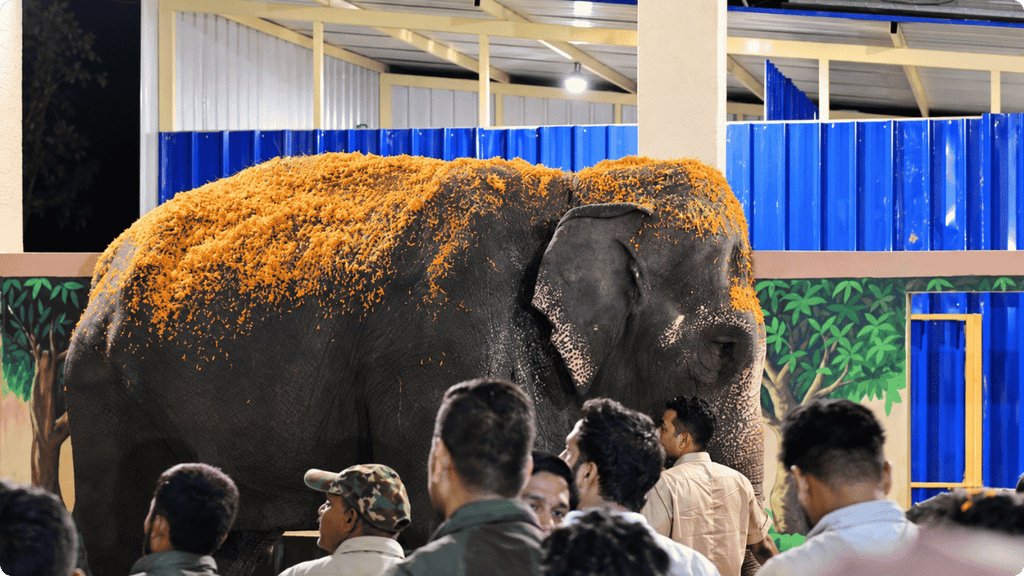
On the night of September 11, 2026, the village of Nandani in Kolhapur’s Karvir taluka turned into a scene of genuine celebration. Thousands of villagers and devotees gathered, banjo music played, fireworks lit the sky, and flowers rained down as an elephant named Madhuri, known locally as Mahadevi, finally made her way home after 13 months away.
For a village that had shared more than three decades of its life with this elephant, her return wasn’t just the end of a legal and administrative process. It was, by every account, treated as an emotional reunion, one residents openly compared to Diwali.
How Madhuri Ended Up Leaving in the First Place
To understand why her return generated such intense celebration, it helps to understand how contentious her departure was. Madhuri had lived for over three decades at the Swastishree Jinsen Bhattarak Pattacharya Mahaswami Sansthan Math, a Jain monastery in Nandani village, where she had effectively become part of the community’s spiritual and cultural life.
Her health, however, had been deteriorating. She suffered from advanced arthritis, chronic foot problems, and serious mobility difficulties, conditions that animal welfare organisation PETA India flagged to the Maharashtra Forest Department and the Supreme Court-appointed High-Powered Committee (HPC), describing her living conditions at the time as cruel and bleak, and alleging she was frequently kept in chains.
The case carried additional complexity. In 2017, Madhuri had fatally injured the Math’s chief priest, reportedly slamming him against a wall in an incident that triggered a prolonged legal battle over her care and management. That combination, documented health concerns and a serious prior incident, ultimately led to a 2024 court order mandating her rehabilitation.
On July 28-30, 2025 (accounts vary slightly on the exact date), Madhuri was transferred to Vantara’s Radhe Krishna Temple Elephant Welfare Trust (RKTEWT) in Jamnagar, Gujarat, an animal welfare centre run by Anant Ambani and supported by Reliance Industries and the Reliance Foundation. The transfer followed HPC directions that were subsequently upheld by both the Bombay High Court and the Supreme Court.
A Community That Refused to Accept the Separation Quietly
Madhuri’s move to Gujarat did not sit well with Nandani or the wider Kolhapur region. In the days following her transfer, the issue escalated into one of the top trending topics on social media in Maharashtra, and organised public pressure followed swiftly, including a mega silent march held in Kolhapur demanding her return.
That pressure reached the state’s highest levels of government. Maharashtra Chief Minister Devendra Fadnavis personally stepped in, meeting with a delegation of public representatives and, separately, a team from Vantara. Following those discussions, Fadnavis announced that Vantara had agreed to join the Maharashtra government’s own petition before the Supreme Court, supporting what would become a coordinated push for Madhuri’s return.
Vantara, for its part, maintained throughout that it had never sought custody of Madhuri in the first place. The organisation described its role as strictly that of a court-appointed recipient facility, stating it acted only in accordance with binding directions issued by the Supreme Court and Bombay High Court, and had cared for Madhuri because it was directed to, not because it had pursued her transfer.
At one point, Vantara even proposed an alternative solution altogether: establishing a satellite rehabilitation centre directly in the Nandani area, equipped with round-the-clock medical facilities, a specialised hydrotherapy pond for joint and muscular relief, a larger water body for swimming, and laser therapy for physical rehabilitation, an attempt to bring Vantara-level care to Kolhapur rather than keeping Madhuri away from it.

The HPC’s Decision, and the Conditions Attached to It
After hearing all parties, reviewing medical reports, and personally inspecting the upgraded care facilities at Nandani, the High-Powered Committee issued its detailed order on September 9, 2026, permitting Madhuri’s return to Kolhapur. The approval didn’t come without serious, binding conditions attached.
Under the HPC’s order, Madhuri cannot be used in religious processions or for any other public or ceremonial purpose going forward. She must receive round-the-clock care, and undergo medical examinations every fortnight, with Vantara’s own veterinarians travelling to Kolhapur to conduct these check-ups and submit reports directly to the relevant authorities as instructed by the committee.
Vantara confirmed it would continue supporting Madhuri’s health even after her return, stating plainly: “This is about continuity of care and safeguarding her welfare, wherever she is housed.” The organisation noted that while her condition had stabilised significantly through sustained veterinary treatment at Jamnagar, her chronic health issues remain and will require continuous, long-term support and monitoring.
What Her New Living Arrangement Actually Looks Like
Vantara worked directly on upgrading Madhuri’s enclosure and facility at Nandani ahead of her return, establishing what the organisation describes as the best possible arrangements within the site’s existing infrastructure constraints. She is currently housed in a renovated shed equipped with a dedicated water tank on the Math premises.
It’s worth noting that further facility improvements have reportedly been limited by town planning restrictions in the area, meaning the current setup, while significantly upgraded from before, still operates within real physical and regulatory constraints rather than representing an unlimited, purpose-built sanctuary environment. Vantara has indicated it remains available to assist the Math with further upgrades in the future, if directed to do so by courts or competent authorities.
Beyond the physical space, Vantara also provided Madhuri’s mahout with a customised diet, exercise, and medication regimen designed to maintain the health gains achieved during her time in Jamnagar.
Two Genuinely Different Views on What’s Best for Madhuri
This case has consistently drawn out two sincerely held but conflicting perspectives on animal welfare, and both deserve fair representation.
For the Nandani community and the Math, Madhuri’s return represents a genuine victory, both spiritually and emotionally. She has been considered part of the community’s extended family for more than three decades, and residents view her homecoming as the correct, humane resolution to a separation many found genuinely distressing to witness.
PETA India has taken the opposite position throughout. The organisation has argued that moving Madhuri away from specialised hospital-level care, hydrotherapy, and crucially, social interaction with other elephants at Vantara, risks undoing the physical and psychological improvements she made during her rehabilitation. Elephants are highly social animals, and PETA’s concerns center on whether a return to a single-elephant environment, however emotionally significant to the local community, genuinely serves Madhuri’s long-term physical and psychological welfare.
A Story Without a Clean Resolution
What makes Madhuri’s case genuinely difficult isn’t a lack of care from either side, it’s that both sides are arguing from real, defensible positions about what constitutes welfare in the first place. Is welfare best served by proximity to advanced medical infrastructure and elephant companionship, or by returning an animal to a familiar environment and the people she has known for most of her life, provided proper medical support continues either way?
The HPC’s conditions, no processions, mandatory round-the-clock care, fortnightly veterinary checks, and continued Vantara oversight, appear designed as a genuine attempt to bridge that divide, allowing Madhuri’s return while trying to preserve as much of her medical progress as possible. Whether that compromise proves sufficient over the coming months and years is something only sustained, transparent monitoring will be able to answer.
For now, Madhuri is home, in a village that waited 13 months to welcome her back, under a framework designed to make sure that homecoming doesn’t come at the cost of everything her rehabilitation achieved.
Pets News Network is India’s first dedicated media platform for the pet and animal industry. For breaking global pet news, brand coverage, and advertising enquiries, contact: info@petsnewsnetwork.com