
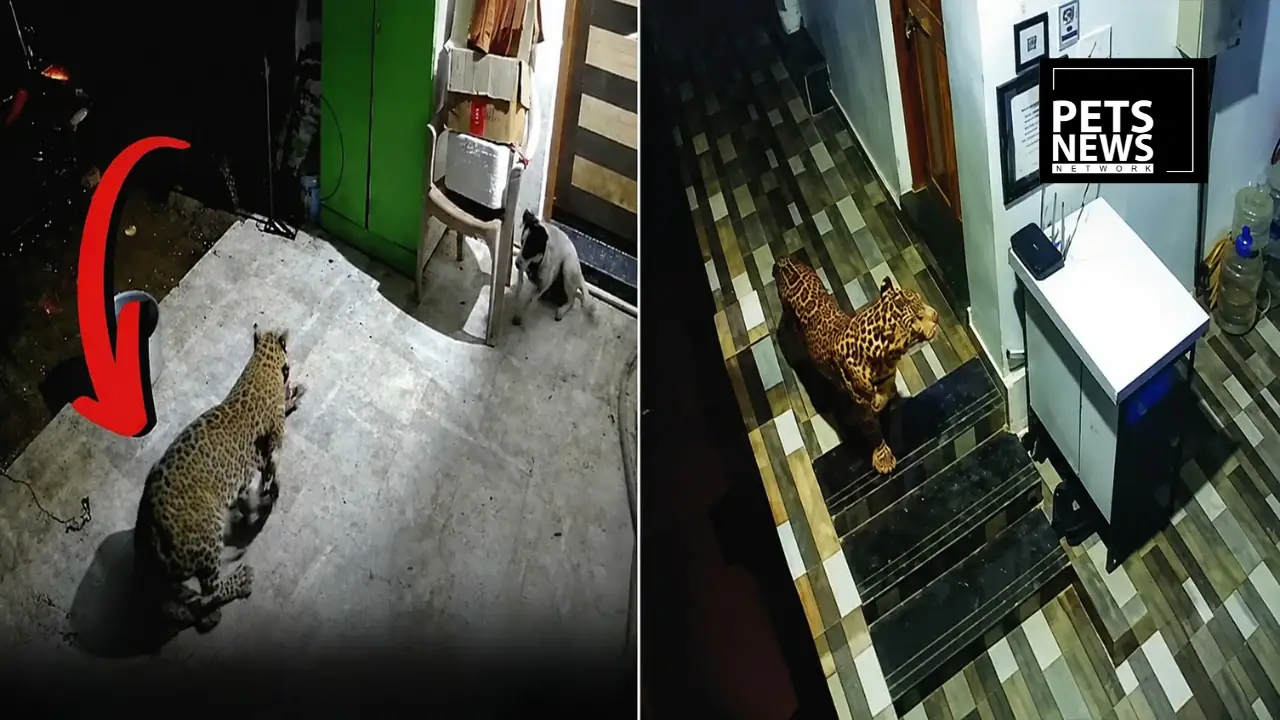

In the quiet coastal village of Varchawada in Arambol, North Goa, a startling scene unfolded in the early hours of Saturday night, one that has since been widely viewed after being captured entirely on CCTV. At around 1:30 AM, a leopard climbed to the first-floor balcony of a local guest house, attacked a dog on the premises, and then retreated into the adjacent forest as quickly as it had appeared.
The footage itself is striking precisely because of where the attack took place, not in an open field or forest edge, but on the elevated balcony of an occupied guest house, underscoring just how comfortable this particular leopard has apparently become moving through built-up, populated areas.
Not an Isolated Incident
For residents of the area, this latest attack wasn’t a one-off shock, it was the continuation of a troubling pattern that’s been building for weeks. According to Ulhas Naik, the owner of the guest house where the attack occurred, the same leopard is believed to be responsible for a string of recent incidents in the immediate area, having killed four dogs and a calf over the preceding weeks alone.
That kind of sustained, repeated activity from a single animal in one localised area paints a clear picture: this isn’t a leopard passing through unfamiliar territory by chance, but one that appears to have established a consistent pattern of hunting domestic animals within close proximity to human settlements in and around Arambol.
A Community Reaching Its Breaking Point
With the frequency of these attacks continuing to escalate, local frustration has reached a genuine tipping point. Residents in the area are now planning to approach the Goa Human Rights Commission, a significant escalation that reflects just how seriously the community views the ongoing risk to both their safety and their animals.
At the core of their grievance is a pointed allegation: that the forest department has failed to take adequate measures to protect both human settlements and domestic animals from the leopard’s repeated incursions. For a community that has now lost multiple animals and witnessed an attack occur directly on an occupied guest house’s first-floor balcony, that frustration is, on its face, entirely understandable.
The Forest Department’s Response
Range Forest Officer Harish Mahale has pushed back against the characterisation of inaction, stating clearly that the department has not been sitting idle in response to the situation. According to Mahale, a trap was set up on Monday evening specifically to capture the leopard responsible for the recent attacks.
The trap itself is being deployed using live bait, in this case, a pet provided by a local villager, a method commonly used by forest departments across India for leopard capture operations, since it offers the most reliable way to draw a predator into a controlled trapping location rather than relying on chance encounters or extended tracking efforts. Once captured, the stated plan is to relocate the animal safely to a more appropriate habitat, away from the immediate human settlement area.
Why Leopards Keep Turning Up Near Goa’s Coastal Villages
Incidents like this one in Arambol reflect a broader pattern seen increasingly across parts of India where forest habitat sits close to expanding human settlements, tourist infrastructure, and agricultural land. Goa’s coastal belt, despite being widely associated with beaches and tourism, sits adjacent to significant forest cover in areas like the Western Ghats foothills, creating exactly the kind of overlap between wild habitat and human development that tends to produce recurring leopard sightings and, occasionally, direct conflict incidents like this one.
Domestic animals, dogs, cats, and livestock, represent a far easier, lower-risk food source for a leopard compared to hunting wild prey in fragmented forest habitat, which likely explains why this particular leopard has continued returning to the same general area over multiple weeks rather than moving on after a single incident.
The Tension Between Safety and Conservation
Cases like Arambol’s sit at a genuinely difficult intersection. On one hand, residents have a legitimate, urgent need for protection, both for themselves and for the domestic animals they depend on or care for, particularly after a pattern of repeated attacks culminating in an intrusion as brazen as climbing onto an occupied building’s balcony. On the other, leopards remain a protected species under Indian wildlife law, meaning any response has to prioritise safe capture and relocation over more drastic measures, a standard the forest department appears to be following through its current trapping operation.
Whether the department’s response proves sufficient, and quick enough, to satisfy a community already moving toward formal legal escalation via the Human Rights Commission, will likely depend heavily on how quickly this specific leopard is actually captured and relocated, and whether similar incidents continue in the interim.
What Happens Next
With the trap currently active and baited, the coming days will be critical in determining whether the forest department succeeds in capturing the leopard responsible for this string of attacks. For residents of Varchawada and the broader Arambol area, the hope is straightforward: a swift, successful capture that ends the immediate threat, without further harm to people, pets, or livestock in the meantime.
For now, the CCTV footage from Saturday night stands as a stark reminder of just how close human-wildlife conflict can come, quite literally, to people’s front doors, even in one of India’s most popular coastal tourist destinations.
Pets News Network is India’s first dedicated media platform for the pet and animal industry. For breaking global pet news, brand coverage, and advertising enquiries, contact: ankur@petsnewsnetwork.com