

It is rare. It is difficult to diagnose. And in cats, it almost never announces itself directly — it shows up as a diabetic cat whose blood sugar refuses to come under control.
A disease that arrives disguised as another one
When a dog develops Cushing’s disease, the signs tend to be recognisable: raging thirst, a pot belly, thinning coat, lethargy. Vets see it often and know the pattern.
In cats, the same condition behaves very differently.
Hyperadrenocorticism — the clinical name for Cushing’s disease — is genuinely rare in cats. One review drawing on the published literature counted a little over 180 reported cases worldwide. When it does occur, it usually arrives wearing a disguise.
Around 80% of cats with Cushing’s disease also have diabetes mellitus, compared with roughly 5–10% of dogs with the condition. Some sources put the feline figure as high as 80–90%.
In practice, that means most feline cases are found not by someone suspecting Cushing’s, but by a vet investigating why a diabetic cat isn’t responding to insulin the way it should.
That single fact shapes everything about how this disease is found, treated and lived with. It is also why so many cases are caught late.
What is actually going wrong
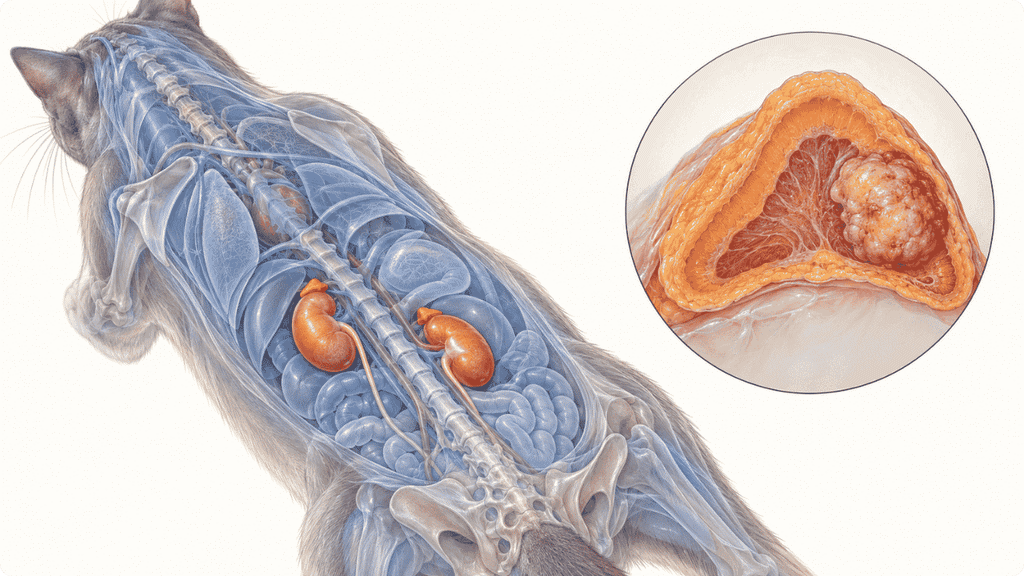
The adrenal glands sit just in front of the kidneys and produce cortisol, the body’s main stress hormone. In Cushing’s disease, they produce far too much of it, for one of two reasons.
Pituitary-dependent disease accounts for roughly 75–85% of feline cases. The problem is not in the adrenal glands at all. A small tumour in the pituitary gland at the base of the brain — usually a benign adenoma — pumps out the signalling hormone ACTH, which drives both adrenal glands to overproduce cortisol.
Adrenal-dependent disease makes up the remaining 15–25%. A tumour in one adrenal gland produces cortisol independently, and a significant proportion of these tumours are malignant.
The distinction matters enormously, because it determines whether surgery is possible and which operation is appropriate.
Sustained excess cortisol does damage across the whole body. It breaks down collagen, thinning the skin. It drives insulin resistance. It wastes muscle. It suppresses the immune system. And it redistributes fat toward the abdomen, producing the classic pot-bellied silhouette.
One reassuring difference from dogs: iatrogenic Cushing’s — the kind caused by long-term steroid treatment — is much harder to induce in cats, possibly because cats have fewer high-affinity glucocorticoid receptors. This is not a licence for casual steroid use, and vets still exercise caution, but a cat on a short course of steroids is at considerably less risk than a dog would be.
One caveat worth knowing: progestins have a structure similar to cortisol and can mimic glucocorticoid effects in cats, producing signs that resemble hyperadrenocorticism.
Why diabetes is nearly always part of the picture
Cats almost exclusively develop a form of diabetes resembling type 2 in humans, driven by insulin resistance rather than a failure to produce insulin.
Excess cortisol directly interferes with how insulin works. Cushing’s disease therefore manufactures precisely the physiological conditions that produce insulin-resistant diabetes. The two conditions are not coincidental neighbours; one generates the other.
This is why a diabetic cat requiring unusually high insulin doses without achieving stable glucose control is the single clearest signal that something else may be driving the problem. The same signal also points toward acromegaly, covered further down, and both are worth investigating before simply escalating the insulin dose again.
It was once assumed that the thirst and excessive urination in these cats were purely diabetic signs. That turned out to be incomplete. Cats with Cushing’s that had not yet developed diabetes have been described showing the same signs, indicating cortisol excess produces them in its own right.
It is also worth noting that not every cat with both conditions has insulin resistance — the combination is common, but it is not universal.
The warning signs
Because the two conditions overlap so heavily, it helps to separate the signs into two groups.
Signs shared with diabetes — these tell you something is wrong, but not what
- Increased thirst and urination
- Increased appetite
- Weight loss despite eating well
- Lethargy
Signs that point more specifically toward Cushing’s
Thin, fragile skin that tears or bruises with gentle handling. This is the hallmark of feline Cushing’s and is far more prominent than in dogs. In advanced cases, cats have developed open wounds simply from grooming themselves. If you notice a cat’s skin tearing during routine handling, that is not a minor observation — mention it to your vet immediately.
- Slow wound healing
- A pot-bellied, distended abdomen
- Generalised muscle wasting and weakness
- Coat changes — symmetrical hair loss, failure of hair to regrow after clipping, and a greasy or unkempt coat in a cat that once groomed meticulously
- Panting
- Recurrent urinary tract infections, and in some cats repeated upper respiratory infections. Cortisol suppresses immunity, while glucose in the urine of a poorly controlled diabetic creates an ideal environment for bacteria.

Neurological signs — circling, stumbling, disorientation, behaviour changes — can occur when a pituitary tumour grows large enough to press on surrounding brain tissue. These are less common but significant when present.
Who gets it
Cushing’s disease in cats is a condition of middle-aged to older animals.
In the largest single treatment series available, median age at diagnosis was 12.3 years, with a range of 2.8 to 16.4 years. Other reports give a mean in the region of 10 to 11 years. The youngest cases on record are under three, so age alone does not rule it out.
No breed predisposition has been identified, unlike some other feline endocrine conditions.
On sex, the picture is less settled than many articles suggest. Most reports find females over-represented, with figures ranging from around 60% in one review to 75–78% in older case series. At least one veterinary teaching text states there is no established sex predilection, only that some reports note more females.
The honest summary is that females appear more often, but the size of that skew is uncertain — largely because the total number of reported cases worldwide is so small.
Why diagnosis is genuinely difficult
There is no single test that confirms feline Cushing’s disease. Diagnosis is assembled from clinical signs, bloodwork, hormone testing and imaging.
The dog’s screening clue does not work in cats
In dogs, a markedly elevated alkaline phosphatase (ALP) is one of the most reliable early flags for Cushing’s, often five to ten times normal.
Cats lack the corticosteroid-induced ALP isoform that makes this useful, and feline ALP has a short half-life besides. Some cats with Cushing’s do show raised ALP, but this is more likely to reflect concurrent hepatobiliary disease or metabolic changes from diabetes than the effect of cortisol.
A normal ALP in a cat does not rule out Cushing’s. If a vet has dismissed the possibility on that basis, it is worth asking about.
Urine cortisol:creatinine ratio (UCCR)
A practical screening step. Morning urine is collected at home over two days, which avoids the stress-related cortisol spike a clinic visit causes.
A negative result makes Cushing’s unlikely. A positive result is not diagnostic on its own and needs confirmation — the test is sensitive but lacks specificity.
The low-dose dexamethasone suppression test (LDDST)
This is the confirmatory test of choice in cats. In a healthy animal, a dose of dexamethasone suppresses cortisol production. In Cushing’s, it doesn’t.
The critical detail is the dose. Cats require 0.1 mg/kg — ten times the 0.01 mg/kg used in dogs.
The reason is physiological: the feline pituitary is inherently more resistant to the suppressive effects of glucocorticoids, and cats respond more variably to dexamethasone than dogs do. At the canine dose, healthy cats and cats with unrelated illnesses have shown inadequate suppression, which risks false positives — particularly in diabetic cats.
Blood is drawn at baseline, four hours and eight hours. Some protocols add samples at two and six hours, because cats with pituitary-dependent disease may suppress early and then escape suppression by the eight-hour mark.
At the correct feline dose, the eight-hour result has been reported as roughly as sensitive for feline Cushing’s as the low-dose test is in dogs.
A useful practical finding: in a study of 22 diabetic cats, 19 suppressed normally at the 0.1 mg/kg dose regardless of how well their diabetes was controlled, and the two abnormal results turned out to be genuine Cushing’s cases confirmed on histopathology. Poor glycaemic control, in other words, does not by itself distort the test.
The ACTH stimulation test
Not recommended in cats for diagnosing this condition. Its sensitivity is poor — roughly 50%, against 80–85% in dogs. Some authors advise against using it for feline diagnosis at all. It retains a role in monitoring treatment.
Imaging
Abdominal ultrasound helps separate pituitary from adrenal disease. Two symmetrically enlarged adrenal glands suggest pituitary-driven disease; one clearly enlarged gland points to an adrenal tumour. Interpretation is harder in cats than dogs.
CT or MRI of the head is used where a pituitary tumour is suspected, particularly if there are neurological signs. A high-dose dexamethasone suppression test at 1.0 mg/kg can also help distinguish pituitary-dependent disease from an adrenal tumour.
Acromegaly must be ruled out
Also called hypersomatotropism, it is caused by a growth-hormone-secreting pituitary tumour and presents with the same headline feature: severe insulin-resistant diabetes.
It occurs in cats of a similar age, but around 88% of reported cases are male — the reverse of the Cushing’s pattern. The other distinguishing feature is skin: fragility syndrome points to Cushing’s, and its absence makes the two harder to tell apart.
Distinguishing them is essential, because the treatments are entirely different.

Treatment: where the experts disagree
This is the part of the story most articles smooth over, and it shouldn’t be.
Medical treatment
Trilostane (sold as Vetoryl) is the most commonly used approach. It works by competitively inhibiting an enzyme in the cortisol production pathway, reducing output at the adrenal glands.
AAHA’s 2023 endocrinopathy guidelines describe it as the mainstay of treatment in cats, noting that the licensed product may need reformulating for the small doses cats require. Merck gives a starting dosage of 1–3 mg/kg orally every 12 hours with food.
However, Merck also takes a markedly different view of its value, stating that cats respond poorly to trilostane and mitotane, and that bilateral adrenalectomy is the treatment of choice in feline hyperadrenocorticism.
Both are authoritative sources. The disagreement is real, and an owner should know it exists rather than assume trilostane is the automatic answer.
Adverse effects of trilostane in cats include anorexia, lethargy, weight loss, pancreatitis and hypoadrenocorticism. Its pharmacokinetics in cats have not been fully established.
Surgical options
These can be curative, which medical management is not.
Unilateral adrenalectomy removes a single cortisol-secreting adrenal tumour and can cure adrenal-dependent disease outright.
Bilateral adrenalectomy removes both glands for pituitary-driven disease. The cat then needs lifelong glucocorticoid and mineralocorticoid replacement. In one series of 11 cats, nine responded well, with thirst and urination resolving, coat regrowth, and diabetes either markedly improved or fully resolved.
Transsphenoidal hypophysectomy removes the pituitary tumour itself. It has been described in small numbers of cats, with diabetes resolving in two of four diabetic cats in one series. It requires a specialist centre.
Radiation therapy is an option for pituitary tumours, particularly larger ones producing neurological signs, targeting the tumour rather than just suppressing cortisol output.
Other drugs — mitotane, ketoconazole, metyrapone — have been tried with inconsistent results and in too few cats to draw conclusions.
The upside worth knowing about
Treating the cortisol excess often improves the diabetes substantially.
In the 15-cat trilostane study, insulin requirements fell by 36% within two months in six of the nine diabetic cats. There is also at least one documented case of full diabetic remission in a cat with pituitary-dependent Cushing’s following trilostane treatment — the first such case reported.
Insulin doses need active adjustment during this period. That is a veterinary decision, not one to make at home.
Monitoring
AAHA recommends bloodwork and urinalysis 7–14 days after starting trilostane and every three to four months thereafter.
The treatment goal is control of clinical signs and quality of life — weight, thirst, appetite, energy — rather than hitting a precise cortisol number.

The honest prognosis
Feline Cushing’s disease is a serious diagnosis. Sources describe the prognosis as guarded, and note the disease is considerably more debilitating in cats than in dogs.
The most useful figure available comes from Mellett Keith et al. (2013), a study of 15 cats treated with trilostane between 2004 and 2012:
- Median survival: 617 days (range 80 to 1,278 days)
- Clinical signs improved in 13 of 15 cats
- Endocrine testing results improved in 13 of 15
- Complications during treatment included weight loss, urinary tract infections, chronic kidney disease, seizures and recurrent pancreatitis
The authors note an important limitation: only cats treated for 60 days or longer were included, which leaves open the possibility that some cats failed to remain on the drug or survive that long.
So the realistic picture is this. With medical treatment, many cats gain meaningful, comfortable time — often a year and a half or more — and their diabetes typically becomes easier to manage. With successful surgery, a cure is genuinely possible for some cats, though it requires specialist facilities and carries its own risks.
Neither route is a small undertaking, and neither is guaranteed.
Because affected cats remain prone to urinary tract infections, twice-yearly screening is a sensible part of long-term management.
When to raise this with your vet
The clearest trigger is a diabetic cat that isn’t responding to insulin as it should, especially alongside any of:
- Skin that tears or bruises with normal handling
- A newly pot-bellied appearance
- Muscle wasting and hind-limb weakness
- A coat that has become thin, greasy or unkempt
- Repeated urinary tract infections
Specific questions worth asking
- Could this be Cushing’s disease or acromegaly rather than poorly controlled diabetes alone?
- Can we start with a urine cortisol:creatinine ratio collected at home?
- If that comes back positive, can we do an LDDST at the feline dose of 0.1 mg/kg?
That last point is worth carrying. It is the most common technical error in diagnosing this condition, and a cat tested at the canine dose may be misdiagnosed either way.
None of this means every hard-to-regulate diabetic cat has Cushing’s disease. It remains rare, and poor insulin control far more often comes down to dose, injection technique, diet, concurrent infection or pancreatitis.
But for a cat showing this particular combination of signs, a proper endocrine investigation is what stands between guessing and knowing.
Editorial note: This condition is rare, and its symptoms overlap with far more common illnesses. This article is for awareness, not self-diagnosis, and no medication named here should be given to a cat except on veterinary prescription. If your cat or dog shows persistent, unusual, painful or rapidly worsening symptoms, consult a qualified veterinarian.
Sources
- Boland LA & Barrs VR. “Peculiarities of feline hyperadrenocorticism: Update on diagnosis and treatment.” Journal of Feline Medicine and Surgery, 2017. doi:10.1177/1098612X17723245 — a review drawing on over 180 reported cases
- Mellett Keith AM, Bruyette D, Stanley S. “Trilostane therapy for treatment of spontaneous hyperadrenocorticism in cats: 15 cases (2004–2012).” Journal of Veterinary Internal Medicine, 2013;27:1471–1477. doi:10.1111/jvim.12178
- AAHA, 2023 Selected Endocrinopathies of Dogs and Cats Guidelines — Feline Hyperadrenocorticism/Hypercortisolism
- Merck Veterinary Manual — Cushing Disease (Pituitary-Dependent Hyperadrenocorticism) in Animals
- University of Minnesota, Veterinary Dermatology open text — Hyperadrenocorticism, Feline
- “Diabetes mellitus remission in a cat with pituitary-dependent hyperadrenocorticism after trilostane treatment,” Journal of Feline Medicine and Surgery Open Reports
- WSAVA 2010 — “Feline Diabetes Mellitus: How Relevant are Acromegaly, Hyperadrenocorticism and Pancreatitis as Underlying Disorders?”
Pets News Network is India’s first dedicated media platform for the pet and animal industry. For breaking global pet news, brand coverage, and advertising enquiries, contact: info@petsnewsnetwork.com