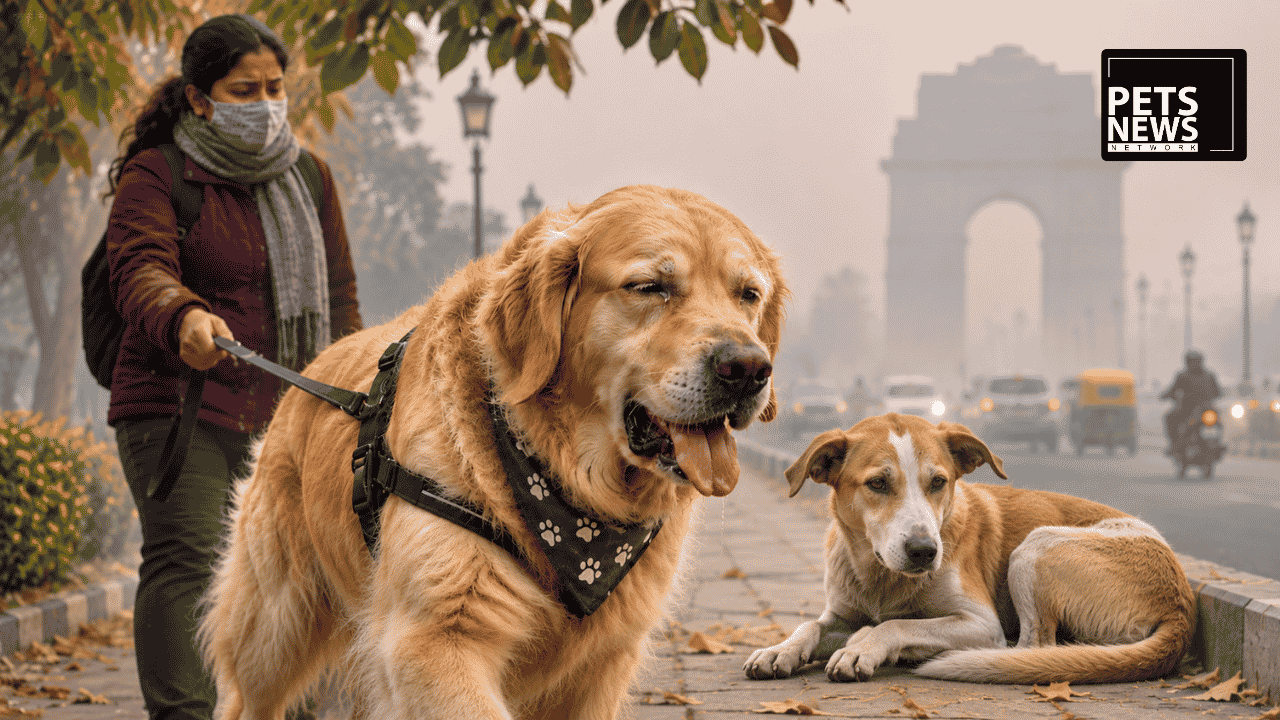

Delhi’s air is in its worst stretch of the season, and Delhi pollution dogs are paying for it. On Friday 6 November, the city’s AQI read 389 in the morning and seven monitoring stations crossed into “severe”. That evening, the Commission for Air Quality Management invoked GRAP Stage III with immediate effect. The advisories that followed were written for people: stay indoors, avoid outdoor exertion, wear a mask. However, your dog received none of them, cannot wear a mask, and still has to go outside.
Where Delhi’s air stands
| Morning reading, 6 November 2026 | AQI |
|---|---|
| Delhi citywide | 389 (very poor) |
| Rohini | 474 (severe) |
| IIT Delhi | 474 (severe) |
| Punjabi Bagh | 465 (severe) |
| RK Puram | 443 (severe) |
| ITO | 422 (severe) |
| Firoz Shah Road | 420 (severe) |
| India Gate | 403 (severe) |
GRAP Stage III followed that evening across Delhi-NCR. The commission cited a citywide reading of 380. The stage bans most construction and demolition and restricts BS-III petrol and BS-IV diesel light vehicles. These numbers move daily, so check the live reading before you plan a walk.
Why Delhi pollution hits dogs harder
They breathe faster. A resting adult human takes roughly 12 to 20 breaths a minute. A resting dog typically takes about 15 to 30, and a small or excited dog takes more. As a result, a dog on a walk moves more air through its lungs, per kilo of body weight, than the person holding the lead.
They breathe close to the source. A dog’s nose sits at about knee to ankle height, near where vehicles emit exhaust and where passing traffic kicks road dust back up. Therefore, the dog walks through a dirtier layer of air than you do.
They pant. Panting moves air rapidly through the mouth and bypasses much of the nasal filtering that normally cleans incoming air.
One correction. People often say that PM2.5 “settles” near the ground, and that this is why dogs get more of it. Fine particles do not behave that way, because they stay suspended and mix through the air. The ground-level problem is real, but it comes from proximity to the source and not from particles sinking.
Above all, a dog cannot choose to stay in, cannot wear an N95 and cannot tell you its chest hurts.

What pollution does to a dog’s lungs
PM2.5 is small enough to travel deep into the lower airway. Vets link sustained exposure in dogs with several problems:
- Acute bronchitis: inflammation of the airways, the most common presentation.
- Allergic rhinitis: inflammation of the nasal passages.
- Lower respiratory infection, where irritation and weakened defences let a secondary infection take hold.
- Worsening of existing asthma-type airway disease.
Two groups carry a much higher risk, and they are not the same group.
Brachycephalic breeds such as Pugs, Bulldogs, French Bulldogs, Boxers and Shih Tzus already live with compressed airways, known as Brachycephalic Obstructive Airway Syndrome (BOAS). They work harder for every breath on a clean day. Add airway inflammation, and the margin disappears.
Toy and small breeds prone to tracheal collapse, such as Pomeranians, Yorkshire Terriers, Chihuahuas and Toy Poodles, face a different risk. Tracheal collapse is mainly a small-breed condition, and the dry, repetitive, irritant-driven cough of a polluted week can trigger and worsen it.
Senior dogs and puppies also sit above baseline risk, the first because they have less reserve and the second because their airways are still developing. Moreover, the harm is not only in the lungs. Vets also report eye infections and watering eyes, and skin irritation where pollutants settle on the coat.
One Delhi vet, Sanjay Mohapatra, who runs the House of Stray Animals NGO, told reporters last December that he had seen 55 to 60 dog and cat cases of lung congestion in about six weeks. He also described cough, fever and eye and nose discharge that can progress to pneumonia.
Warning signs of pollution harm in dogs
Any one of these during a severe-AQI stretch is worth a vet call, not a wait-and-see.
- A dry, persistent cough, a repeated hacking or throat-clearing sound.
- Laboured or noisy breathing: audible effort, wheezing, or a raised breathing rate at rest.
- Lethargy: sleeping through the day, or tiring on a walk it used to manage easily.
- Discharge from the eyes or nose: watering, redness or crusting.
- Loss of appetite.
Count the breaths. While the dog rests or sleeps, count its chest rises for 30 seconds and double the number. Note it on a good day so you have a baseline. A resting rate that climbs well above that baseline and stays there is a reason to call a vet.

What vets do about it
Vets use nebulisation for dogs with severe coughing. It delivers medication as a fine mist directly into the airways to reduce inflammation and ease bronchial constriction. In more serious cases, they add inhalers, anti-inflammatory medication, antihistamines and supportive care.
None of this is self-prescribable. Human inhalers, human antihistamines and human doses do not transfer to dogs, and several common human medicines are toxic to them. Nebulisation needs the right drug, the right dose and the right mask.
What dog owners can do this week
- Move the long walk to the afternoon. Pollutant levels in Delhi are typically highest in the early morning and late evening, and they usually ease in the afternoon. Keep dawn and post-sunset outings short.
- Clean the paws and coat on return. Wipe the paws, legs, face and coat with a damp cloth or pet-safe wipe, so the dog does not lick the particles off later.
- Keep water fresh and bowls full. Hydration supports the mucous membranes that trap irritants.
- Run a purifier in the room where the dog sleeps. One HEPA unit in the room where the dog spends eight to ten hours does more than a weak unit covering the whole house.
- Swap some exercise for indoor play. Scent games, puzzle feeders and training sessions burn energy without putting the dog on the road.
Street dogs and Delhi pollution: no door to go inside
Everything above assumes a dog with a household around it. Delhi’s free-roaming dogs have none of that. Estimates of their number vary widely, with some reports citing up to about 10 lakh, and the civic body has no definitive count.
Start with the arithmetic. A pet dog may spend perhaps 30 to 60 minutes a day outdoors, and the rest of its time in a room that may have a purifier. A street dog is outdoors for 1,440 minutes a day. It has no shortened walk, no afternoon timing, no wipe-down and no room to retreat to. Its exposure continues for the whole season.
Nobody monitors them, either. Someone who lives with a pet dog notices a new dry cough within a day or two. By contrast, nobody holds a baseline for a street dog. By the time a community dog visibly struggles to breathe, with audible effort or elbows pushed out, the illness is usually well advanced. Puppies born into this season face the greatest risk, because their airways are still developing and they spend their time closest to the road.
What actually helps
- Put out clean water and change it daily. Particulate settles into standing bowls, and the dog then drinks it.
- Move the feeding spot off the main road. A feeding point on a busy roadside keeps dogs at exhaust height, beside traffic, while they eat and rest. Shifting it into a quieter lane or a side entrance costs nothing and cuts their exposure.
- Let them stay where they have sheltered. A dog resting under a stairwell, in a covered parking bay or behind a gate on a severe-AQI day is not loitering. Enclosed and semi-enclosed spaces usually hold less particulate than open roadside air.
- Remember the cold. Night temperatures are falling, and a dog dealing with both cold stress and airway inflammation has less reserve. Dry sacking or cardboard in a sheltered corner helps with both.
If a street dog is in obvious respiratory distress, such as laboured breathing at rest, blue or grey gums, or collapse, contact a local veterinarian or a registered animal welfare organisation. Do not try to medicate the animal yourself.
The honest limit of all this
None of these steps fixes the air. Afternoon walks, wipes and purifiers reduce a dog’s dose without removing it, and for the dogs living on the street they barely apply.
Every animal in this city breathes what its people breathe, with faster lungs, closer to the road, and without any of the warnings.
When the advisory tells Delhi to stay indoors, remember who cannot read it, and who has no indoors to go to.
Pets News Network is India’s first dedicated media platform for the pet and animal industry. For breaking global pet news, brand coverage, and advertising enquiries, contact: info@petsnewsnetwork.com