
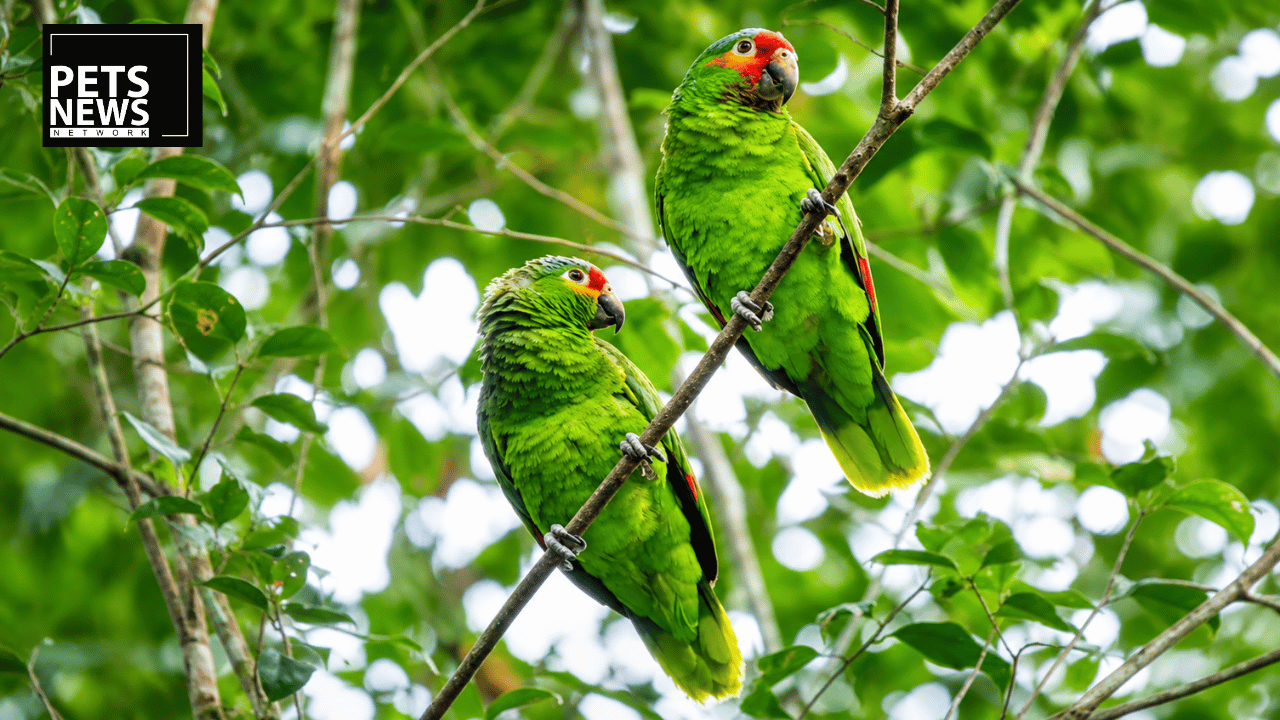

Two red-lored Amazon parrots from separate smuggling cases met at the Bronx Zoo this summer and have now raised two chicks. It is an encouraging outcome, yet it highlights a hard reality: confiscated parrots release programs rarely succeed—not because of the birds themselves, but because the records of where they came from are missing.
What the zoo has taken in
According to the Wildlife Conservation Society, the Bronx Zoo has assisted with nine parrot confiscations since April 2022. Together they involved more than 50 birds from seven species. Moreover, wildlife officials classify some of these species as Endangered, though the zoo has not named which ones.
| Detail | What has been reported |
|---|---|
| Who seized the birds | The US Fish and Wildlife Service, a wildlife enforcement agency |
| Where | Smuggling cases at the US–Mexico border |
| Confiscations since April 2022 | Nine, involving more than 50 birds across seven species |
| Latest arrivals | White-fronted Amazons and orange-fronted conures |
| The conures | From three separate confiscations over about 17 months, now at a partner zoo |
| Condition | Veterinary exams found the newly arrived birds in very good health |
| Where they live | Some at the Bronx Zoo’s World of Birds, some at the Central Park Zoo |
The zoo’s Curator of Ornithology, Chuck Cerbini, said of the birds: “These animals were stolen from the wild and are victims of the illegal wildlife pet trade.”
The chicks
Specifically, the two red-lored Amazons came from separate confiscations and formed a pair this summer at the World of Birds. They raised two chicks. Cerbini called it “an encouraging outcome” and credited appropriate veterinary care, stable surroundings and opportunities for natural behaviour.
It is a fair measure of good husbandry. Seized parrots often arrive stressed, underweight and unsettled, and birds in that state rarely breed. But it is not a conservation result, and that distinction matters for what follows.

Why a confiscated parrots release rarely works
Conservation bodies generally describe three options for a confiscated wild animal: keep it in captivity, return it to the wild, or euthanise it. IUCN’s guidelines on managing confiscated live organisms treat release as suitable only in a limited number of cases, and they warn that a poorly planned release can do more harm than good.
The obstacles are specific, and none of them is about the bird’s ability.
| Barrier | Why it matters |
|---|---|
| Provenance | A bird cannot be returned to a population nobody can identify. Trafficked birds usually arrive with no capture location on record |
| Genetics | Releasing a bird into the wrong population risks mixing groups that evolved apart |
| Disease | A bird held in smuggling conditions may carry pathogens a wild flock has never met |
| Behaviour | Months in a cage can leave a bird unable to spot predators, find food or join a flock |
| Cost | A responsible release is expensive and labour-intensive |
That is why the red-lored Amazon parents are unlikely to go anywhere. Because researchers cannot trace the parents to a wild population, and the chicks were never wild, a successful confiscated parrots release is impossible. Nobody failed them. However, smugglers erased the origin data the moment they captured the birds, and no veterinary care can bring it back.
But release can work, and this is what it takes
A programme in Colombia, published in 2026 in the journal Bird Conservation International, received 27 confiscated Yellow-crowned Amazon nestlings and judged 18 suitable for a first release, which took place in June 2023. First, the birds went through free-flight training, where trainers fly young parrots in open air daily to build flight strength, navigation, and flock behaviour before a confiscated parrots release.
| Point after release | Result |
|---|---|
| At release | All birds used the supplemental feeders; all showed good flock cohesion; 94% showed good site fidelity |
| One month | 94% still using the feeders |
| Three months | 89% |
| One year | 72% |
| Predation | None witnessed; birds reacted appropriately to raptors |
Seventy-two per cent of birds still visiting the feeders after a year is a strong result for any reintroduction. It measures how many birds were still around and using the programme, not how many survived. A bird that stopped visiting could still be alive.
The programme worked because it had what the guidance calls for. The birds were young and in their country of origin. They had free-flight conditioning rather than a cage and a release date, and supplemental feeding afterwards. The programme also held a permit from the regional environmental authority and had the cooperation of about 70 local farmers.

So the gap is not that zoos refuse to release birds, or that released birds always die. The gap is a trained programme, in the right country, with the right birds. A parrot seized far from an unidentified capture site is not one of those birds.
What this means for anyone buying a parrot
The demand behind a bird hidden in a smuggler’s container is ordinary demand: someone wanted a parrot and did not ask enough questions. Wild-caught birds are cheaper to supply than captive-bred ones, which is why the trade persists. Three habits help.
- Ask where the bird hatched, and expect paperwork. A legitimate breeder can give a hatch date, the parents and a ring or band number. A seller who is vague about origin is describing a bird whose history someone may want hidden.
- Treat a suspiciously cheap large parrot as a warning. Hand-rearing a parrot costs real money, and a price far below that suggests someone did not pay to raise the bird.
- Plan for decades. Larger species can outlive dogs several times over and need daily interaction and room to fly.
Where this stands
Nine confiscations, more than 50 birds and seven species. Ultimately, one breeding pair formed because border agents interrupted two separate smuggling attempts. The two chicks are the first of this group with no wild origin at all, so going home was never an option. Meanwhile, for the birds that arrived from the wild, the missing origin record remains the main barrier to any confiscated parrots release.
Pets News Network is India’s first dedicated media platform for the pet and animal industry. For breaking global pet news, brand coverage, and advertising enquiries, contact: info@petsnewsnetwork.com