
The Hassan elephant capture that ended this week took three days, two teams, a thermal drone and at least six trained elephants. Forest staff in Karnataka’s coffee country darted and secured two wild males suspected of involvement in the deaths of two people within three days. It was a difficult operation, and no injuries have been reported. However, it leaves the district’s larger question exactly where it was: what happens to the animals now, and to the dozens still moving through its villages.
What happened
| Detail | What is reported |
|---|---|
| Where | Sakleshpur taluk, on the Belur–Sakleshpur border, Hassan district |
| The deaths | 14 November: Jayamma, of Choudanahalli in Belur taluk. 16 November: Hafeez-Ur-Rehman, 55, at Nagenahalli, reportedly on his way to work at a coffee estate |
| The operation | Named Operation Gaja; two teams of forest staff, mahouts and veterinarians |
| Duration | Three days |
| Result | Two male elephants tranquillised and secured |
| Described as | The first phase of a longer operation |
The two elephants had reportedly been moving together through the area for several months.
How the capture was done
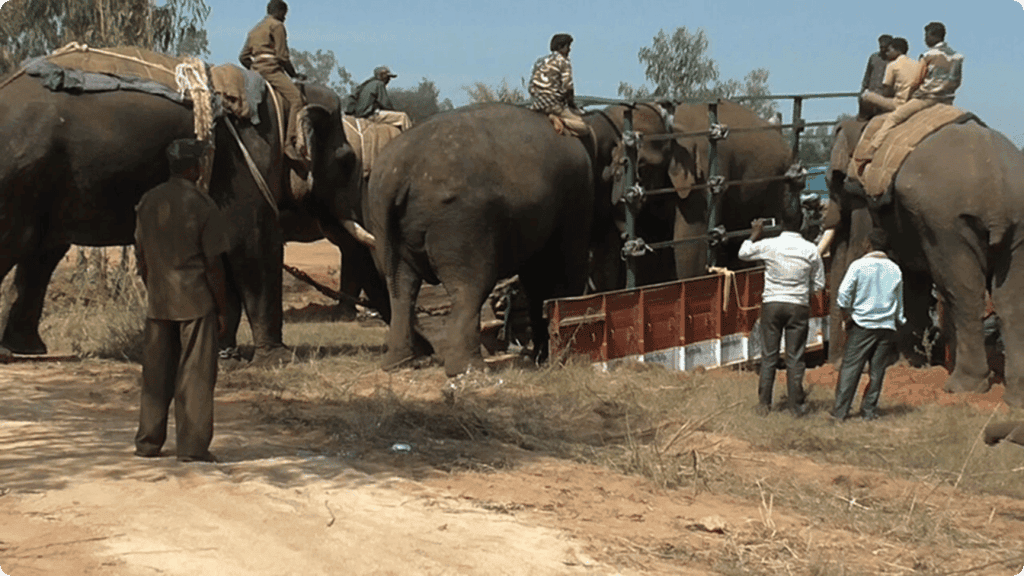
Teams of forest staff, mahouts and wildlife veterinarians worked across a string of villages and coffee estates in dense cover. A drone fitted with a thermal camera helped them find the animals.
An earlier attempt failed when the elephants moved deep into forest. On the third day the teams closed in again:
- The larger elephant was darted by the veterinary team. By one account, a second dart was needed before he slowed. Another account says both animals walked for about half an hour after being darted before they went down.
- The smaller elephant, described as a young male, was also tranquillised.
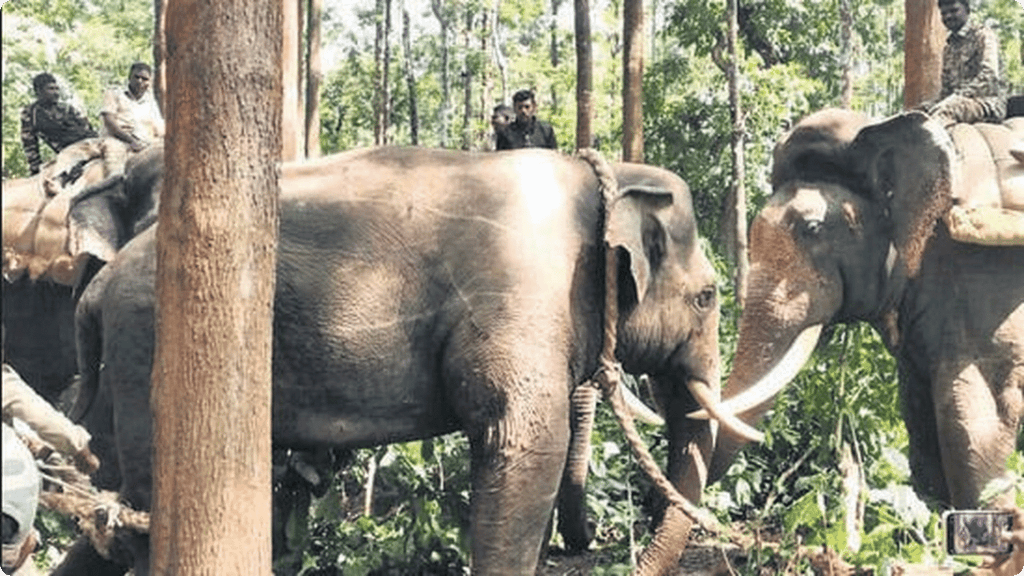
- Trained camp elephants, known as kumkis, then surrounded and steadied both animals. Six have been named: Srikantha, Ashoka, Rohit, Manikya, Ayyappa and Ekalavya. Another account puts the number at seven.
No injuries to staff or to the elephants have been reported.
Where accounts differ
The day. One account places the capture on Wednesday. Others place it on Thursday, 19 November, after a failed attempt the day before.
The place. The estate where the animals were secured is named differently in different accounts. All agree it is in Sakleshpur taluk.
The identification. The two elephants are described as suspected of involvement in the deaths. No account explains how they were linked to the two incidents, which happened two days apart.
What has not been confirmed
Where the two elephants will go. One account says they are to be taken to Nagarahole. Most accounts give no destination, and it is not clear whether the animals will be trained at a camp, held in an enclosure or released elsewhere.
What happens to the younger animal. He was travelling with the adult and was captured with him.
What the next phase is. The capture has been called a first phase, with no detail of the second.
What happens to a captured elephant
When a wild elephant is captured after conflict with people, the authorities broadly have two choices.
| Option | What it means | The difficulty |
|---|---|---|
| Move it | The elephant is transported to a forest elsewhere and released, usually with a radio collar | Elephants know their home ranges well. Research on translocated males in Sri Lanka found that many left the release area, and some walked back |
| Keep it | The elephant is placed in a wooden enclosure called a kraal, trained over months and usually kept at a forest camp for life | The animal is safe and people are safe, but it never lives wild again |
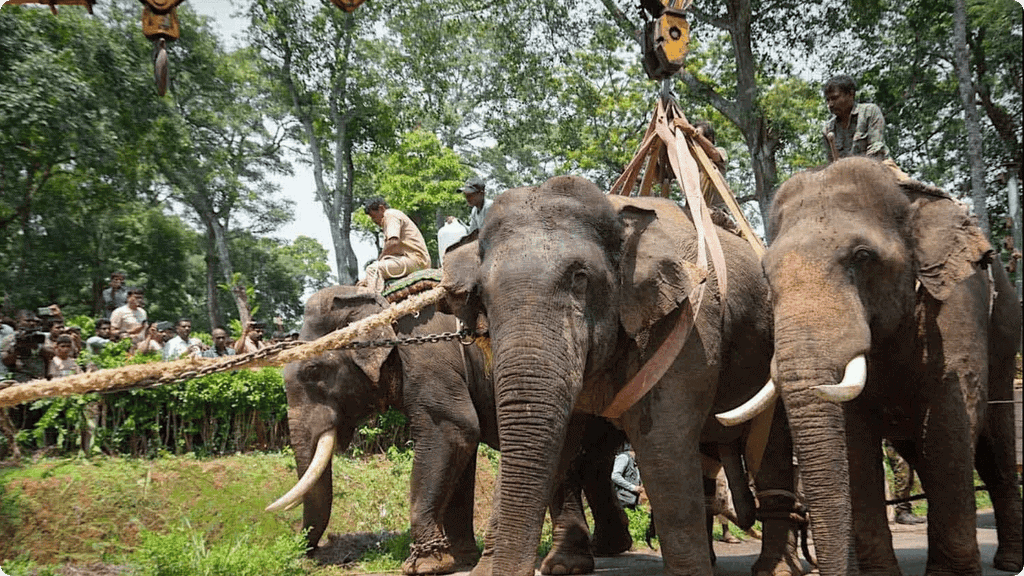
Karnataka has long experience of both, and maintains several elephant camps where captured animals are trained and later used in operations like this one. Kumkis like the ones that secured these two elephants are themselves captured wild elephants, or the camp-born young of such animals. The same choice between collaring and captivity was at the centre of the recent operation to dart a wild elephant in Chhattisgarh.
Hassan has been here before. About a decade ago, more than twenty elephants were captured from the Alur–Sakleshpur area following the recommendations of an expert task force. Elephants are still in the district today, which is why this week’s operation was needed.
The 56
The two captured animals are a small part of the picture. The Forest Department has been working to drive about 56 wild elephants out of settled areas of Hassan district, and plans to move them towards the Bhadra forests in neighbouring Chikkamagaluru.
That plan has met resistance at the receiving end. Residents in the Sringeri assembly constituency and in N.R. Pura taluk oppose it. Protesters there blocked a road this week and reportedly withdrew only after an assurance that no elephant would be moved before 25 November.
The same week brought two reminders of how wide the problem is. In Chikkamagaluru, a farmer named Krishnamurthy was killed by an elephant in N.R. Pura taluk. Meanwhile, in Mysuru district, a trained camp elephant named Ramaiah died on 18 November after a wild tusker attacked him at his camp the night before.
In Hassan, villagers and farmers’ groups have been asking for a lasting solution since the deaths.
Why Hassan
The Sakleshpur and Belur area is a patchwork of coffee estates, paddy fields, villages and forest fragments. Estates offer shade, water and cover, while fields offer food. For an elephant, the landscape is attractive and there is no clear line between forest and farm.
For the people who work in it, the risk falls at predictable times. Many encounters happen in the early morning and around dusk, when estate workers are walking to or from work and elephants are on the move.
For people living in elephant areas
The standard advice from forest departments in such districts is consistent:
- Avoid walking alone before sunrise or after dusk, especially on estate paths
- Never approach, follow or photograph a wild elephant, and keep well back from one near a road
- Do not try to drive elephants away yourself; call the forest department
- Act on local alerts about elephant movement, where an alert system operates
- Keep dogs close; a barking dog can provoke a charge and then run back to its owner
Where this stands
- Two male elephants have been captured; their destination has not been confirmed.
- About 56 elephants remain in and around settlements in Hassan district.
- The plan to move them towards Bhadra is opposed by residents there.
- Two families lost a member within three days.
The operation did what it set out to do. The decisions that follow it are the harder ones.
Pets News Network is India’s first dedicated media platform for the pet and animal industry. For breaking global pet news, brand coverage, and advertising enquiries, contact: info@petsnewsnetwork.com