
The rescue was the easy part. The seven-month-old cub now faces a rehabilitation process that does not always end in freedom — and it belongs to a tiger population unlike any other on earth.
What happened at Khaparakhai
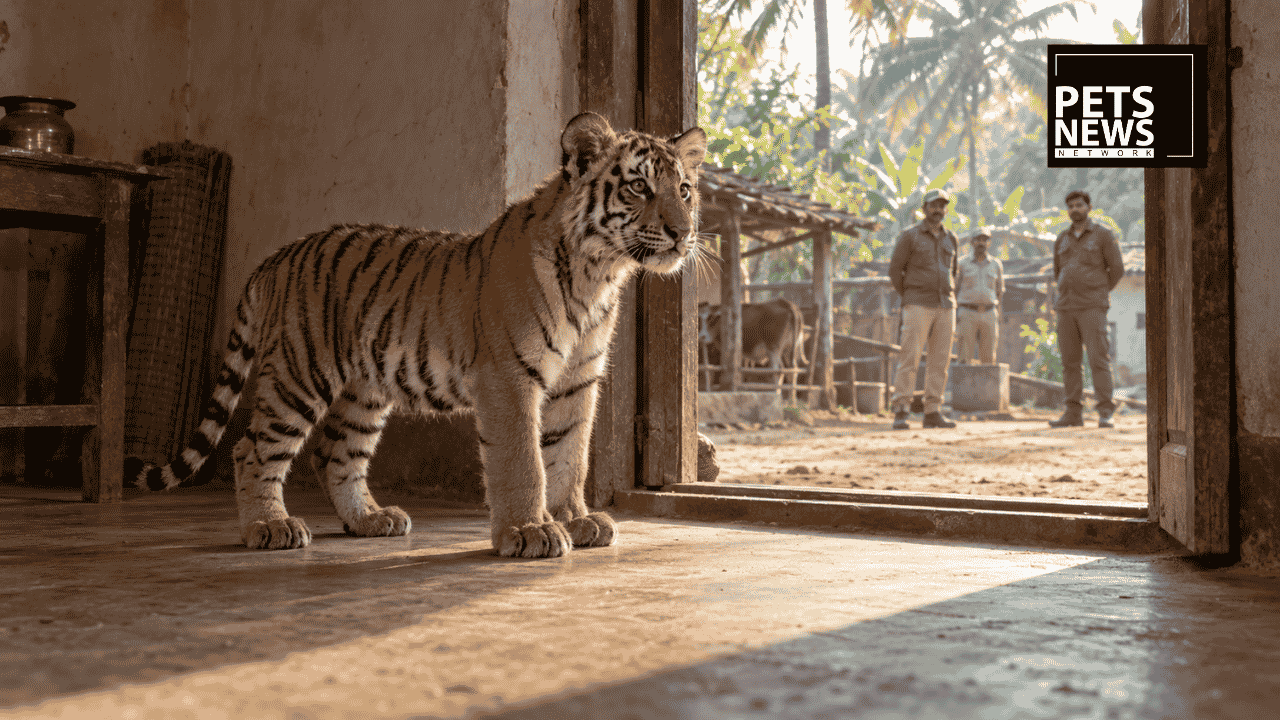
On the night of 24 September, a tiger cub walked into a cattle shed at Khaparakhai village, in the Thakurmunda Range of Odisha’s Karanjia Forest Division, on the fringes of Similipal.
The animal was growling. That noise alerted the household, and panic spread through the village as people realised a wild big cat was sheltering in their neighbourhood. The cub then moved into an unoccupied house nearby and stayed there through the night.
By the morning of 25 September a senior forest team had reached the spot, including Karanjia Divisional Forest Officer Ajay Kumar Sahu and assistant conservators Prabhat Kumar Kuanr, Phalguni Behera and Ashok Kumar Das, with staff from the Thakurmunda and Similipal ranges.
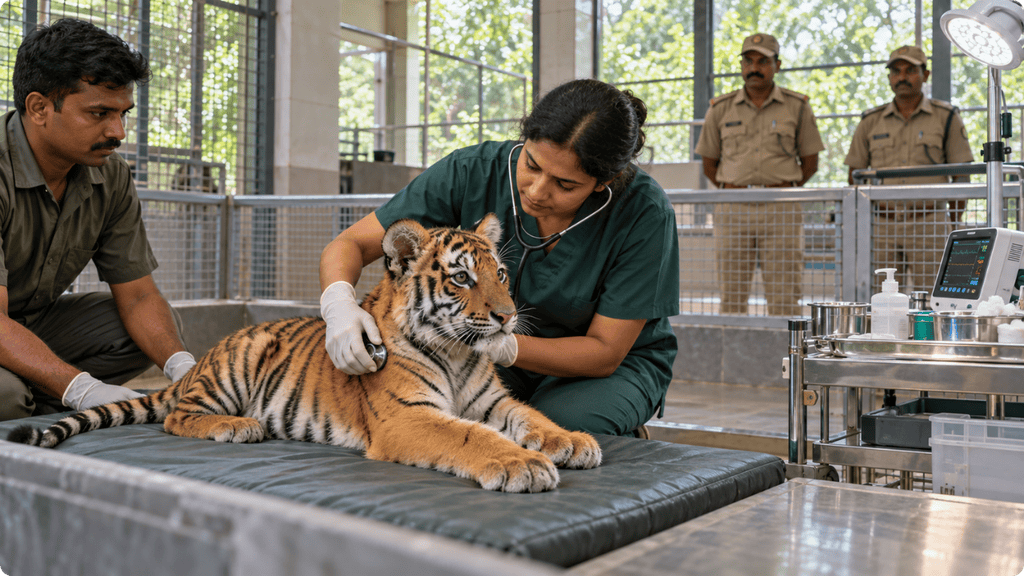
On examination, officials found the cub was unwell and needed veterinary care. It was secured in a cage at around noon.
“The cub remained inside the unoccupied house until Friday morning,” said Prakash Chand Gogineni, field director of Similipal Tiger Reserve. “On examination, forest officials found that the cub required veterinary care and rescued it around noon.”
Reports put the cub at seven to eight months old. According to one Odisha outlet, it had been roaming the area for around three days before entering the house, and is suspected to have become separated from its mother. Forest staff are reviewing camera-trap footage to locate her and establish whether she has other cubs.
The cub was reported calm and gradually recovering, with a blood sample to be collected for testing.
Nobody was hurt. That alone makes this an unusually good outcome.
Why they could not simply put it back
The instinctive question is why the forest department did not release the cub at the forest edge and let its mother find it. The answer is that at seven months, that is close to a death sentence.
A tiger cub of this age is still entirely dependent. Cubs typically remain with their mother for around two years, and the second year is when they learn to hunt, stalking, selecting prey, delivering a killing bite, and defending a kill. A seven-month-old has watched its mother hunt. It cannot yet feed itself.
Released alone, an unwell cub of that age would most likely starve, or be killed by another predator, or drift back into a village in search of easy prey. That last outcome is how a rescued cub becomes a conflict animal, and how a conflict animal ends up in permanent captivity.
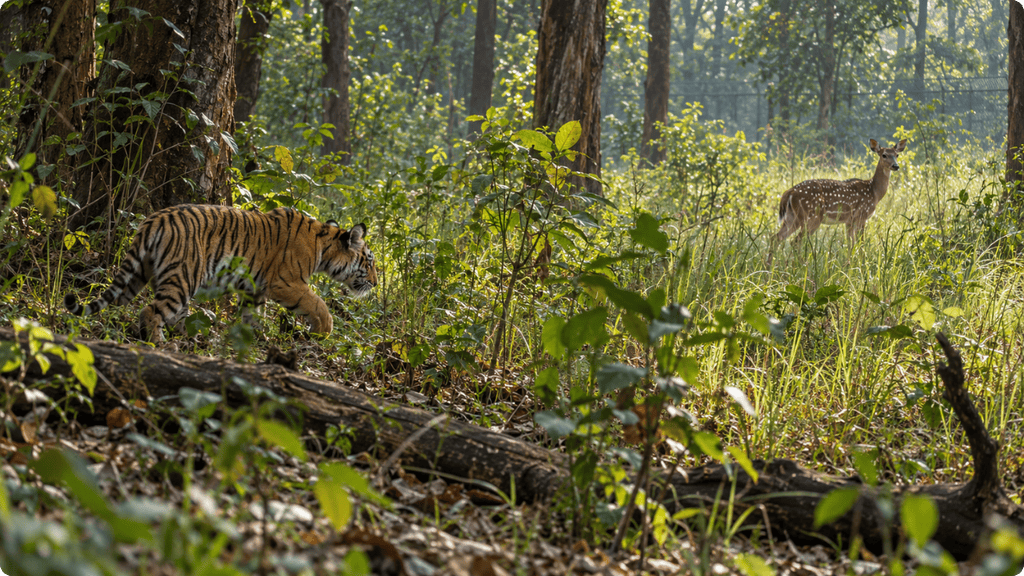
So the department has taken the longer route. The cub will receive veterinary treatment and observation, and once it has recovered sufficiently it will be moved to a larger enclosure at Jamuna, inside Similipal’s core area, to build up the physical condition and hunting ability it will need.
“It will be released into the wild once it is fit to hunt and survive on its own,” Gogineni said.
The part that is genuinely uncertain
That sentence carries more weight than it appears to.
Soft-release rehabilitation of big cats works, but it is difficult, slow and not guaranteed. The animal has to learn or relearn to kill live prey without becoming habituated to the people feeding and monitoring it. Keepers have to minimise human contact precisely when the animal is most dependent. And the final test, whether it can hold territory and feed itself in a landscape that already has resident tigers, cannot be run in an enclosure.
Where this works, the enclosure phase is long, prey is live, and human contact is deliberately minimised. Where it fails, the animal remains in captivity for life.
This is why the Jamuna enclosure step matters and why it deserves reporting attention long after the rescue headline has passed. The honest position today is that the cub has been given a chance, not that it has been saved.
If the mother is located through camera traps and the cub recovers quickly, reunion is theoretically the best outcome. Neither of those things is certain.
Why Similipal is not an ordinary tiger reserve
This is the context that turns a local rescue into a story of national significance.
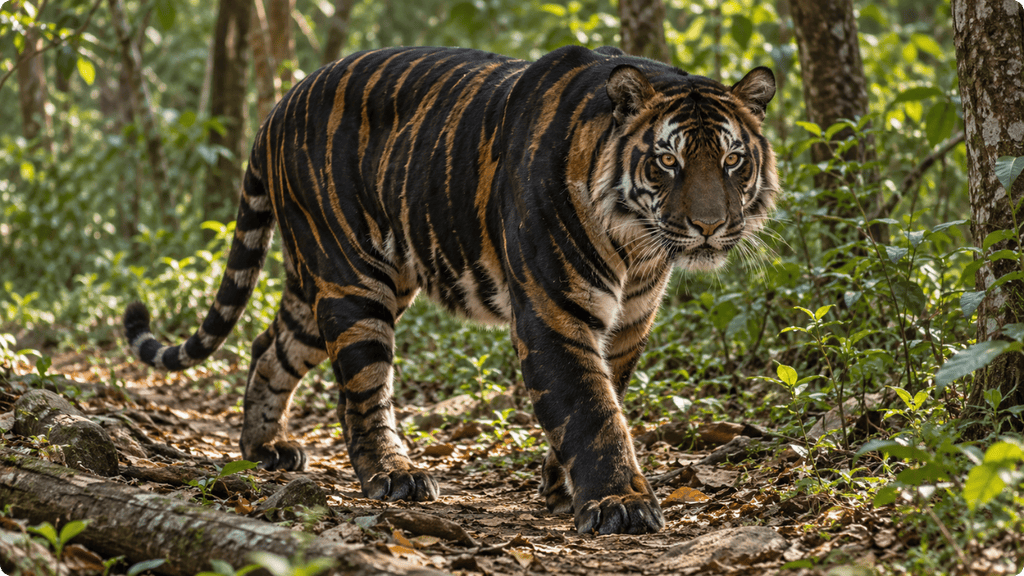
Similipal holds the only wild population of pseudomelanistic tigers in the world. These are the animals popularly called black tigers, not truly black, but carrying stripes so wide and merged that the coat appears dark.
A 2021 study published in the Proceedings of the National Academy of Sciences, led by researchers at the National Centre for Biological Sciences in Bengaluru, identified the cause: a missense mutation in a gene called Taqpep, inherited as an autosomal recessive trait. The same gene produces blotched patterns in domestic cats and the unusual markings of king cheetahs.
The researchers found that 10 of 12 tigers sampled in Similipal carried at least one copy of the mutation. Among 395 tigers surveyed outside the reserve, not a single one carried even one copy.
At the time of that study, roughly 37% of Similipal’s tigers were pseudomelanistic. Later state estimates put the number of black tigers in the reserve at 13.
That sounds like a conservation success. It is closer to the opposite.
A rare trait is a warning sign here
The reason black tigers are concentrated in Similipal is not that the trait is advantageous. It is that the population is small, isolated and inbred.
The PNAS study confirmed Similipal as a small population with poor gene flow, genetically differentiated from other Indian tiger populations, with simulations suggesting past bottlenecks explain why the recessive Taqpep variant became so common. A recessive trait only shows up when an animal inherits the mutation from both parents. For that to happen so often, the gene pool has to be very narrow.
In other words, the black tigers are visible evidence of a closed genetic system. Researchers have flagged exactly this, that small isolated tiger populations are subject to genetic drift and inbreeding, and that the long-term futures of such populations are not well understood.
Against that background, every individual tiger in Similipal carries more weight than a tiger elsewhere. A seven-month-old cub is not just an animal in distress. It is a meaningful fraction of a population that cannot easily replace it.
And the population is under pressure from poaching
The genetic problem is not the only one.
Similipal’s black tigers have been targeted. Three have died in suspected poaching cases in recent years, and two black tiger skins seized in March and May led to 17 arrests across two separate trafficking cases, according to reporting by Deccan Chronicle.
A distinctive, rare and photogenic animal is exactly what an illegal wildlife market prices highly. That Similipal’s tigers are unique in the world is, from a trafficking perspective, a liability rather than an asset.
What to watch
The rescue is done and the cub is stable. The questions that actually matter now are the ones that rarely get follow-up coverage:
- Do camera traps locate the mother, and does she have other cubs?
- What did the blood tests show, and what was the cub being treated for?
- How long does it spend in the Jamuna enclosure, and is it learning to kill live prey?
- Is it eventually released, or does it remain in captivity?
A rescue is a moment. A rehabilitation is a process, and in a reserve holding the only black tigers on the planet, the outcome of that process is worth following to the end.
Pets News Network is India’s first dedicated media platform for the pet and animal industry. For breaking global pet news, brand coverage, and advertising enquiries, contact: info@petsnewsnetwork.com