

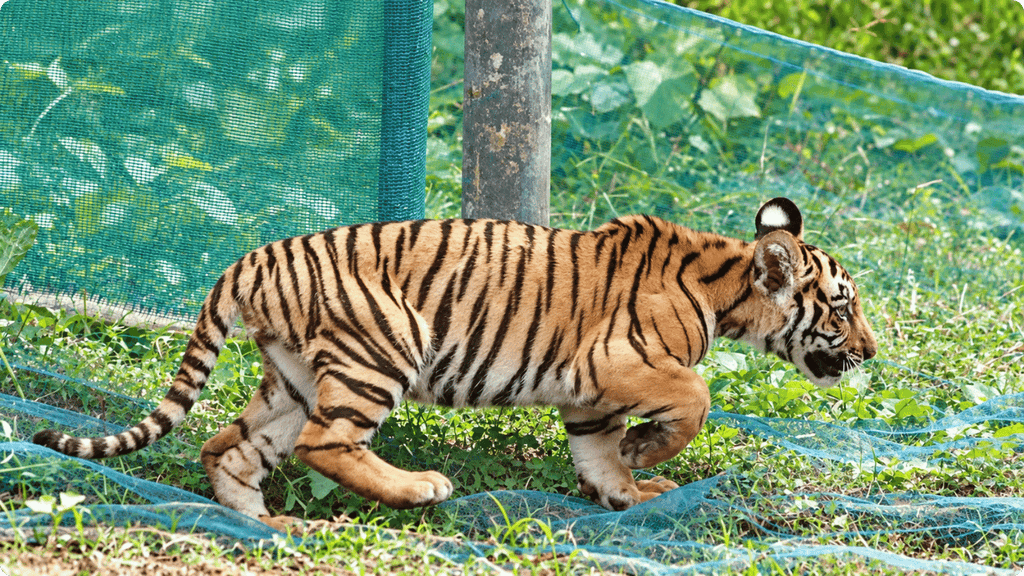
A 3-month-old wild tiger cub found itself separated from its mother in Assam’s Biswanath district after being swept away by strong, swollen river currents, the kind of sudden, disorienting event that can permanently separate young wildlife from their parents during the region’s flood-prone months. For a cub still entirely dependent on its mother for food, protection, and survival skills, that kind of separation is typically a life-threatening emergency in its own right, long before any human intervention becomes necessary.
The cub’s ordeal came to public attention on September 17, when it was found entangled in a fishing net inside a home’s kitchen garden, an unlikely and precarious place for a wild tiger cub to wash up, but one that likely also put it within reach of help far sooner than it might otherwise have received it.
A Careful, Age-Appropriate Rescue
Forest officials, working alongside the Wildlife Trust of India (WTI), responded to rescue the young cub. Given its extremely young age, just three months old, the rescue team made the deliberate decision to carry out the operation without using chemical immobilisation or tranquilisers, a call that reflects how differently very young wild animals need to be handled compared to fully grown adults. Sedating a cub that young carries its own significant risks, and the team’s ability to safely extract it from the fishing net without resorting to that option speaks to a carefully managed, age-conscious rescue approach from the outset.
Attempting a Reunion, Not Just a Rescue
What makes this case notable is that the goal from very early on wasn’t simply to save the cub and place it in permanent captivity or a rehabilitation facility, it was to actively attempt a reunion between the cub and its mother in the wild. Forest officials and WTI’s Centre for Bear Rehabilitation and Conservation (CBRC) launched a coordinated mission specifically built around that objective, reflecting a broader principle in wildlife rescue work: a wild tiger cub’s best long-term outcome is almost always life with its own mother in its natural habitat, not a life raised by humans, however well-intentioned the care.
The reunification effort involved ferrying the cub via a mechanised country boat to an upstream riverine island near Murkhuwa and Bhawani, an area presumably chosen for its proximity to where the cub was believed to have been separated from its mother, or to known tiger movement patterns in the region. Once there, the cub was provided with food and water and placed under monitoring using camera traps, a method that allows rescue teams to observe an area for signs of the mother tigress without direct human presence potentially interfering with a reunion attempt.
When the River Turned Against the Rescue Effort
The operation did not proceed without complications. A drone survey conducted the following day confirmed the cub’s location on the riverine island, but it also revealed a serious emerging threat: rising river water levels that risked submerging the enclosure where the cub had been placed. Given that the cub’s original separation from its mother had itself been caused by dangerous river currents, this development carried an uncomfortable echo of the very crisis the rescue was meant to resolve.
The response team moved quickly, relocating the cub to a safer, higher-ground site before rising waters could put it at risk again. This kind of rapid, adaptive decision-making, informed directly by real-time drone survey data, illustrates how modern wildlife rescue operations increasingly combine traditional fieldwork with aerial monitoring technology to respond to fast-changing, weather-driven conditions in real time.
Signs of a Successful Return to the Wild
The most encouraging developments in this story came in the days that followed. On September 19, the cub left its temporary enclosure on its own, a significant and positive sign, since a cub voluntarily leaving a safe, food-provisioned shelter suggests it retained the instinct and physical capability to move independently in its natural habitat, rather than becoming dependent on the temporary human-provided food and shelter.
Then, on September 23, rescue teams discovered fresh pugmarks belonging to the cub roughly 200 metres from the release point. While pugmarks alone don’t confirm a successful reunion with the mother tigress, their discovery at a meaningful distance from the release site indicates the cub is alive, mobile, and actively exploring its surroundings, exactly the kind of behaviour consistent with a young tiger reintegrating into its natural environment.
What Comes Next
As of the most recent update, monitoring via camera traps remains ongoing, with the explicit goal of confirming a successful reunion between the cub and its mother. This kind of extended, patient monitoring period is standard practice in wildlife reunification efforts: a single sighting or set of pugmarks is encouraging, but confirming that a young cub has genuinely rejoined its mother and resumed a stable, protected existence in the wild typically requires sustained observation over days or weeks, not a single data point.
Why This Case Matters
Cases like this one offer a valuable window into how modern wildlife rescue operations in India increasingly prioritise reintegration over permanent removal from the wild, even when doing so involves considerably more risk, effort, and uncertainty than simply keeping a rescued animal in captivity. Choosing to attempt a river crossing by boat, monitor via drone and camera trap, and relocate an enclosure under time pressure from rising waters all reflect a rescue philosophy built around giving a wild animal the best possible chance of returning to a genuinely wild life, rather than defaulting to the more controlled, but ultimately more limiting, option of lifelong captivity.
For a species like the tiger, where every individual animal carries outsized significance for a population that remains a global conservation priority, successful reunions like this one, if ultimately confirmed, represent far more than a single heartwarming rescue story. They represent one more wild tiger given the chance to grow up as, and remain, a genuinely wild tiger.
Pets News Network is India’s first dedicated media platform for the pet and animal industry. For breaking global pet news, brand coverage, and advertising enquiries, contact: info@petsnewsnetwork.com